Utility of REMS-Derived Fragility Score and Trabecular Bone Score in Evaluating Bone Health in Type 2 Diabetes Mellitus
Antonella Al Refaie, Caterina Mondillo, Guido Cavati, Sara Gonnelli, Maria Dea Tomai Pitinca, Elena Ceccarelli, Paola Pisani, Luigi Gennari, Stefano Gonnelli, Carla Caffarelli

TL;DR
This study explores how REMS and TBS can better assess bone health in Type 2 diabetes patients, who are at higher fracture risk despite normal bone density.
Contribution
The study introduces REMS-derived fragility score and TBS as improved tools for evaluating bone quality in Type 2 diabetes.
Findings
REMS BMD T-scores were significantly lower than DXA at lumbar and femoral sites in T2DM patients.
Patients with prior fractures had lower TBS and higher FS values compared to those without fractures.
REMS parameters may improve osteoporosis diagnosis and fracture risk assessment in T2DM.
Abstract
Background/Objectives: A significantly higher fracture risk characterizes Type 2 diabetes mellitus (T2DM) patients when compared to the non-diabetic population, even though their average bone mineral density (BMD) tends to be normal or high. This elevated risk is primarily driven by defective bone quality. The trabecular bone score (TBS) and radiofrequency echographic multispectrometry (REMS) have recently been proposed to improve the assessment of bone quality in T2DM individuals. This study aimed to evaluate whether TBS and REMS can improve the identification of osteoporosis and fracture risk in these patients. Methods: BMD was measured in 223 consecutive T2DM patients (126 women and 97 man) and 102 controls. BMD values for the lumbar spine (LS), femoral neck (FN), and total hip (TH) were obtained via both dual-energy X-ray absorptiometry (DXA) and radiofrequency echographic…
Genes, proteins, chemicals, diseases, species, mutations and cell lines named across the full text — each resolved to its canonical identifier and authoritative record.
Click any figure to enlarge with its caption.
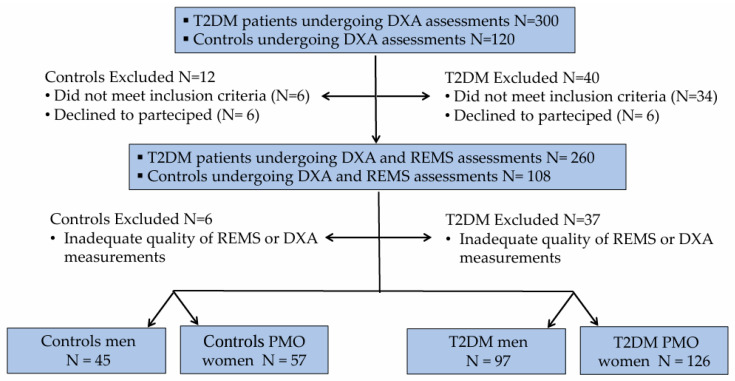 Figure 1
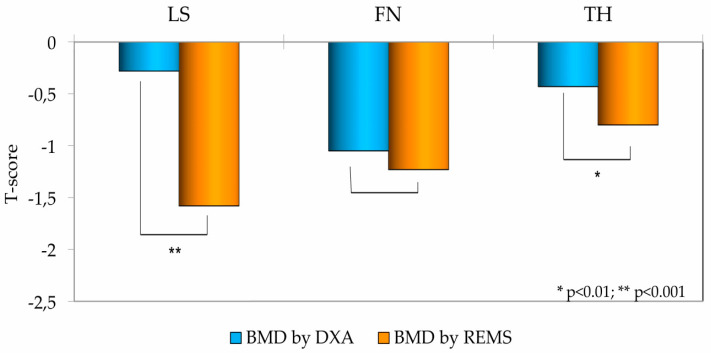 Figure 2
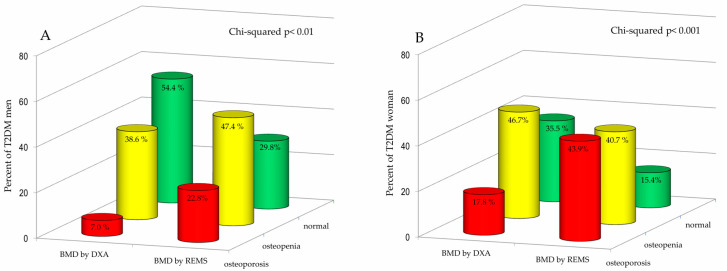 Figure 3
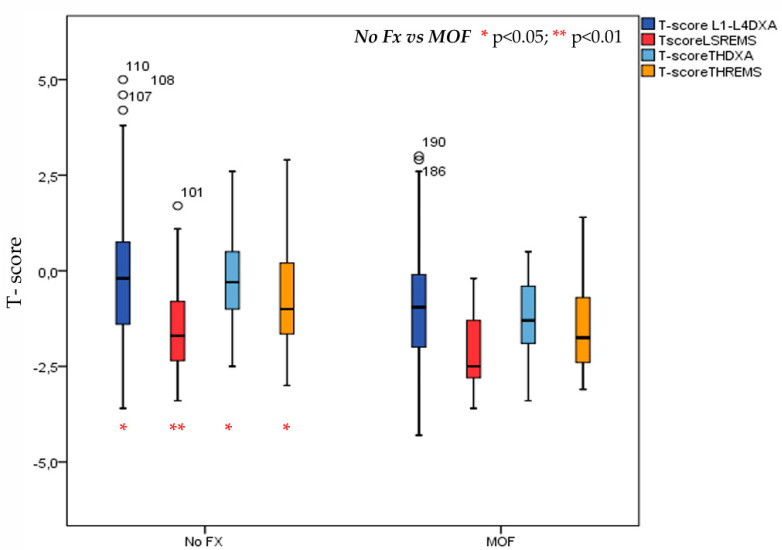 Figure 4
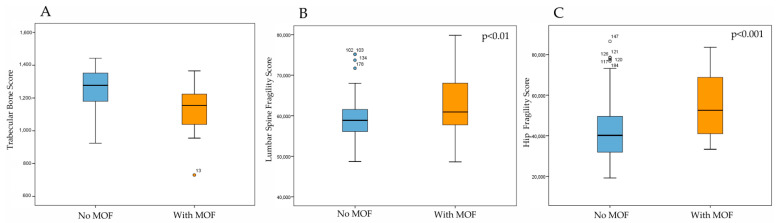 Figure 5
Peer Reviews
No public reviews on file for this paper yet. If you reviewed it on a platform where reviews are public (OpenReview, ICLR, NeurIPS, ICML), you can paste yours below so the community can read it here.
Videos
No videos yet. Explain this paper in a talk, walkthrough, or lecture? Add one.
Taxonomy
TopicsBone health and osteoporosis research · Parathyroid Disorders and Treatments · Bone Metabolism and Diseases