The Embodied Simulation of L2 Grammatical Aspect: Proficiency-Dependent Evidence from the Action-Sentence Compatibility Effect
Chunqiao Hu, Shifa Chen, Yufeng Liu

TL;DR
This study shows that how Chinese learners of English process grammatical aspects in sentences depends on their language proficiency and involves different mental simulation strategies.
Contribution
The study introduces a proficiency-dependent dual-pathway model for how grammatical meaning is embodied in second language acquisition.
Findings
Advanced learners show action-sentence compatibility effects only for progressive aspect sentences.
Low-proficiency learners exhibit compatibility effects for perfective aspect sentences.
Embodiment in L2 grammatical processing evolves from lexical to grammatical as proficiency increases.
Abstract
Using the Action–Sentence Compatibility Effect (ACE) paradigm, this study investigated whether types of grammatical aspects and L2 proficiency influence embodied simulation during L2 sentence comprehension of English among Chinese learners. Participants judged the semantic plausibility of sentences in progressive or perfective aspect by performing directional actions (toward or away the body) that were either compatible or incompatible with the action direction described. Analysis of the reaction times (RTs) revealed a significant main effect of proficiency, with low-proficiency learners responding more slowly overall. Crucially, we observed a significant three-way interaction between aspect, action–sentence consistency, and proficiency. Simple effects analyses revealed a qualitative reversal: advanced learners exhibited a significant ACE only for sentences in the progressive aspect,…
Genes, proteins, chemicals, diseases, species, mutations and cell lines named across the full text — each resolved to its canonical identifier and authoritative record.
Click any figure to enlarge with its caption.
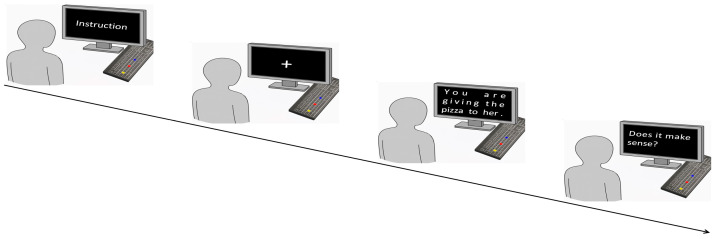 Figure 1
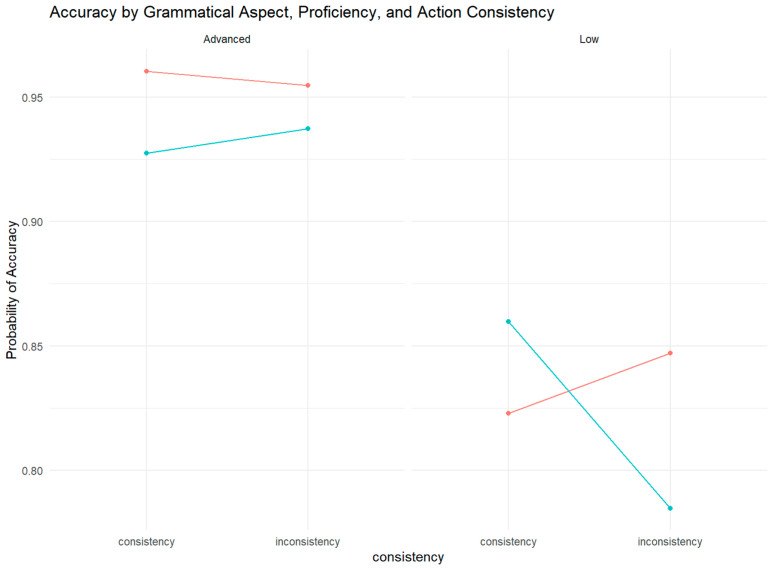 Figure 2
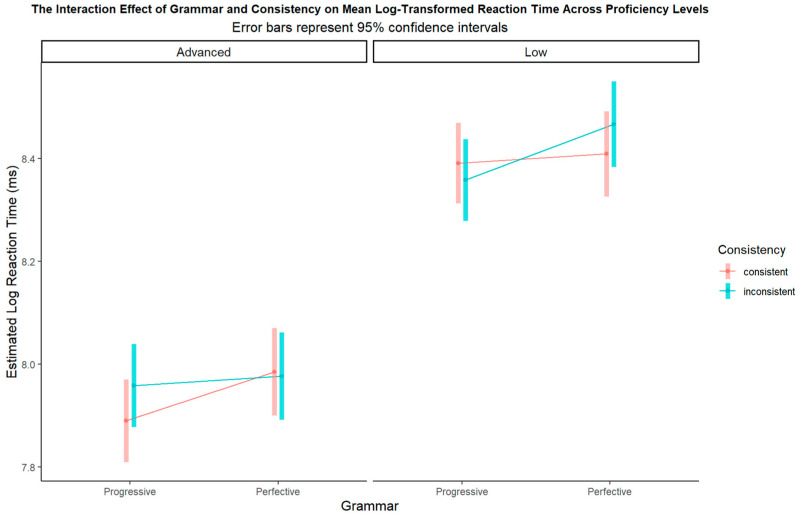 Figure 3
Peer Reviews
No public reviews on file for this paper yet. If you reviewed it on a platform where reviews are public (OpenReview, ICLR, NeurIPS, ICML), you can paste yours below so the community can read it here.
Videos
No videos yet. Explain this paper in a talk, walkthrough, or lecture? Add one.
Taxonomy
TopicsAction Observation and Synchronization · Categorization, perception, and language · Neurobiology of Language and Bilingualism