What kind of urban–rural basic public services can affect the urban–rural income gap?–an analysis of FsQCA based on the TOE framework
Qianqian He, Tiantian Dong, Cairang Gadan

TL;DR
This study explores how urban-rural public services influence income gaps in China's Yangtze River Delta using a framework that considers technology, organizations, and environment.
Contribution
The study introduces a novel fsQCA-based analysis within the TOE framework to identify multiple pathways influencing urban-rural income disparities.
Findings
Three configurations each of high and non-high income disparity were identified, emphasizing the importance of combinations over single factors.
High-disparity pathways include fiscal constraints, digital infrastructure lag, and economic stagnation linked to public service shortages.
Non-high-disparity pathways involve economic output rebalancing, regional coordination, and governance innovations.
Abstract
The urban–rural income gap and the non-equalization of basic public services constitute the core contradiction in China’s urban–rural development. This study employs the fsQCA method based on the TOE framework to determine how technological, organizational, and environmental conditions collectively shape the urban–rural income gap in China’s Yangtze River Delta region. The findings reveal three distinct configurations of high income disparity and three distinct configurations of non-high income disparity, emphasizing that no single factor is indispensable. Rather, combinations are crucial. High-disparity configurations manifest through three divergent pathways: dual squeezes from fiscal constraints and lagging digital infrastructure; structural disconnect between economic growth and digitalization; and cyclical lock-in between low-level economies and public service shortages.…
Genes, proteins, chemicals, diseases, species, mutations and cell lines named across the full text — each resolved to its canonical identifier and authoritative record.
Click any figure to enlarge with its caption.
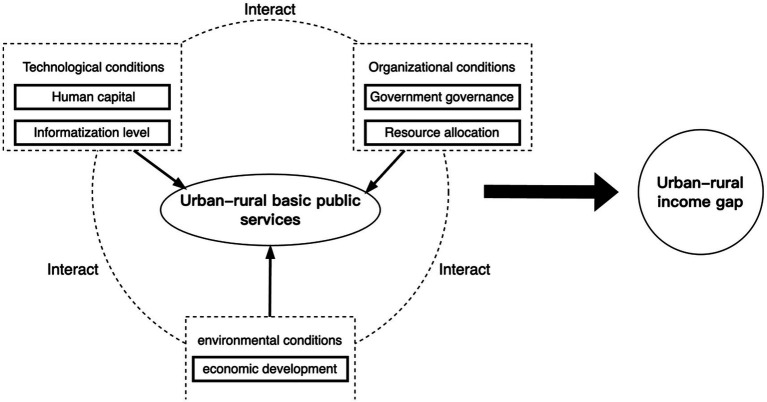 Figure 1
 Figure 2
 Figure 3
 Figure 4
 Figure 5
Peer Reviews
No public reviews on file for this paper yet. If you reviewed it on a platform where reviews are public (OpenReview, ICLR, NeurIPS, ICML), you can paste yours below so the community can read it here.
Videos
No videos yet. Explain this paper in a talk, walkthrough, or lecture? Add one.
Taxonomy
TopicsChina's Socioeconomic Reforms and Governance · Rural development and sustainability · Sustainability and Climate Change Governance