Unveiling the Chemical Profile of Teucrium chamaedrys subsp. gracile (Batt.) Rech.F. dried Aerial Parts From Algeria
Claudio Frezza, Daniela De Vita, Chiara Dal Bosco, Khellaf Rebbas, Hamdi Bendif, Stefania Garzoli

TL;DR
This study presents the first chemical analysis of Teucrium chamaedrys subsp. gracile from Algeria, identifying key compounds in its aerial parts.
Contribution
The paper provides the first detailed phytochemical profile of Teucrium chamaedrys subsp. gracile using multiple analytical techniques.
Findings
Palmitic acid was the major fatty acid identified in the sample.
β-caryophyllene and humulene were the dominant volatile compounds.
Five non-volatile compounds, including teucrioside and chlorogenic acid, were characterized.
Abstract
In this paper, the first phytochemical analysis on Teucrium chamaedrys subsp. gracile was reported. The dried aerial parts collected in Algeria were studied, and the analysis was conducted using different techniques: gas chromatography/mass spectrometry (GC/MS) for the fatty acid content, headspace solid‐phase microextraction‐GC‐MS for the volatile composition, column chromatography along with nuclear magnetic resonance spectroscopy, and MS for non‐volatile pattern characterization. Saturated fatty acids were found to be prevalent, with palmitic acid as the major compound. In the volatile fraction, β‐caryophyllene and humulene, comprised in the class of sesquiterpenes, were the major components. Indeed, five non‐volatile compounds were observed, namely teucrioside (1), cirsiliol (2), harpagide (3), and chlorogenic acid (4). The employed analytical techniques have proven to be suitable…
Genes, proteins, chemicals, diseases, species, mutations and cell lines named across the full text — each resolved to its canonical identifier and authoritative record.
Click any figure to enlarge with its caption.
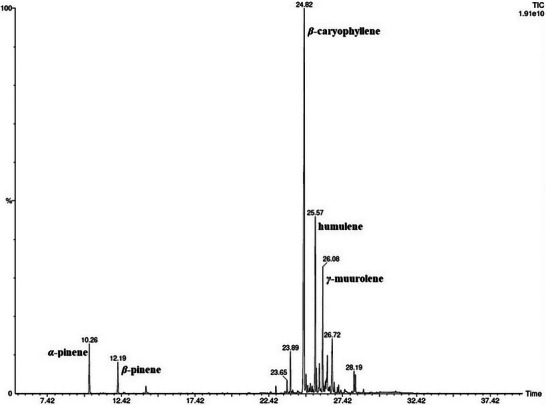 Figure 1
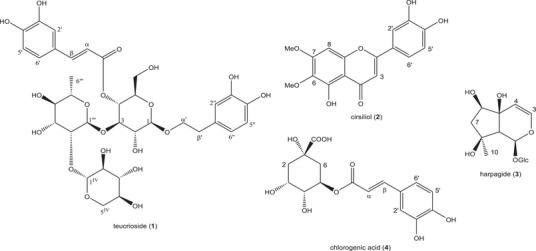 Figure 2
 Figure 3
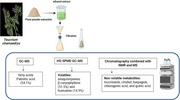 Figure 4
Peer Reviews
No public reviews on file for this paper yet. If you reviewed it on a platform where reviews are public (OpenReview, ICLR, NeurIPS, ICML), you can paste yours below so the community can read it here.
Videos
No videos yet. Explain this paper in a talk, walkthrough, or lecture? Add one.
Taxonomy
TopicsPhytochemistry and Biological Activities · Natural product bioactivities and synthesis · Sesquiterpenes and Asteraceae Studies