The cognitive side of communication in social insects
Martin Giurfa

TL;DR
This paper explores how social insects use flexible cognitive abilities in their communication, challenging the idea that it's purely instinctual.
Contribution
The paper reveals cognitive plasticity in social insect communication, previously thought to be entirely genetically encoded.
Findings
Cognitive modulation occurs in communication contexts of social insects.
This challenges the traditional view of communication as purely innate and stereotyped.
It highlights a previously unrecognized level of cognitive flexibility in social insects.
Abstract
Social insects rely on multiple communication channels. These channels have traditionally been considered innate, eliciting stereotyped responses. However, recent research has shown that cognitive modulation occurs in communication contexts long assumed to be entirely genetically encoded, thus revealing a previously unrecognized cognitive plasticity in social insect communication. Social insects rely on multiple communication channels. These channels have traditionally been considered innate, eliciting stereotyped responses. However, recent research has shown that cognitive modulation occurs in communication contexts long assumed to be entirely genetically encoded, thus revealing a previously unrecognized cognitive plasticity in social insect communication.
Genes, proteins, chemicals, diseases, species, mutations and cell lines named across the full text — each resolved to its canonical identifier and authoritative record.
Click any figure to enlarge with its caption.
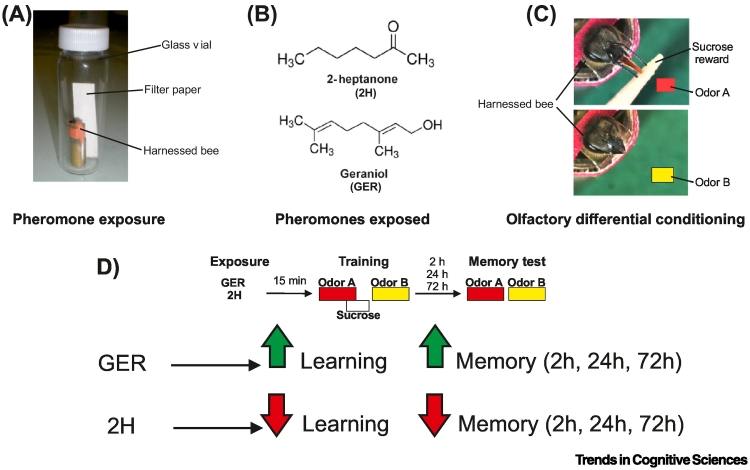 Figure 1
Peer Reviews
No public reviews on file for this paper yet. If you reviewed it on a platform where reviews are public (OpenReview, ICLR, NeurIPS, ICML), you can paste yours below so the community can read it here.
Videos
No videos yet. Explain this paper in a talk, walkthrough, or lecture? Add one.
Taxonomy
TopicsInsect and Arachnid Ecology and Behavior · Plant and animal studies · Animal Behavior and Reproduction