Risk of viral respiratory infection associated with shared washroom between adjoining rooms: a test-negative study
Victoria Williams, Karoleen Volpentesta, Melisa Avaness, Christina Chan, Radhika Chawla, Amna Rizvi, Payton Bayley, Rob Kozak, Jerome A. Leis

TL;DR
Residents sharing a washroom with an infected neighbor are more likely to catch a viral respiratory infection.
Contribution
This study identifies shared adjoining washrooms as a risk factor for viral respiratory infections.
Findings
Shared rooms increase VRI risk with an odds ratio of 2.28.
Shared adjoining washrooms increase VRI risk with an odds ratio of 1.65.
Preventive measures for shared rooms should also apply to shared washrooms.
Abstract
In test-negative study of residents exposed to viral respiratory infection (VRI), odds of VRI (excluding SARS-CoV-2) was higher with shared room (OR = 2.28, 95% CI, 1.53–3.40) and shared adjoining washroom (OR = 1.65, 95% CI, 1.03–2.64) than neighboring rooms. Measures recommended for exposed residents in shared rooms should be considered for shared washrooms.
Genes, proteins, chemicals, diseases, species, mutations and cell lines named across the full text — each resolved to its canonical identifier and authoritative record.
Click any figure to enlarge with its caption.
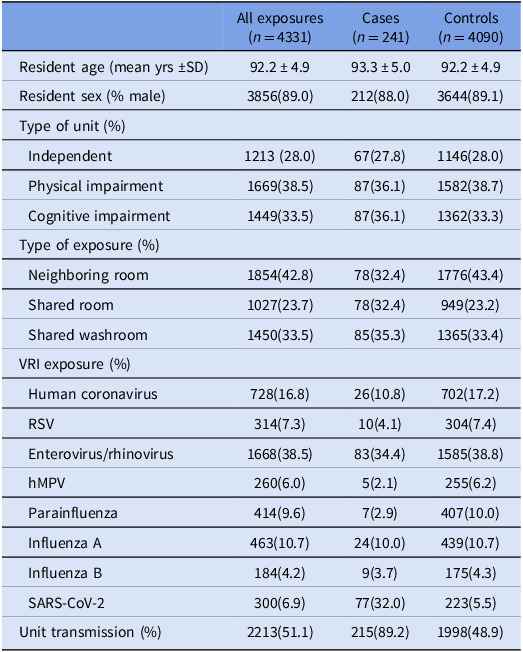 Figure 1
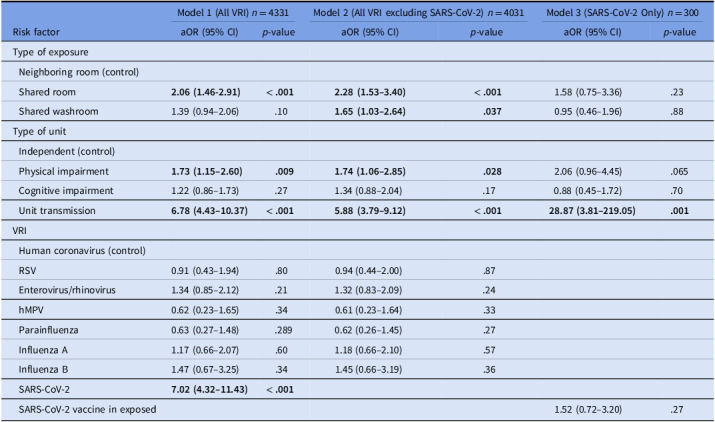 Figure 2
Peer Reviews
No public reviews on file for this paper yet. If you reviewed it on a platform where reviews are public (OpenReview, ICLR, NeurIPS, ICML), you can paste yours below so the community can read it here.
Videos
No videos yet. Explain this paper in a talk, walkthrough, or lecture? Add one.
Taxonomy
TopicsInfection Control and Ventilation · Evacuation and Crowd Dynamics · Urban Green Space and Health