Draft genome sequence of Streptomyces sp. strain G6 reveals biosynthetic gene clusters, including lanthipeptides with potential biomedical applications
Michael Angelou L. Nada, Ursela G. Bigol

TL;DR
The genome of Streptomyces sp. strain G6 contains gene clusters for making diverse natural products, including potential new antibiotics.
Contribution
The discovery of novel biosynthetic gene clusters in a potentially new Streptomyces species.
Findings
The genome encodes multiple biosynthetic gene clusters for natural product synthesis.
Lanthipeptide gene clusters suggest potential biomedical applications.
Genomic analysis indicates G6 may represent a novel Streptomyces species.
Abstract
The 7.20 Mbp draft genome of Streptomyces sp. strain G6 encodes multiple biosynthetic gene clusters, including posttranslationally modified peptides, nonribosomal peptides, and polyketide synthases. Genomic analysis suggests that G6 is a novel species, highlighting its potential for novel antibiotic discovery.
Genes, proteins, chemicals, diseases, species, mutations and cell lines named across the full text — each resolved to its canonical identifier and authoritative record.
Click any figure to enlarge with its caption.
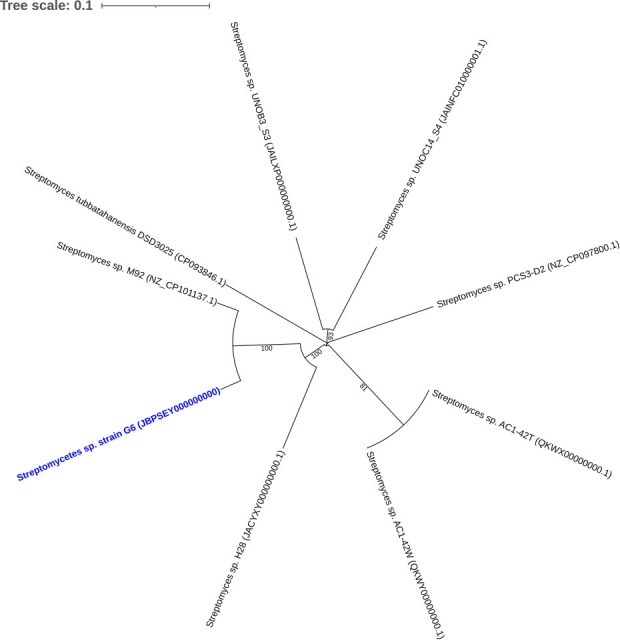 Fig 1
Fig 1| Region | Type | Location in the genome | Most similar known cluster | Similarity confidence |
|---|---|---|---|---|
| Region 1.1 | Ectoine | 76,330-86,728 | Ectoine | High |
| Region 1.2 | Melanin | 969,821–980,435 | – | – |
| Region 1.3 | NI-siderophore | 1,056,379–1,086,151 | Desferrioxamin B/desferrioxamine E | High |
| Region 1.4 | NRPS | 1,239,461–1,301,423 | Sarpeptin A / sarpeptin B | Low |
| Region 1.5 | Lanthipeptide class V | 1,859,177–1,905,374 | Pristinin A3 | Low |
| Region 1.6 | Lanthipeptide class I | 2,167,140–2,191,821 | Planosporicin | High |
| Region 1.7 | Terpene | 2,984,468–3,005,562 | Albaflavenone | High |
| Region 1.8 | Terpene-precursor | 3,014,127–3,035,263 | – | – |
| Region 1.9 | T2PKS | 3,045,612–3,118,157 | Spore pigment | Medium |
| Region 1.10 | NI-siderophore | 3,542,356–3,572,287 | Kinamycin | Low |
| Region 1.11 | NRP-metallophore, NRPS | 3,632,177–3,695,619 | Coelibactin | 100% |
| Region 1.12 | RiPP-like | 3,795,770–3,807,107 | – | – |
| Region 1.13 | Terpene | 3,823,888–3,846,068 | Geosmin | High |
| Region 1.14 | NI-siderophore | 3,981,331–4,012,496 | – | |
| Region 1.15 | T2PKS, Lanthipeptide class I | 4,255,863–4,328,354 | Rubiginone A2/rubiginone J/rubiginone K/rubiginone L/rubiginone M/rubiginone N/ochromycinone/rubiginone B2 | High |
| Region 1.16 | Terpene | 4,689,446–4,716,197 | Hopene | High |
| Region 1.17 | Hydrogen-cyanide | 4,832,899–4,845,784 | – | – |
| Region 1.18 | Lanthipeptide class I | 4,952,205–4,978,542 | – | – |
| Region 1.19 | NRPS, T1PKS, butyrolactone | 5,064,116–5,178,515 | C-1027 | Low |
| Region 1.20 | Terpene, T1PKS, | 5,260,095–5,315,767 | 2-Methylisoborneol | High |
| Region 1.21 | Indole | 5,507,691–5,528,818 | 5-Dimethylallylindole-3-acetonitrile | High |
| Region 1.22 | Terpene | 5,587,287–5,626,147 | Isorenieratene | Medium |
| Region 1.23 | T3PKS | 6,048,991–6,090,082 | Flaviolin/1,3,6,8-tetrahydroxynaphthalene | High |
| Region 3.1 | Lanthipeptide class I, T3PKS, | 35,819–91,698 | 2-Methoxy-5-methyl-6-(13-methyltetradecyl)−1,4-benzoquinone/2-methoxy-5-methyl-6-(13-methyltetradecyl)phenol | High |
| Region 3.2 | Terpene precursor | 147,273–168,415 | Isorenieraten | Low |
- —Department of Science and Technologyhttp://dx.doi.org/10.13039/501100010892
Peer Reviews
No public reviews on file for this paper yet. If you reviewed it on a platform where reviews are public (OpenReview, ICLR, NeurIPS, ICML), you can paste yours below so the community can read it here.
Videos
No videos yet. Explain this paper in a talk, walkthrough, or lecture? Add one.
Taxonomy
TopicsMicrobial Natural Products and Biosynthesis · Genomics and Phylogenetic Studies · Plant-Microbe Interactions and Immunity
ANNOUNCEMENT
Streptomyces is a genus of Gram-positive bacteria with genome sizes ranging from 4.8 to 13.6 Mbp (GC content: ~72%). They are known to synthesize a diverse array of metabolites with significant medicinal and biotechnological applications, resulting in the deposition of 3,569 Streptomyces genomes in NCBI RefSeq database (1). Seven Streptomyces strains have been isolated in the Philippines (2–5) and have demonstrated antibacterial activity against multidrug-resistant (MDR) bacteria (6), attributed to their production of bioactive compounds, such as chlorinated carbazole alkaloids (7). Streptomyces sp. strain G6 exhibits antagonistic activity against MDR clinical isolates of Enterococcus faecalis and Acinetobacter baumannii (DOST Annual Report). Here, we report its draft genome to support the discovery of bioactive secondary metabolites.
G6 was isolated from a soil sample collected at the Department of Science and Technology Garden, Taguig City, Philippines (14°29′22.1″N, 121°03′02.3″E) using serial dilution and plated on Tryptic Soy agar (Merck) plates for 5–7 days. Single colonies were propagated into 250 mL tryptic soy broth (TSB) and incubated at 30°C with shaking (175 rpm) for 4 days, forming dense yellow-orange bacterial pellet. Then, 1 mL culture was centrifuged (12,000 rpm, 15 min) to pellet bacterial cells. DNA was extracted using Genomic DNA Purification Kit (Promega #A1120). Sequencing library (15 pM) was prepared using Illumina DNA prep kit and sequenced on Illumina MiSeq platform (Illumina MiSeq Reagent Kit v3; 2 × 301 bp paired-end chemistry). Read quality was assessed using FastQC v0.11.9 (8) and trimmed with Trimmomatic v0.39 (Q-score:≥28; MinLen:100) (9), resulting in 3,110,139 raw sequences. Reads were assembled de novo using SPAdes v4.2.0 (--isolate) (10) and scaffolded using RagTag v2.1.0 (11). The reference strain Streptomyces mutabilis (GCF_014649815.1) was identified using TYGS platform (12). Genome quality, completeness, and coverage were determined using Quast v5.3.0 (13), CheckM2 v1.0.2 (14), BUSCO v5.8.0 (actinobacteria_phylum_odb10) (15), and BBMap v39.28 (16). The draft genome was annotated using the NCBI Prokaryotic Genome Annotation Pipeline v6.10 (17). Default parameters were used unless otherwise stated.
G6 has a genome size of 7.20 Mbp (GC content: 71.8%; coverage: 162×). The draft genome (CheckM2 completion: 99.9%, contamination: 0.42%; BUSCO: 93.8%), composed of 29 contigs (N50 >7,173 Kbp), has 6,982 coding sequences (coding density: 88.4%) and 67 tRNAs. Three plasmids and one prophage region were detected using geNomad v1.11.1 (18). Taxonomic classification was performed using GTDB-Tk v2.4.1 and the GTDB database v220 (19, 20), which identified Streptomyces sp. M92 (GCF_028473745.1) as the closest relative (96.1% ANI). The dDDH value (65.5%), calculated using Genome-To-Genome Distance Calculator v3.0 (12), suggests that G6 is a distinct species closely related to M92 (Fig. 1), based on Streptomyces-specific delineation thresholds (21).
Phylogenomic tree of Streptomyces sp. strain G6 and other isolates from the Philippines. Branch numbers indicate bootstrap support values (100 replicates), with an average branch support of 80.0%. The branch lengths were scaled in terms of Genome BLAST Distance Phylogeny (GBDP) distance formula d5 . The tree was rooted at midpoint. Pairwise genome comparison between Streptomyces sp. G6 and Streptomyces sp. M92 show 96.2% ANI and 65.5% dDDH, suggesting close but potentially distinct species-level relatedness. Full pairwise genome comparisons between Streptomyces sp. strain G6 and other isolates are available on Figshare. The Streptomyces-specific delineation thresholds are ≥96.7% ANI and ≥70 dDDH.
AntiSMASH v8.0 (22) and BAGEL4 (23) identified 25 biosynthetic gene cluster (BGC) regions (Table 1), including those involved in the production of terpenes and their precursor, nonribosomal peptides (NRPS), polyketide synthase (Type I, II, III PKS), siderophores, indole, ectoine, and other metabolites commonly observed in Streptomyces isolates. Notably, clusters involved in the production of ribosomally synthesized and post-translationally modified peptides (RiPPs), such as lanthipeptides and planosporicin, were also detected. These small peptides are known for their antimicrobial and antiviral activities (24). Future validation of these bioactive compounds may be undertaken to confirm their biological activity.
The reference list from the paper itself. Each links out to its DOI / PubMed record.
- 1Mohite OS, Jørgensen TS, Booth TJ, Charusanti P, Phaneuf PV, Weber T, Palsson BO. 2025. Pangenome mining of the Streptomyces genus redefines species’ biosynthetic potential. Genome Biol 26:9. doi:10.1186/s 13059-024-03471-939810189 PMC 11734326 · doi ↗ · pubmed ↗
- 2Verdera AB, Montecillo AD, Obusan MCM. 2021. Draft genome sequence of Streptomyces sp. isolate H 28 from the Meycauayan River, Philippines. Microbiol Resour Announc 10:e 01269-20. doi:10.1128/MRA.01269-2033414351 PMC 8407727 · doi ↗ · pubmed ↗
- 3Bayot-Custodio AN, Alcantara EP, Zulaybar TO. 2014. Draft genome sequence of insecticidal Streptomyces sp. strain PCS 3-D 2, isolated from mangrove soil in Philippines. Genome Announc 2:e 00448-14. doi:10.1128/genome A.00448-1424926046 PMC 4056289 · doi ↗ · pubmed ↗
- 4Marasigan RV, Alcantara E, Pangilinan EA, Tablizo F, Morado EK, Araiza SM, Punayan K, Maralit B, Bautista MA. 2022. Draft genome sequences of two Streptomyces isolates obtained from volcanic soils in the Philippines. Microbiol Resour Announc 11:e 0108721. doi:10.1128/mra.01087-2135142551 PMC 8830324 · doi ↗ · pubmed ↗
- 5De Leon MP, Park A-Y, Montecillo AD, Siringan MAT, Rosana ARR, Kim S-G. 2018. Near-complete genome sequences of Streptomyces sp. strains AC 1-42T and AC 1-42W, isolated from bat Guano from Cabalyorisa Cave, Mabini, Pangasinan, Philippines. Microbiol Resour Announc 7:e 00904-18. doi:10.1128/MRA.00904-1830533909 PMC 6256446 · doi ↗ · pubmed ↗
- 6Tenebro CP, Trono DJVL, Vicera CVB, Sabido EM, Ysulat JA Jr, Macaspac AJM, Tampus KA, Fabrigar TAP, Saludes JP, Dalisay DS. 2021. Multiple strain analysis of Streptomyces species from Philippine marine sediments reveals intraspecies heterogeneity in antibiotic activities. Sci Rep 11:17544. doi:10.1038/s 41598-021-96886-434475427 PMC 8413401 · doi ↗ · pubmed ↗
- 7Tenebro CP, Trono DJVL, Balida LAP, Bayog LKA, Bruna JR, Sabido EM, Caspe DPC, de Los Santos ELC, Saludes JP, Dalisay DS. 2023. Synergy between genome mining, metabolomics, and bioinformatics uncovers antibacterial chlorinated carbazole alkaloids and their biosynthetic gene cluster from Streptomyces tubbatahanensis sp. nov., a novel actinomycete isolated from Sulu Sea, Philippines. Microbiol Spectr 11:e 0366122. doi:10.1128/spectrum.03661-2236809153 PMC 10100901 · doi ↗ · pubmed ↗
- 8Andrews S. 2010. Fast QC: a quality control tool for high throughput sequence data. Babraham Bioinformatics, Babraham Institute. Available from: https://www.bioinformatics.babraham.ac.uk/projects/fastqc/