Human papillomavirus partial L2 gene variants in the Barrett’s metaplasia-dysplasia-adenocarcinoma sequence
Kishen Rajendra, Aliakbar Khabiri, Shanmugarajah Rajendra, Mohammad Rabiei

TL;DR
This study examines HPV gene variants in the progression of Barrett’s esophagus to cancer, finding that HPV-16 is most common.
Contribution
The study identifies the prevalence of HPV-16 over HPV-18 in Barrett’s metaplasia-dysplasia-adenocarcinoma sequence.
Findings
32 out of 33 HPV partial L2 genes sequenced were HPV-16.
Only one specimen was identified as HPV-18.
Phylogenetic analysis highlights HPV-16's dominance in the disease progression.
Abstract
High-risk human papillomavirus (HPV) genotypes 16 and 18 are associated with Barrett’s dysplasia and esophageal adenocarcinoma. We sequenced 33 HPV partial L2 genes from Australian esophageal specimens. Phylogenetic analysis showed 32 were HPV-16 and one was HPV-18, underscoring the predominance and importance of HPV-16.
Genes, proteins, chemicals, diseases, species, mutations and cell lines named across the full text — each resolved to its canonical identifier and authoritative record.
Click any figure to enlarge with its caption.
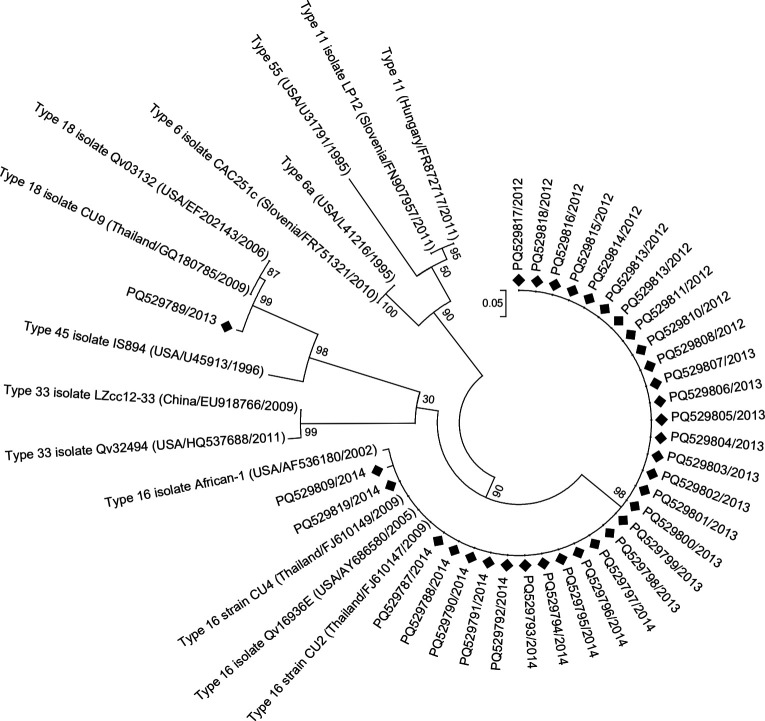 Fig 1
Fig 1| Component | HPV-16 ( | HPV-18 ( | Thermal cycling conditions |
|---|---|---|---|
| Forward primer (5’→3’) | AAC CGA AAT CGG TTG AAC CG | GGA GTA ACC GAA AAC GGT | - Denaturation: 95°C, 30 s - Annealing: 57°C, 30 s - Extension: 72°C, 1 min |
| Reverse primer (5’→3’) | TGA TGT GTA TGT AGA CAC AGA C | CAT ACA TGC ATA CAC AAA AGC | |
| Target region | Partial L2 gene | Partial L2 gene | |
| Reference sequence |
Peer Reviews
No public reviews on file for this paper yet. If you reviewed it on a platform where reviews are public (OpenReview, ICLR, NeurIPS, ICML), you can paste yours below so the community can read it here.
Videos
No videos yet. Explain this paper in a talk, walkthrough, or lecture? Add one.
Taxonomy
TopicsEsophageal Cancer Research and Treatment · Genetic factors in colorectal cancer · Cancer-related gene regulation
ANNOUNCEMENT
Oncogenic viruses are responsible for a substantial percentage of global cancer cases (1). Human papillomavirus (HPV), a key player, is linked to approximately 30% of virus-related cancers (2). HPV is a small, double-stranded DNA virus that belongs to the Papillomaviridae family with an ~8 kb genome divided into early (E), late (L), and long control (LCR) regions; types are classified based on <90% L1 gene nucleotide similarity, subtypes on 90–98%, and variants on >98% similarity (3). The L2 gene was selected in this study because its partial conservation made it a suitable target for broad primers, while its higher divergence provided better variant discrimination than L1 (4).
In esophageal adenocarcinoma (OAC), studies have indicated that high-risk HPV is associated with 25% of malignancies (5, 6). In this study, we report the partial L2 genes of HPV strains detected from OAC cases from Bankstown-Lidcombe Hospital in Sydney, Australia, and compare them phylogenetically to previously reported strains. Viral genome sequences are essential for understanding the genetic diversity, evolution, and epidemiology of HPV.
From 2012 to 2014, we collected 33 biopsies from patients with Barrett’s metaplasia–dysplasia–adenocarcinoma (median age 46, range 42–79). Samples were homogenized, and viral DNA was extracted using the DNeasy Blood & Tissue Kit (Qiagen, USA). DNA quality and concentration were assessed with a NanoDrop spectrophotometer. The partial L2 region was amplified by PCR with type-specific primers (Table 1), visualized on agarose gels, and purified (Qiagen, USA). Amplicons (90–100 bp) were sequenced bidirectionally by the Sanger method at the Ramaciotti Centre for Genomics (UNSW, Sydney). Consensus sequences were compared with GenBank references, showing >99% similarity, and the most closely related strains were used for phylogenetic analysis. A maximum likelihood tree was constructed in MEGA X to determine evolutionary relationships.
Sequences showed >99% similarity with GenBank references. One sequence clustered with HPV-18 strains CU9 (Thailand) and Qv03132 (USA), while 32 clustered with HPV-16 strains CU2/CU4 (Thailand) and African-1 (USA) (Fig. 1).
Phylogenetic tree based on the partial L2 gene sequences of HPV. Raw sequence reads from forward and reverse primers were assembled and trimmed to generate consensus sequences for each sample using BioEdit software. Consensus sequences were compared with published sequences in the NCBI database using BLASTn. Multiple sequence alignment was performed using Clustal Omega (https://www.ebi.ac.uk/Tools/msa/clustalo/) with available sequences from GenBank. The alignment included 47 nucleotide sequences, with codon positions 1st+2nd+3rd+Noncoding. All positions containing gaps and missing data were eliminated, resulting in a final data set of 81 positions. The phylogenetic tree was constructed using the Maximum Likelihood method in MEGA X (7) with 1,000 bootstrap replications, applying the maximum composite likelihood model. Evolutionary analyses were conducted in MEGA X. All HPV16 variants were highly similar, with pairwise sequence similarity ranging from 99.79% to 100%, mainly because of the sequence length.
The predominance of HPV-16 among the samples aligns with global epidemiological trends, highlighting its significant role in oncogenesis (8). The clustering patterns observed could inform future public health strategies and vaccination programs. Additionally, the identification of HPV-18, although less frequent, emphasizes the need for comprehensive screening and monitoring to address all high-risk HPV types effectively.
The reference list from the paper itself. Each links out to its DOI / PubMed record.
- 1Serrano-Pozo A, Das S, Hyman BT. 2021. APOE and alzheimer’s disease: advances in genetics, pathophysiology, and therapeutic approaches. Lancet Neurol 20:68–80. doi:10.1016/S 1474-4422(20)30412-933340485 PMC 8096522 · doi ↗ · pubmed ↗
- 2Siegel RL, Miller KD, Wagle NS, Jemal A. 2023. Cancer statistics, 2023. CA Cancer J Clin 73:17–48. doi:10.3322/caac.2176336633525 · doi ↗ · pubmed ↗
- 3Bernard H-U, Burk RD, Chen Z, van Doorslaer K, zur Hausen H, de Villiers E-M. 2010. Classification of papillomaviruses (P Vs) based on 189 PV types and proposal of taxonomic amendments. Virology (Auckl) 401:70–79. doi:10.1016/j.virol.2010.02.002PMC 340034220206957 · doi ↗ · pubmed ↗
- 4Han Z, Wang S, Mu T, Zhao P, Song L, Zhang Y, Zhao J, Yin W, Wu Y, Wang H, Gong B, Ji M, Roden RBS, Yang Y, Klein M, Wu K. 2024. Vaccination with a human papillomavirus L 2 multimer provides broad protection against 17 human papillomavirus types in the mouse cervicovaginal challenge model. Vaccines (Basel) 12:689. doi:10.3390/vaccines 1206068938932417 PMC 11209485 · doi ↗ · pubmed ↗
- 5Rajendra S, Yang T, Xuan W, Sharma P, Pavey D, Lee CS, Le S, Collins J, Wang B. 2017. Active human papillomavirus involvement in barrett’s dysplasia and oesophageal adenocarcinoma is characterized by wild-type p 53 and aberrations of the retinoblastoma protein pathway. Int J Cancer 141:2037–2049. doi:10.1002/ijc.3089628722212 · doi ↗ · pubmed ↗
- 6Rajendra S, Xuan W, Merrett N, Sharma P, Sharma P, Pavey D, Yang T, Santos LD, Sharaiha O, Pande G, Cosman P, Wu X, Wang B. 2018. Survival rates for patients with Barrett high-grade Dysplasia and Esophageal adenocarcinoma with or without human papillomavirus infection. JAMA Netw Open 1:e 181054. doi:10.1001/jamanetworkopen.2018.105430646096 PMC 6324261 · doi ↗ · pubmed ↗
- 7Tamura K, Nei M, Kumar S. 2004. Prospects for inferring very large phylogenies by using the neighbor-joining method. Proc Natl Acad Sci USA 101:11030–11035. doi:10.1073/pnas.040420610115258291 PMC 491989 · doi ↗ · pubmed ↗
- 8Milano G, Guarducci G, Nante N, Montomoli E, Manini I. 2023. Human papillomavirus epidemiology and prevention: is there still a gender gap? Vaccines (Basel) 11:1060. doi:10.3390/vaccines 1106106037376449 PMC 10303003 · doi ↗ · pubmed ↗