Complete chloroplast genomes analysis of Lamium barbatum and Leucas ciliata (Lamiaceae)
Qing Du, Baoxiang Xue, Benyi Tan

TL;DR
This paper analyzes the complete chloroplast genomes of two Lamiaceae species to understand their evolutionary relationships and provide data for conservation.
Contribution
The study provides new complete chloroplast genome sequences for Lamium barbatum and Leucas ciliata, enhancing phylogenetic understanding.
Findings
Lamium barbatum is closely related to four other Lamium species based on chloroplast genome analysis.
Leucas ciliata clusters with Leucas mollissima in the phylogenetic analysis.
The chloroplast genome sequences are valuable for species identification and evolutionary research.
Abstract
The two Lamioideae species, Lamium barbatum Siebold & Zucc. 1846, is distributed across Europe, North Africa, Asia, and North America, while Leucas ciliata Hochst. ex Benth. 1829 is found in southern China and Southeast Asia. We sequenced their complete chloroplast genomes using the Illumina platform, obtaining lengths of 150,887 bp and 151,259 bp, respectively. Phylogenetic analysis showed Lamium barbatum is closely related to four other Lamium species, including Lamium takeshimense, Lamium album, Lamium amplexicaule, and Lamium galeobdolon. The Leucas ciliata species clusters with Leucas mollissima. These findings provide valuable data for species identification, evolutionary research, and conservation genetics.
Genes, proteins, chemicals, diseases, species, mutations and cell lines named across the full text — each resolved to its canonical identifier and authoritative record.
Click any figure to enlarge with its caption.
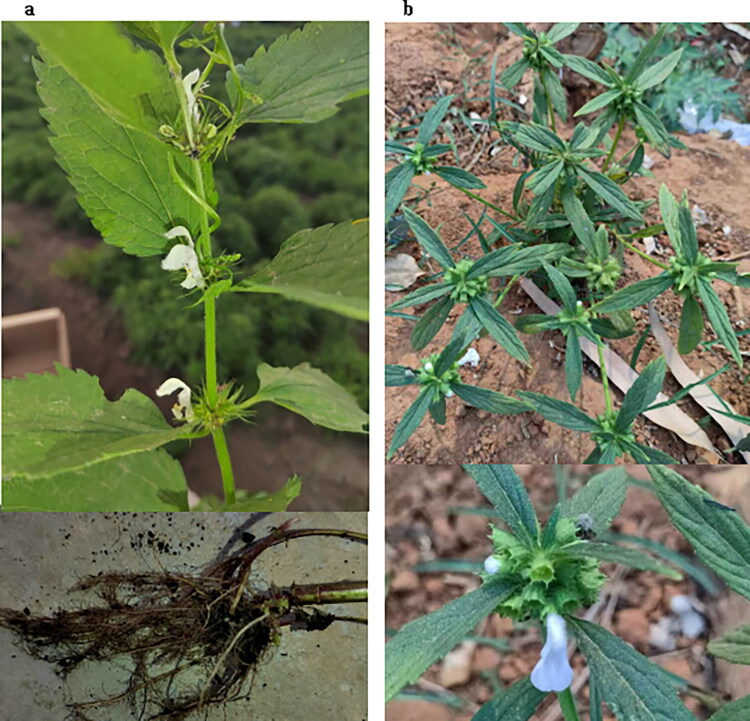 Figure 1
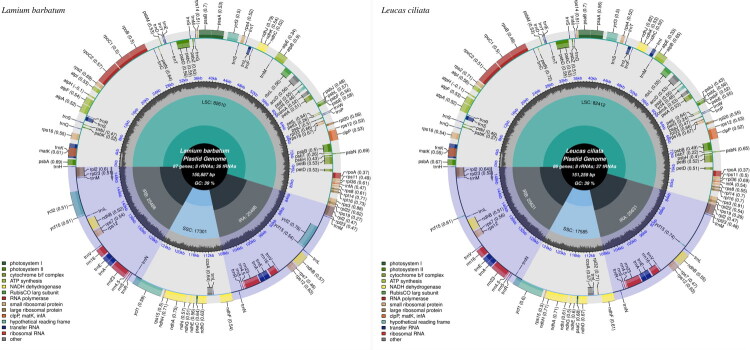 Figure 2
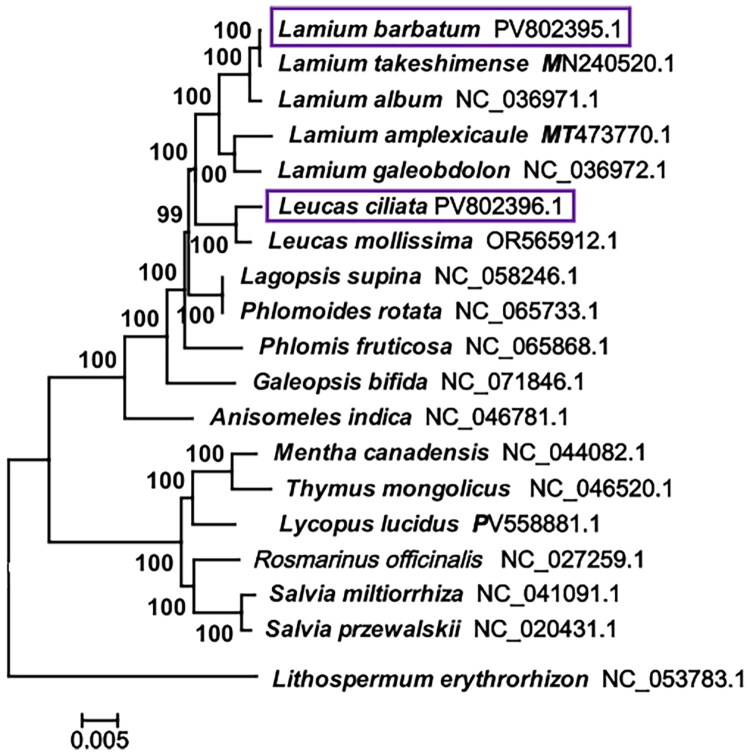 Figure 3
Peer Reviews
No public reviews on file for this paper yet. If you reviewed it on a platform where reviews are public (OpenReview, ICLR, NeurIPS, ICML), you can paste yours below so the community can read it here.
Videos
No videos yet. Explain this paper in a talk, walkthrough, or lecture? Add one.
Taxonomy
TopicsPhytochemistry and Biological Activities · Genomics and Phylogenetic Studies · Plant Diversity and Evolution
Introduction
The Lamiaceae is the sixth-largest angiosperm family with worldwide distribution. Most genera are predominantly distributed in Asia, Africa, and Europe, with approximately 1387 species within 100 genera in China (Chang et al. 2014). Many species possess significant economic, ornamental, aromatic, and medicinal value, as well as the ability to activate blood circulation (Guzman and Molina 2018). The two species of Lamium album subsp. barbatum Siebold & Zucc. 1846 and Leucas ciliata Hochst. ex Benth. 1829 in this study belong to different genera within the Lamioideae subfamily of the Lamiaceae family, as classified by chloroplast regions (Cantino and Sanders 1986; Bendiksby et al. 2011). Previous studies have shown that Lamium album subsp. barbatum contains various bioactive compounds, including flavonoid glycosides, phenylpropanoid glycosides, sterols, steroids, and cycloartane glycosides, which can be used for the treatment of traumatic injuries, pediatric malnutrition, and diseases affecting the uterine and urinary systems (Tjendana Tjhin et al. 2024). As species of the same subfamily, Leucas ciliata and Anisomeles indica are two varieties of ‘Fang feng’ in the Lamiaceae family, including differentiated main chemicals (Gui et al. 1991). The species Leucas ciliata contains tricin, cirsilineol, daucosterol, leucasin, and 17 phenolic acid compounds, which have effects on regulating liver blood flow, removing wind, and detoxifying (Wang et al. 2012; Kuang et al. 2024).
The chloroplast genome and its key genes, due to their highly conserved structure and moderate mutation rate, play a crucial role in the biosynthesis and metabolism of plant chemical components, particularly in the phylogenetic development of biodiversity species (Wang et al. 2024). By regulating photosynthetic rates across plant species, chloroplasts significantly influence growth efficiency, reproductive success, and breeding outcomes (Zhang et al. 2023). These organelles not only act as energy production hubs but also drive carbon assimilation processes, fundamentally shaping ecosystem energy flows. Crucially, chloroplasts are deeply intertwined with plant metabolism. Many bioactive compounds in traditional medicinal plants originate from secondary metabolites synthesized within chloroplasts, demonstrating a close evolutionary connection between chloroplast evolution and their medicinal value (Gomez-Casati et al. 2022). The chloroplast genomes from 288 species in 191 genera of the Lamiaceae family were used to construct a phylogenetic relationship, which revealed new findings indicating that these species form twelve supported, updated clades (Li et al. 2016). Many species of the subfamily and genera of Lamioideae have been studied in terms of their chloroplast genome and molecular systematics, including Lamium takeshimense, Thymus mongolicus, Lycopus lucidus, and Mentha canadensis (Huaizhu et al. 2019, 2020; Park et al. 2019; Wang et al. 2021). Whereas the complete chloroplast genomes of the two species in this study have not been reported, nor have their morphological and genomic characteristics been compared. Therefore, this study addresses these gaps to explore the analysis of chloroplast genomes and their evolutionary relationships, gaining a better understanding of these species.
Materials and methods
Fresh leaves of Lamium barbatum and Leucas ciliata (Figure 1) were collected from Zuojia County (44°3′18″ N, 126°5′54″ E), Jilin City of Jilin Province, China, and Xuwen County (20°16′48ʺ N, 110°11′24ʺ E), Zhanjiang City of Guangdong Province, China. The specimens were deposited at the National Plant Specimen Resource Center (Li Zexin, [email protected]) and Specimen Museum, Institute of Botany, Chinese Academy of Sciences, Jiangsu Province (Dong Xiaoyu, [email protected]), under the voucher numbers Duq2023013 and Duq2022080. The two plants were identified by Dr. Linqinwen, Dr. Liubing, and Dr. Limin (Institute of Botany, Chinese Academy of Sciences, [email protected] and [email protected]), Mr. Louanrui (Bozhou Planting Agriculture Technology Co., Ltd., Bozhou, China, [email protected]), and the authors.
Morphological characteristics of the Lamium barbatum (a) and Leucas ciliata (b).
Characteristics: (a) herbs, perennial, rhizome with long underground creeping branches; stem is solitary, erect, quadrangular, hollow, and nearly hairless; the leaf is ovate or reniform to obovate; the calyx is bell-shaped, and the corolla is white or light yellow. (b) Herbs, annual, the stem is erect or twisted at the top, densely covered with golden yellow long and hard hairs; the leaves are ovate-lanceolate or lanceolate, and the corolla is white or purple with slightly soft hairs on the outside near the throat. The photographs were taken by Xue Baoxiang on 2 June 2023 (a) and by Lou Anrui on 13 April 2023 (b).
The total genomic DNA of the two species was extracted using the Plant Genomic DNA Kit (Tiangen Biotech, Beijing, China). The quality detection of DNA purity and concentration was executed in a DNA library at the laboratory of Genepioneer Biotechnology Co., Ltd. (Nanjing, China). The qualified samples were then sequenced on an Illumina HiSeq 3000 platform (San Diego, CA). The raw data were filtered (Q30 is greater than 85%), assembled, annotated, corrected, and visualized using GetOrganelle v1.7.5 and CPGview software as described in the reference, as well as the analysis of simple sequence repeats (SSRs) (http://www.1kmpg.cn/cpgview, Jin et al. 2020; Du et al. 2022; Liu et al. 2023). The sequencing depth has been aligned, acquired, treated, and represented using CPtools, Bowtie2, and ggplot2 software (Langmead and Salzberg 2012; Wickham 2016; Huang et al. 2024). After that, the annotated sequences from the two chloroplast genomes were submitted to the GenBank database of the National Center for Biotechnology Information (NCBI) to obtain the accession numbers PV802395.1 (Lamium barbatum) and PV802396.1 (Leucas ciliata).
The phylogenetic analysis was constructed based on complete chloroplast genomes of the two species and 17 other species downloaded from the NCBI database using the Phylosuite software (version 1.2.3, http://phylosuite.jushengwu.com/, Xiang et al. 2023). The species Lithospermum erythrorhizon served as the outgroup species. The phylogenetic method of construction and illustration referred to the publication (Yuan et al. 2024) with 1000 replications as the assessing bootstrap standard.
Results
The length of the chloroplast genome of Lamium barbatum and Leucas ciliata is 150,887 bp and 151,259 bp, with the typical quadripartite structure (Figure S1), comprising a large single-copy region (LSC, 82,610 bp and 82,412 bp), a small single-copy region (SSC, 17,301 bp and 17,585 bp), and two inverted repeat regions (IR, 25,488 bp and 25,631 bp by each) (Figure 2, Table S1). The GC contents of the two total chloroplast genomes are 38.5% and 38.6% and that of IR regions (43.39% and 43.41%) is higher than LSC regions (36.84% and 36.87%) and SSC regions (32.76% and 32.55%). After mapping and calculation, the coverage ranges of the sequencing data were all 99.86%. The sequencing depth range of genomes varied from 33× to 3830× (Lamium barbatum) and from 26× to 7046× (Leucas ciliata) (Figure S2). A total of 131 genes were identified within the two species, including 87 (Lamium barbatum) and 86 (Leucas ciliata) protein-coding genes, 36 (Lamium barbatum) and 37 (Leucas ciliata) tRNA genes, and eight rRNA genes (Table S1). Seven protein-coding genes are duplicated in the IR regions, including rps7, rps12, rpl2, rpl23, ndhB, ycf2, and ycf15 (Table S2). Within the two studied chloroplast genomes, cis-splicing was detected in twelve genes, and two trans-splicing rps12 genes were also identified at diverse locations (Figures S3 and S4 and Table S3), which included two introns and three exons, in addition to the other two cis-splicing genes, ycf3 and clpP.
Graphic representation in the chloroplast genomes of the Lamium barbatum (a, PV802395.1) and Leucas ciliata (b, PV802396.1) using CPGView (http://www.1kmpg.cn/cpgview).
Each map contains seven circles, each representing the distribution of repeats, microsatellite sequences, the size of the four regions, GC content, and genes (Du et al. 2022).
In this study, a total of 22 and 26 SSRs with the length range of 10–41 bp and 10–87 bp were detected in the two chloroplast genomes of Lamium barbatum and Leucas ciliata (Table S4), among which were two types of repeats, that is, most of the mono-nucleotide repeats (18 for Lamium album subsp. barbatum and 20 for Leucas ciliata), and the dinucleotide repeats (three for Lamium barbatum and four for Leucas ciliata). The number of complex repeats within the two species is one and two by each species (Table S5). The SSR sequences of each species can be amplified by designing primers at both ends through PCR to obtain the target DNA sequences. The size of the amplification products is then analyzed by gel electrophoresis to determine the genotype of each sample.
The results revealed that the two species clustered into a single larger clade, whereas they were located at different branches, with closely related species in the same genus (Figure 3). Within this framework, Lamium barbatum was found to be most closely related to the four Lamium species, including Lamium takeshimense, Lamium album, Lamium amplexicaule, and Lamium galeobdolon. The species Leucas ciliata was grouped with Leucas mollissima into a single clade. All the evolutionary clades were well-supported, united groups with high bootstrap values (99–100%). The two studied species, although both belonging to the tribe Lamiinae of the subfamily Lamioideae, exhibit evolutionary development that indicates a close relationship, and their similar morphology (leaves and flowers) also supports this kinship.
The maximum-likelihood (ML) phylogenetic tree in the 19 studied species based on the nucleotide sequences of 68 shared CDS genes within the complete genomes.
The bootstrap support value is 99–100% on each branch after 1000 bootstrap replicates. The bar of scaled branch is 0.005. The accession numbers of the two new chloroplast genomes are given as PV802395.1 (Lamium barbatum) and PV802396.1 (Leucas ciliata), listed behind their respective Latin names (in a purple square frame). The species name and accession number of the other 17 species downloaded are Lamium takeshimense (MN240520.1) (Park et al. 2019), Lamium album (NC_036971.1) (Park et al. 2019), Lamium amplexicaule (MT473770.1) (Zhao et al. 2021), Lamium galeobdolon (NC_036972.1) (Park et al. 2019), Leucas mollissima (OR565912.1), Thymus mongolicus (NC_046520.1) (Huaizhu et al. 2020), Mentha canadensis (NC_044082.1) (Huaizhu et al. 2019), Lycopus lucidus (PV558881.1) (Wang et al. 2021), Rosmarinus officinalis (NC_027259.1) (Wang et al. 2021), Lagopsis supina (NC_058246.1) (Bendiksby et al. 2011), Phlomis fruticosa (NC_065868.1) (Zhao et al. 2021), Phlomoides rotata (NC_065733.1) (Bendiksby et al. 2011), Galeopsis bifida (NC_071846.1) (Zhao et al. 2021), Anisomeles indica (NC_046781.1) (Zhao et al. 2021), Salvia przewalskii (NC_041091.1) (Du et al. 2019), Salvia miltiorrhiza (NC_020431.1) (Du et al. 2019), and Lithospermum erythrorhizon (NC_053783.1) (Park et al. 2020) selected as the outgroup.
Discussion and conclusions
This study presents the first complete sequencing and analysis of the chloroplast genomes of Lamium barbatum and Leucas ciliata, two Lamioideae species from different genera with distinct morphological features. Phylogenetic analysis confirmed that Lamium barbatum is closely related to Lamium tenuifolium and Lamium album, consistent with previous findings (Park et al. 2019). Importantly, we identified a previously unknown close relationship between the two Leucas species. Additionally, five species from diverse Lamiaceae genera (Lagopsis supina, Phlomis fruticosa, Phlomoides rotata, Galeopsis bifida, and Anisomeles indica) were found to be genetically related to the studied species within a single branch. The SSR sequences identified here offer effective tools for plant variety identification, seed purity assessment, genetic relationship analysis, and molecular marker development. Complex SSR fragments, in particular, may serve as valuable genetic markers to accelerate the selection of superior varieties. The observed differences in morphology, chloroplast genome content, SSR sequences, and genetic relationships between these two species provide important resources for medicinal plant authentication, evolutionary studies, and germplasm selection.
Supplementary Material
Figure S4.png
Figure S3.jpg
Figure S1.png
Table S.xlsx
Figure S2.jpg
The reference list from the paper itself. Each links out to its DOI / PubMed record.
- 1Bendiksby M, Thorbek L, Scheen AC, Lindqvist C, Ryding O. 2011. An updated phylogeny and classification of Lamiaceae subfamily Lamioideae. Taxon. 60(2):471–484. 10.1002/tax.602015 · doi ↗
- 2Cantino PD, Sanders RW. 1986. Subfamilial classification of Labiatae. Syst Bot. 11(1):163–185. 10.2307/2418955 · doi ↗
- 3Chang M, Chen X, Chen S, Ma L. 2014. Analysis of the diversity and geographical pattern of wild Lamiaceae species in China. Subtrop Plant Sci. 53(3):234–242.
- 4Du Q et al. 2022. Complete chloroplast genomes of two medicinal Swertia species: the comparative evolutionary analysis of Swertia genus in the Gentianaceae family. Planta. 256(4):73. 10.1007/s 00425-022-03987-z 36083348 · doi ↗ · pubmed ↗
- 5Du Y, Wang YY, Xiang CL, Yang MQ. 2019. Characterization of the complete chloroplast genome of Salvia przewalskii Maxim. (Lamiaceae), a substitute for Dan-Shen Salvia miltiorrhiza Bunge. Mitochondrial DNA Part B. 4(1):981–982. 10.1080/23802359.2019.1581107 · doi ↗
- 6Gomez-Casati DF, Barchiesi J, Busi MV. 2022. Mitochondria and chloroplasts function in microalgae energy production. Peer J. 10:e 14576. 10.7717/peerj.1457636545385 PMC 9762248 · doi ↗ · pubmed ↗
- 7Gui J-S, Wei Q-H, Yang S-D. 1991. Discussion on Leucas varieties in Yunnan. J Yunnan Coll Tradit Chin Med. 2:23–25. 10.19288/j.cnki.issn.1000-2723.1991.02.013 · doi ↗
- 8Guzman E, Molina J. 2018. The predictive utility of the plant phylogeny in identifying sources of cardiovascular drugs. Pharm Biol. 56(1):154–164. 10.1080/13880209.2018.144464229486635 PMC 6130559 · doi ↗ · pubmed ↗