Gene model for the ortholog of Gar1 in Drosophila willistoni
Nora Doughty, Ethan Pini, Alizabeth Tobin, Mia Lacenere, Allison Rea, Taylor Holt, Christopher Park, Amy Jones, Michael S. Foulk, Christopher D. Shaffer

TL;DR
This paper identifies the gene model for Gar1 in Drosophila willistoni and compares it to the related gene in Drosophila melanogaster.
Contribution
The study establishes the orthology of Gar1 in D. willistoni and reveals structural differences in the gene.
Findings
The Gar1 gene in D. willistoni has four coding exons, while D. melanogaster has three.
Intron positions are not conserved between the two species.
The Gar1 protein has a glycine-rich N-terminus and C-terminus.
Abstract
The Drosophila willistoni feature with NCBI Gene ID 6651170 was established to be orthologous to Drosophila melanogaster gene Gar1 . The Gar1 protein contains the conserved domain H/ACA_rnp_Gar1/Naf1 (InterPro accession IPR007504) and the N-terminus and C-terminus of the protein are glycine-rich. There are major changes in the gene structure of the ortholog, Gar1-PA, between D. melanogaster and D. willistoni , which have three and four coding exons respectively. Notably, none of the intron positions are conserved between the two species.
Genes, proteins, chemicals, diseases, species, mutations and cell lines named across the full text — each resolved to its canonical identifier and authoritative record.
Click any figure to enlarge with its caption.
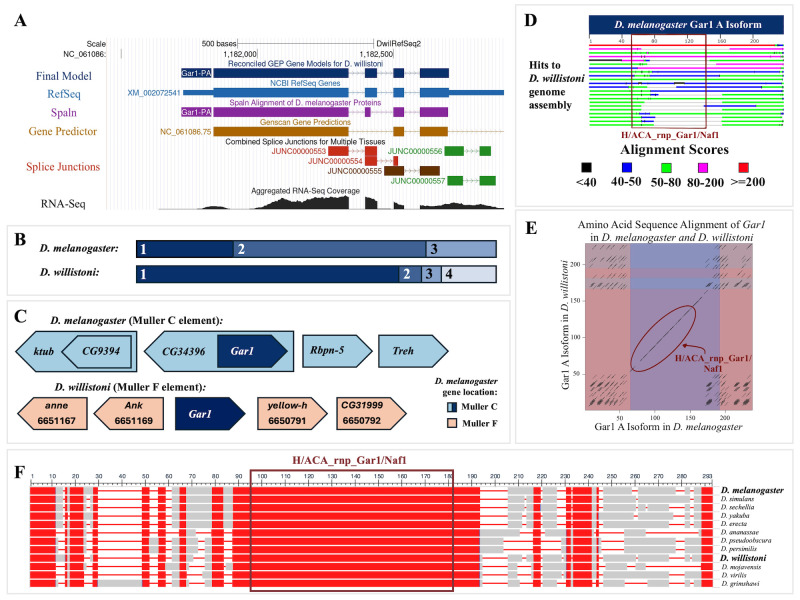 Figure 1
Peer Reviews
No public reviews on file for this paper yet. If you reviewed it on a platform where reviews are public (OpenReview, ICLR, NeurIPS, ICML), you can paste yours below so the community can read it here.
Videos
No videos yet. Explain this paper in a talk, walkthrough, or lecture? Add one.
Taxonomy
TopicsDevelopmental Biology and Gene Regulation · Chromosomal and Genetic Variations · Genomics and Phylogenetic Studies
Description
*Drosophila melanogaster * Gar1 ribonucleoprotein ( Gar1) gene (FlyBase accession FBgn0011824) encodes the Gar1 protein and is located on the right arm of chromosome 2 (chr2R; Muller C element). *Gar1 * is assigned to the H/ACA Small Nucleolar Ribonucleoprotein Complex gene group in FlyBase (FBgg0001764). Gar1 forms the H/ACA Small Nucleolar Ribonucleoprotein (snRNP) complex with *NHP2 * (FBgn0029148), *Nop10 * (FBgn0033548), and *Nop60B * (FBgn0259937) (Breznak et al., 2023, Sanchez et al., 2016). This complex is vital for ribosome biogenesis, forming a complex that assists in the pseudouridylation of specific sites in ribosomal RNA (Breznak et al., 2023, Sanchez et al., 2016). *Gar1 * contains the H/ACA ribonucleoprotein complex, subunit Gar1/Naf1 (H/ACA_rnp_Gar1/Naf1) protein signature (of the protein family IPR007504), which identifies protein domains that bind to Cbf5 (Leulliot et al., 2007). The conserved protein signature is flanked on both sides by glycine-rich regions. According to the “Orthologs” section of the FlyBase Gar1 gene report (FBgn0011824), *D. melanogaster Gar1 * is orthologous to human *GAR1 * (NCBI Gene ID 54433).
** Large number of changes in gene structure compared to the *D. melanogaster * ortholog **
A preliminary FlyBase BLAST (database release 6.53) search of the *D. willistoni * protein sequence XP_002072577.1 (derived from the gene with the NCBI Gene ID 6651170) to the D. melanogaster annotated proteins database yields only one hit to Gar1-PA with a score of 215.698 and an E-value of 3e-56, prompting an initial ortholog assignment of Gar1 . The D. willistoni Gar1 gene model was annotated according to the protocol detailed in Rele et al., 2023. The *Gar1 * gene in *D. melanogaster * contains one isoform (Gar1-PA) with three coding exons. In contrast, the proposed gene model for *D. willistoni * has four coding exons ( Figure 1A ). The gene structure is supported by multiple lines of experimental and computational evidence. For example, all donor and acceptor sites are supported by both significant drops in the aggregated RNA-Seq expression data coverage and corresponding splice junctions. The chosen start codon is the only option that maintains an open reading frame in coding exon 1 without truncating conserved amino acids from the N-terminus. Compared to D. melanogaster , *Gar1 * has multiple complex changes in gene structure ( Figure 1B ). The first coding exon of the *D. willistoni * Gar1-PA ortholog aligns to the first coding exon in D. melanogaster as well as the first 111 amino acids of the second coding exon in D. melanogaster . The second coding exon of D. willistoni aligns to amino acids 112-125 of the second coding exon in *D. melanogaster. * The third coding exon of D. willistoni aligns to the last amino acid of the second coding exon as well as the first 12 amino acids of the third coding exon in *D. melanogaster. * The fourth coding exon of D. willistoni aligns to amino acids 13-47 of the third coding exon in D. melanogaster .
** Gar1 is located on a different chromosome and in a different genomic neighborhood than the D. melanogaster ortholog **
In
- D. melanogaster* , Gar1 is located on chr2R, which corresponds to the Muller C element, whereas our gene of interest is located on chromosome 3 (Muller E+F elements) in
- D. willistoni* . Moreover, local synteny analysis reveals that the gene is located in different genomic neighborhoods in the two species ( Figure 1C ). In D. willistoni ,
- Gar1* is flanked by F element genes rather than the C element genes surrounding the D. melanogaster ortholog. Additionally, in D. melanogaster , Gar1 is nested within an intron of CG 34396 (Gene ID: 37398). There is insufficient evidence based on our published annotation protocol to suggest that the putative *Gar1 * gene in D. willistoni is nested within a gene, *CG34396 * or otherwise. In D. willistoni the ortholog of *CG34396 * is found at a single locus within the D. willistoni genome on scaffold NW_025814046. This scaffold has tentatively been assigned to the Muller C element.
** *D. willistoni * feature with NCBI Gene ID 6651170 putative orthology assigned to
- Gar1* . **
The large changes in gene structure of the proposed Gar1 gene and its new chromosomal environment prompted a deeper investigation into the orthology assignment. A tBLASTn search (BLAST+ 2.16.0) with the D. melanogaster Gar1-PA protein sequence (FBpp0071562) against the entire D. willistoni genome assembly (GCF_018902025.1) was performed using the search parameters as described in Rele et al., 2023, without masking for low complexity regions. The top hit is to scaffold NC_061086.1 (chromosome 3) with a max score of 301, total score of 36,382, and an E-value of 3e-93, in comparison to the second-best hit to scaffold NW_025814363.1 with a lower max score of 108, lower total score of 19,400, and a higher E-value of 6e-27. The top individual hit within chromosome 3 maps to the expected D. willistoni feature (NCBI Gene ID 6651170, XM_002072541) with E-value 3e-93 and percent identity 65%. Additionally, the graphic summary ( Figure 1D ) demonstrates that many of the other top hits to the query sequence only align to the ends of the protein (low complexity, glycine-rich regions) rather than the central region with the conserved domain IPR007504. Repeating the tBLASTn search with the low complexity filter yields just one hit to the feature of interest in chromosome 3 and has coordinates that encompass the conserved domain. This hit has a score of 185, an E-value of 9e-53, and percent identity of 92%. Because both tBLASTn searches (with and without the low complexity filter) placed the best match to the D. melanogaster Gar1 gene in the same genomic region, the feature is likely to be the ortholog, rather than a novel paralog, of Gar1 . The low E-values and high percent identities for both whole genome tBLASTn searches further support the hypothesis that the feature is the putative ortholog despite the major changes in gene structure.
** Gar1 includes a conserved domain and glycine-rich ends **
A dot plot of the alignment between the Gar1-PA proteins in *D. melanogaster * and D. willistoni ( Figure 1E ) depicts a region of high sequence similarity as demarcated by the maroon oval, which contains the match to the H/ACA_rnp_Gar1/Naf1 protein signature (IPR007504). Outside of this region there is a high density of short alignment blocks, which can be attributed to multiple matches to the glycine-rich regions at the N-terminus and C-terminus of the Gar1-PA protein. The COBALT multiple sequence alignment ( Figure 1F ) demonstrated high conservation of the H/ACA_rnp_Gar1/Naf1 conserved domain across twelve Drosophila species. The low-complexity regions on the N and C-terminus show comparatively lower conservation, which demonstrates the potential for variability in these regions and is consistent with the importance of the conserved domain to Gar1 function.
Methods
Annotation of protein-coding genes was performed according to the protocol in Rele et al., 2023, based on FlyBase D. melanogaster gene models in version 2024_06 ( D. melanogaster release 6.53), and using FlyBase BLAST version 2.2.18. The protocol included accessing a version of the UCSC Genome Browser created by Genomics Education Partnership (GEP) (Genomics Education Partnership, 2025). Additionally, the Gene Record Finder (Genomics Education Partnership, 2025) was used to find isoform and coding exon information in *D. melanogaster * and the Gene Model Checker (Genomics Education Partnership, 2025) was used to produce an alignment of *D. willistoni * and D. melanogaster Gar1-PA proteins ( Figure 1E ). The D. willistoni genome (UCI_dwil_1.1: GCF_018902025.1; GCA_018902025.2) was viewed in the Genome Browser with experimental and computational evidence tracks, including RNA-Seq (PRJNA388952, SRP108530), tBLASTn (BLAST+ 2.16.0), *D. willistoni * RefSeq genome assembly (PRJNA811224), and Genscan computational gene predictor. NCBI BLAST+ v2.16.0 was used to compare D. melanogaster and *D. willistoni * sequences using no compositional score adjustment. Otherwise, default parameters were used. Figure 1F was generated using the Constraint-based Alignment Tool (COBALT) (Papadopoulos & Agarwala, 2007). The website version of COBALT was used to perform the analysis (last accessed on February 21st, 2025). Unless otherwise stated, algorithm versions and assembly accession numbers are consistent with Rele et al., 2023. The Aggregated RNA-Seq track shows the cumulative RNA-Seq read coverage from seven tissue-specific samples in *D. willistoni * males and females. These tissue types include male head, male thorax, male abdomen, male digestive system, male gonad, male reproductive tract, and male whole body, as well as female head, female thorax, female abdomen, female digestive system, female gonad, female reproductive tract, and female whole body (NCBI SRA accession number SRP108530) (Yang et al., 2018). The RNA-Seq data from these tissues were combined into one track using bigWigMerge, one of the command line utilities provided by the UCSC Genome Browser Project Team (Perez et al., 2025).
The reference list from the paper itself. Each links out to its DOI / PubMed record.
- 1Breznak Shane M. Peng Yingshi Deng Limin Kotb Noor M. Flamholz Zachary Rapisarda Ian T. Martin Elliot T. La Barge Kara A. Fabris Dan Gavis Elizabeth R. Rangan Prashanth 2023623 H/ACA sn RNP–dependent ribosome biogenesis regulates translation of polyglutamine proteins Science Advances 9252375-254810.1126/sciadv.ade 5492 PMC 1028455137343092 · doi ↗ · pubmed ↗
- 2Genomics Education Partnership. (2025). Gene Model Checker (Version 2.0) . Retrieved August 4, 2025, from https://gander.wustl.edu/~wilson/genechecker/index.html
- 3Genomics Education Partnership. (2025). Gene Record Finder V 1.3 . Retrieved July 18, 2025, from https://gander.wustl.edu/~wilson/dmelgenerecord/index.html
- 4Genomics Education Partnership . (2025). GEP UCSC Genome Browser . Retrieved July 18, 2025, from https://gander.wustl.edu/
- 5Leulliot Nicolas Godin Katherine S. Hoareau-Aveilla Coralie Quevillon-Cheruel Sophie Varani Gabriele Henry Yves Van Tilbeurgh Herman 200781 The Box H/ACA RNP Assembly Factor Naf 1p Contains a Domain Homologous to Gar 1p Mediating its Interaction with Cbf 5p Journal of Molecular Biology 37150022-28361338135310.1016/j.jmb.2007.06.03117612558 · doi ↗ · pubmed ↗
- 6Papadopoulos Jason S. Agarwala Richa 200731 COBALT: constraint-based alignment tool for multiple protein sequences Bioinformatics 2391367-48111073107910.1093/bioinformatics/btm 07617332019 · doi ↗ · pubmed ↗
- 7Perez Gerardo Barber Galt P Benet-Pages Anna Casper Jonathan Clawson Hiram Diekhans Mark Fischer Clay Gonzalez Jairo Navarro Hinrichs Angie S Lee Christopher M Nassar Luis R Raney Brian J Speir Matthew L van Baren Marijke J Vaske Charles J Haussler David Kent W James Haeussler Maximilian 20241026 The UCSC Genome Browser database: 2025 update Nucleic Acids Research 53D 10305-1048 D 1243 D 124910.1093/nar/gkae 974PMC 1170159039460617 · doi ↗ · pubmed ↗
- 8Rele Chinmay P. Sandlin Katie M. Leung Wilson Reed Laura K. 20231013 Manual annotation of Drosophila genes: a Genomics Education Partnership protocol F 1000 Research 112046-14021579157910.12688/f 1000 research.126839.337854289 PMC 10579860 · doi ↗ · pubmed ↗