Syphilitic Aortitis Incidentally Detected by Fluorine-18 Fluorodeoxyglucose (18F-FDG) PET/CT
Kazunori Seo, Hiroshi Oiwa

TL;DR
A rare case of syphilitic aortitis was discovered using a PET/CT scan, highlighting its potential for early detection.
Contribution
This case demonstrates how 18F-FDG PET/CT can detect syphilitic aortitis before symptoms appear.
Findings
Syphilitic aortitis was detected incidentally using 18F-FDG PET/CT imaging.
Early detection via PET/CT may allow timely intervention and prevent severe complications.
Abstract
Syphilis shows a variety of symptoms at various stages; it is a sexually transmitted infection caused by Treponema pallidum. Syphilitic aortitis is a recognized complication of tertiary syphilis that may progress to aortic aneurysm formation. Because this condition can be fatal, early diagnosis is crucial to optimize patient outcomes. We describe a rare case of syphilitic aortitis incidentally detected by Fluorine-18 fluorodeoxyglucose (18F-FDG) PET/CT. Utilization of 18F-FDG PET/CT imaging can facilitate the identification of syphilitic aortitis during its subclinical phase, thereby enabling timely intervention and potentially averting severe or fatal complications.
Genes, proteins, chemicals, diseases, species, mutations and cell lines named across the full text — each resolved to its canonical identifier and authoritative record.
Click any figure to enlarge with its caption.
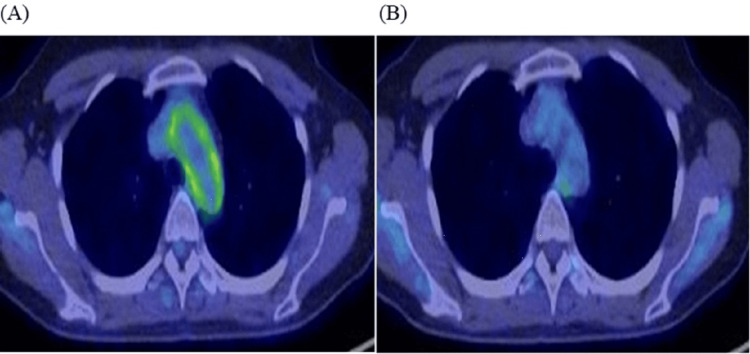 Figure 1
| Test Name | Result | Reference Range |
| Leukocytes | 3.2 × 10³/µL | 4.0–11.0 × 10³/µL |
| Hemoglobin | 11.7 g/dL | 12-16 g/dL |
| Platelets | 219 × 10³/µL | 150–450 × 10³/µL |
| CRP | 0.5 mg/dL | 0-0.14 mg/dL |
| ESR | 47 mm | 0-15 mm |
| TPHA | 125562 T.U. | 0-9.99 T.U. |
| RPR | 2000 R.U. | 0-0.99 R.U. |
| HIV antibody test | Negative | Negative |
Peer Reviews
No public reviews on file for this paper yet. If you reviewed it on a platform where reviews are public (OpenReview, ICLR, NeurIPS, ICML), you can paste yours below so the community can read it here.
Videos
No videos yet. Explain this paper in a talk, walkthrough, or lecture? Add one.
Taxonomy
TopicsSyphilis Diagnosis and Treatment · Vasculitis and related conditions · Eosinophilic Disorders and Syndromes
Introduction
Syphilis, caused by Treponema pallidum, shows a range of symptoms throughout its different stages. Uncomplicated syphilitic aortitis can occur in 70-80% of untreated cases, with complications including aortic regurgitation, coronary ostial stenosis, and aortic aneurysms occurring in 10%; aneurysms may form over 15-30 years [1,2], though in the era of effective antibiotic therapy, syphilitic aortitis has become an exceptionally rare clinical entity [3]. After the introduction of penicillin, the incidence of syphilis across all stages in the United States decreased by approximately 95% between 1943 and 2000 [4], but aortitis caused by syphilis can be fatal and should therefore be diagnosed at an early stage. This case presentation refers to the importance of considering syphilis in the differential diagnosis of aortitis even in the absence of typical late-stage manifestations and demonstrates the utility of imaging modalities in monitoring treatment response.
Case presentation
A 35-year-old woman underwent a regular Fluorine-18 fluorodeoxyglucose (18F-FDG) PET/CT scan after surgery for breast cancer. The 18F-FDG PET/CT scan performed one month prior to presenting at our institution showed increased metabolic activity (SUV max 3.8) in the ascending aortic wall (Figure 1A). She had no symptoms, including fever, malaria, or loss of body weight, and no symptoms suggestive of cardiovascular involvement, such as chest pain, dyspnea, or palpitations. Blood examinations showed a slight leukopenia and C-reactive protein (CRP) level of 0.5 mg/dL, and the erythrocyte sedimentation rate (ESR) is also elevated at 47 mm/hour. Based on the findings of 18F-FDG PET/CT, we suspected the possibility of Takayasu's disease. However, serological tests for syphilis were positive, with rapid plasma reagin (RPR) at 2000 R.U. and Treponema pallidum hemagglutination assay (TPHA) at 125562 T.U. (Table 1), suggesting active syphilitic vasculitis. HIV antibody screening was performed and found to be non-reactive. She was treated for one month with amoxicillin and probenecid. After six months of treatment, uptake of the aortic arch on 18F-FDG PET/CT had disappeared (Figure 1B), and one year later, RPR quantification had decreased to 287 R.U. Finally, we diagnosed her as having syphilitic aortitis.
18F-FDG PET/CT scan findingsA: showed increased metabolic activity in the ascending aortic wall; B: after six months of treatment, the 18F-FDG PET/CT scan showed that aortic arch uptake had disappeared.18F-FDG: Fluorine-18 fluorodeoxyglucose
Discussion
Syphilis, caused by Treponema pallidum, shows a variety of symptoms at various stages. Syphilitic aortitis is a known complication of tertiary syphilis and can cause aneurysm of the aorta [5]. Although this condition has been rare due to the widespread use of antimicrobial agents, aortitis caused by syphilis can be fatal and should therefore be diagnosed at an early stage [3]. The differential diagnosis of aortitis encompasses both infectious etiologies, most commonly involving Salmonella, Staphylococcus, or Streptococcus species, and non-infectious conditions, such as vasculitis of the great vessels (including giant cell arteritis and Takayasu arteritis), IgG4-related disease, and aortitis secondary to systemic inflammatory disorders [6]. It is important to include syphilis in the differential diagnosis when aortitis is observed. Several case reports have described accumulation observed in the aortic arch by 18F-FDG PET/CT, leading to a diagnosis of syphilitic aortitis, with some cases undergoing 18F-FDG PET/CT for treatment assessment; however, such cases remain exceedingly rare [5,7-10]. It is important to include syphilis in the differential diagnosis when aortitis is observed. In our literature search, several cases of syphilitic arteritis diagnosed by PET/CT have been reported to date [5,7-11], and to our knowledge, this is the first documented case in which the condition was incidentally detected in an asymptomatic, non-HIV-infected patient. Performing an 18F-FDG PET/CT scan may allow the early diagnosis of syphilitic aortitis at a subclinical stage and prevent life-threatening or fatal outcomes [7,11].
Conclusions
This case presentation refers to the importance of considering syphilis in the differential diagnosis of aortitis even in the absence of typical late-stage manifestations. It demonstrates the utility of imaging modalities in monitoring treatment response. Therefore, the sensitivity, specificity, and practical application of 18F-FDG PET/CT scans in both the diagnosis and monitoring of syphilitic aortitis require further evaluation.
The reference list from the paper itself. Each links out to its DOI / PubMed record.
- 1Syphilitic aortitis and ostial coronary stenosis treated by endarterectomy, bypass grafting and aortic valve replacement: a case report AME Case Rep Shavonne Ki Fung Ip Kevin Lim Randolph Hung Leung Wong 721729152023 https://pubmed.ncbi.nlm.nih.gov/37122961/10.21037/acr-22-32PMC 1013067937122961 · doi ↗ · pubmed ↗
- 2Syphilitic ostial coronary artery occlusion treated with percutaneous coronary intervention: case series and literature review Am Heart J Plus Baydoun Y Stukov Y Purlee MS 1003373620233851010210.1016/j.ahjo.2023.100337 PMC 10945892 · doi ↗ · pubmed ↗
- 3Syphilitic aortic aneurysm: a rare entity in the era of antibiotics Cureus Chaudhary F Faghihimehr A Subedi Y Hodanazari SM Yousaf MN 013202110.7759/cureus.13647 PMC 801273933824800 · doi ↗ · pubmed ↗
- 4Syphilis ascendant: a brief history and modern trends Trop Dis Travel Med Vaccines Willeford WG Bachmann LH 20220162888396410.1186/s 40794-016-0039-4PMC 5530970 · doi ↗ · pubmed ↗
- 5Syphilitic aortitis in secondary syphilis JAMA Dermatol Dietrich A Gauglitz GG Pfluger TT Herzinger T Braun-Falco M 79079115020142459927610.1001/jamadermatol.2013.9537 · doi ↗ · pubmed ↗
- 6Aortitis: recent advances, current concepts and future possibilities Heart Pugh D Grayson P Basu N Dhaun N 1620162910720213359399510.1136/heartjnl-2020-318085 · doi ↗ · pubmed ↗
- 7Usefulness of (18)F-FDG PET/CT in disease extent and treatment response assessment in a patient with syphilitic aortitis Clin Nucl Med Treglia G Taralli S Maggi F Coli A Lauriola L Giordano A 0738201310.1097/RLU.0b 013e 3182638 e 6523143047 · doi ↗ · pubmed ↗
- 8Probable syphilitic aortitis documented by positron emission tomography Sex Transm Dis Joseph Davey D Acosta Ldel R Gupta P Konda KA Caceres CF Klausner JD 1992004320162685980810.1097/OLQ.0000000000000411 PMC 4748391 · doi ↗ · pubmed ↗