Synthetic study toward vibralactone
Liang Shi, Jiayi Song, Yiqing Li, Jia-Chen Li, Shuqi Li, Li Ren, Zhi-Yun Liu, Hong-Dong Hao

TL;DR
This paper describes a new synthetic approach to create vibralactone, a compound that inhibits pancreatic lipase.
Contribution
A novel method for synthesizing an all-carbon quaternary center in vibralactone is introduced.
Findings
The all-carbon quaternary center in vibralactone was successfully synthesized.
Intramolecular alkylidene carbene C–H insertion was used to form the cyclopentene ring.
Abstract
A synthetic study toward vibralactone, a potent inhibitor of pancreatic lipase, is reported. The synthesis of the challenging all-carbon quaternary center within the cyclopentene ring was achieved through intramolecular alkylidene carbene C–H insertion.
Genes, proteins, chemicals, diseases, species, mutations and cell lines named across the full text — each resolved to its canonical identifier and authoritative record.
Click any figure to enlarge with its caption.
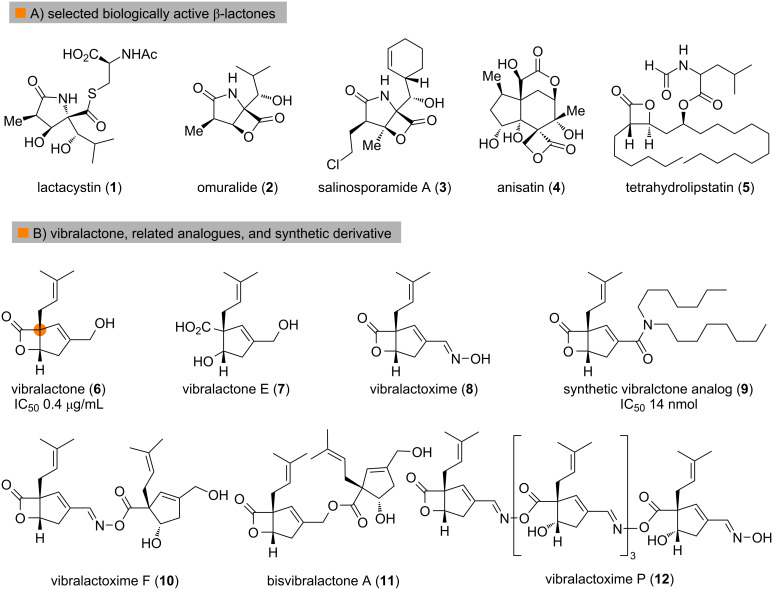 Figure 1
 Scheme 1
 Scheme 2
 Scheme 3
 Scheme 4
 Scheme 5
- —Natural Science Basic Research Program of Shaanxi Provincehttps://doi.org/10.13039/501100017596
- —Qin Chuangyuan Innovation and Entrepreneurship Talent Project
- —National Natural Science Foundation of Chinahttps://doi.org/10.13039/501100001809
Peer Reviews
No public reviews on file for this paper yet. If you reviewed it on a platform where reviews are public (OpenReview, ICLR, NeurIPS, ICML), you can paste yours below so the community can read it here.
Videos
No videos yet. Explain this paper in a talk, walkthrough, or lecture? Add one.
Taxonomy
TopicsPharmacological Receptor Mechanisms and Effects · Cyclopropane Reaction Mechanisms · Pharmacology and Obesity Treatment
Introduction
β-Lactones have attracted continuous interest and have been widely utilized as key intermediates in the synthesis of natural products and polymers due to their innate ring strain [1–6]. Moreover, several natural products and their derivatives containing β-lactone as key structural moiety have been isolated and demonstrate potent bioactivities [7] (Figure 1). For example, lactacystin (1) which was isolated by Ōmura and co-workers [8–9], is a potent and selective proteasome inhibitor; its active form is the synthetic precursor omuralide (2) [10–11]. Similarly, salinosporamide (3), a marine natural product isolated by Fenical and co-workers [12], also acts as a proteasome inhibitor and displays more potent in vitro cytotoxicity than omuralide (2). Anisatin (4), which contains a characteristic spiro β-lactone has been identified as a noncompetitive antagonist of GABA-gated ion channels [13]. Tetrahydrolipstatin (5) is a potent pancreatic lipase inhibitor and has been developed into an antiobesity drug marketed under the generic name Orlistat. Vibralactone (6), which was isolated by Liu and co-workers from Basidiomycete Boreostereum vibrans, features a fused β-lactone with a cyclopentene ring containing an all-carbon quaternary center [14], and inhibits pancreatic lipase with an IC_50_ of 0.4 µg/mL. Several congeners with varying oxidation state, as well as related β-hydroxy acids or esters have also been isolated from the culture broth of the basidiomycete [15–21]. Additionally, a series of vibralactone homodimers and oxime esters 10–12 were reported by the groups of Liu and Zhang, respectively [22–23]. Through modification of the primary hydroxy group, a structure-based optimization of vibralactone (6) was carried out by Liu and co-workers and yielded several potent pancreatic lipase inhibitors with nanomolar IC_50_ values [24], further supporting vibralactone as a promising lead compound warranting further investigation.
Selected representative natural products and derivatives with β-lactone moiety.
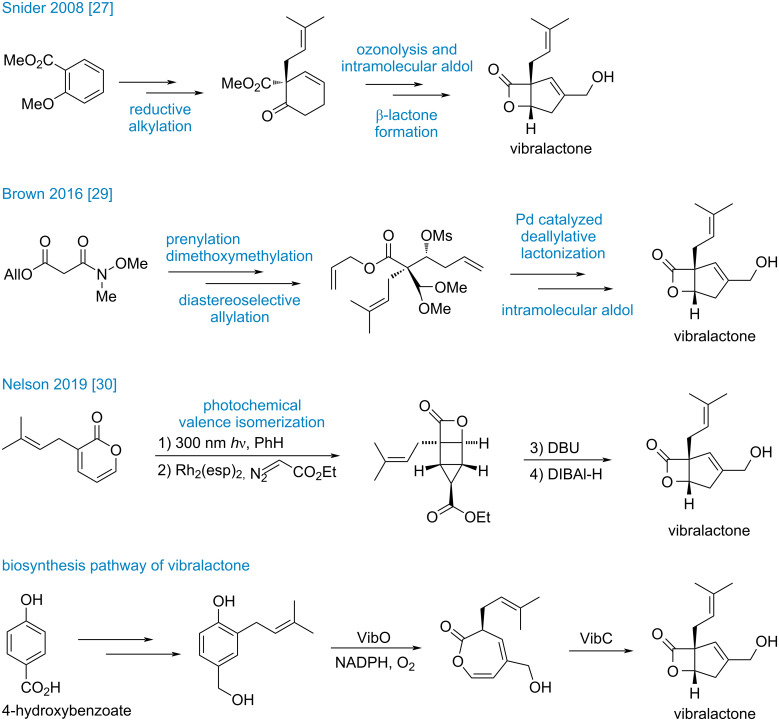
Although vibralactone (6) is a relatively small natural product, its molecular structure features a unique 4/5-fused bicyclic β-lactone with an all-carbon quaternary center and two trisubstituted olefin moieties. It is therefore not surprising that this compound has attracted considerable interest from both the chemical biology and synthetic chemistry communities. Sieber and co-workers disclosed that vibralactone can target ClpP1 and ClpP2 and it could be utilized as a probe to study the activity and structure of the ClpP1P2 complex from Listeria monocytogenes [25]. Previously, Snider and co-worker reported the first total synthesis of vibralactone (6) employing Birch reductive alkylation, intramolecular aldol reaction and late-stage lactonization as key steps [26] (Scheme 1). Subsequently, they achieved the asymmetric synthesis of vibralactone (6) based on the asymmetric Birch reduction–alkylation methodology developed by the Schultz group [27–28]. In 2016, Brown and co-workers described an efficient synthetic route featuring a novel Pd-catalyzed β-lactone formation [29]. In addition to these approaches, Nelson and co-workers reported a very concise and impressive total synthesis of vibralactone involving photochemical valence isomerization of substituted pyrone, cyclopropanation, and ring expansion [30]. Zeng, Liu and co-workers investigated the biosynthetic pathway of vibralactone (6). They established that 4-hydroxybenzoate serves as the direct ring precursor of vibralactone and the β-lactone moiety was formed via vibralactone cyclase (VibC)-catalyzed cyclization [31–34]. This is a fascinating cyclization as the all-carbon quaternary center is formed in the last step. Given that the β-lactone moiety may act as a potential covalent inhibitor toward target proteins and that the sterically congested bicyclic skeleton presents a significant synthetic challenge, we herein report our synthetic study toward vibralactone.
Previous syntheses of vibralactone (6).
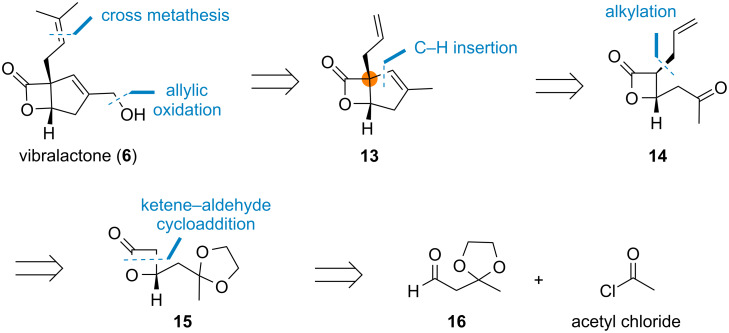
Impressed by the unexpected biosynthetic pathway, our synthetic strategy also aimed to construct the quaternary center in the late stage. The retrosynthetic analysis of vibralactone (6) is descripted in Scheme 2. Initially, we proposed that vibralactone could be synthesized from lactone 13 through allylic oxidation and cross metathesis. For the construction of the cyclopentene ring, an alkylidene carbene-mediated C–H insertion would be applied [35]. The synthetic route could be traced back to β-lactone 14, which contains two continuous stereogenic centers with trans configuration. This intermediate was intended to be prepared through allylation [36] with its precursor 15 accessible from aldehyde 16 and acetyl chloride through ketene–aldehyde [2 + 2] cycloaddition [37].
Retrosynthetic analysis of vibralactone (6).
Results and Discussion
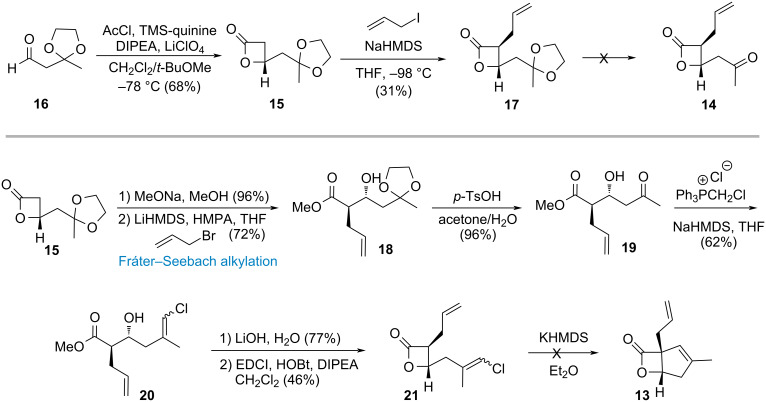
Our synthetic route commenced from the known aldehyde 16 which is readily accessed in a single step from commercially available fructone [38] (Scheme 3). Following an efficient O-trimethylsilylquinine-catalyzed ketene–aldehyde cycloaddition and subsequent alkylation [36], 17 was synthesized. From 17, it was envisioned that the bicyclic skeleton could be efficiently constructed through ketal deprotection followed by C–H insertion. However, when attempting to remove the ketal protecting group, only decomposition of the starting material was observed. A plausible explanation for this outcome is that the β-lactone ring, located at the β-position of the methyl ketone, may undergo facile β-elimination, although the corresponding enone product was not isolated. Facing a dead-end, the synthetic route to precursor 14 needed to be revised. From 15, after sodium methoxide-mediated ring opening of lactone, the Fráter–Seebach alkylation [39–41] was applied to afford β-hydroxy ester 18. At this stage, the ketal moiety was removed and the resulting intermediate underwent Wittig olefination to yield vinyl chloride 20. Subsequent hydrolysis and intramolecular esterification furnished intermediate 21, which was then subjected to C–H insertion [42–44]. To our disappointment, this ring closure still did not proceed to form the all-carbon quaternary center and only decomposition of 21 was observed. The failure is likely due to the sterically hindered environment of the substituted β-lactone ring which precludes the C–H insertion or deprotonation of the β-lactone and interrupted the generation of the alkylidene carbene. Therefore, we modified the synthetic sequence and opted to construct the five-membered ring prior to β-lactone formation, identifying intermediate 19 as a potentially suitable precursor.
Synthetic study toward vibralactone (6) in the present of β-lactone.
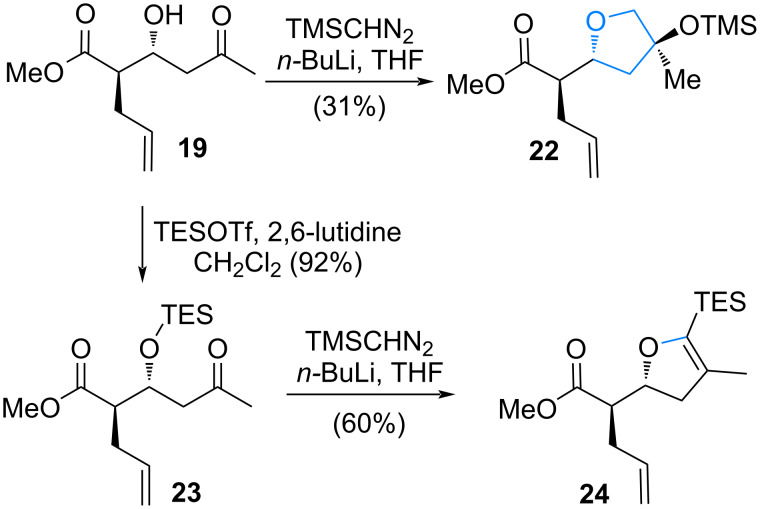
From 19, after treatment with lithiotrimethylsilyldiazomethane [45], only tetrahydrofuran 22 was isolated via a formal [4 + 1] annulation pathway [46] (Scheme 4). Since the hydroxy group interrupted the C–H insertion, it was protected as the TES ether 23 and subjected to the same conditions. However, the reaction only afforded the C–Si insertion product 24 [47].
C–H insertion utilizing linear precursor 19.
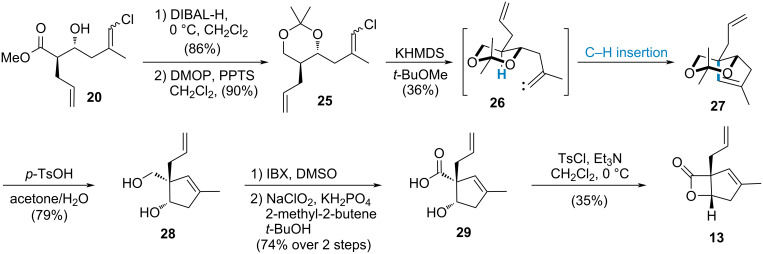
Based on the above results, although the β-lactone was converted into the linear methyl ester 19 to decrease the potential steric hinderance associated with the fused bicyclic skeleton, substrates containing a free hydroxy group or the corresponding TES ether still failed to close the cyclopentene ring. In this scenario, it was necessary to explore additional protecting groups for the hydroxy functionality. Furthermore, given that alkylidene carbenes are electron-deficient and highly electrophilic, electron-rich C–H bonds are more prone to undergo C–H insertion [48]. Following this analysis, commencing from 20, after reduction, the 1,3-diol intermediate was transformed into acetonide 25 (Scheme 5). Subsequently, the desired five-membered ring was successfully constructed through the in situ-generated alkylidene carbene 26 followed by C–H insertion; herein lies a significant electronic effect influencing this crucial step. With this key intermediate in hand, β-hydroxy acid 29 was synthesized through deprotection, IBX oxidation, and Pinnick–Lindgren–Kraus oxidation and the β-lactone 13 was subsequently obtained through activation of the carboxylic acid. Although we successfully constructed the molecular scaffold of vibralactone (6), however, the need to open, reduce, oxidize, and reform the β-lactone lengthened the route beyond initial expectations. Currently an alternative approach towards synthesizing compound 25 is actively being pursued with aims to streamline the overall synthesis.
Construction the bicyclic skeleton of vibralactone (6) through C–H insertion.
Conclusion
In summary, we have developed an approach to assemble the bicyclic skeleton of vibralactone (6) utilizing an intramolecular alkylidene carbene C–H insertion as key step. The insights gained from this study illustrate how diverse reactivity patterns and electrophilic characteristics of alkylidene carbenes influence ring closure outcomes. As intermediate 13 may serve as a valuable precursor to vibralactone (6) and other congeners such as vibralactone E (7), an alternative synthetic route toward 13 is currently being carried out in our laboratory and will be reported in due course.
Supporting Information
File 1Characterization data and ^1^H NMR, ^13^C NMR spectra of the compounds.
The reference list from the paper itself. Each links out to its DOI / PubMed record.
- 1Wang X Wang Z Ma X Huang Z Sun K Gao X Fu S Liu B Angew Chem, Int Ed 202261 e 20220025810.1002/anie.20220025835102682 · doi ↗ · pubmed ↗
- 2Guo Z Bao R Li Y Li Y Zhang J Tang Y Angew Chem, Int Ed 202160145451455310.1002/anie.20210261433848039 · doi ↗ · pubmed ↗
- 3Leverett C A Purohit V C Johnson A G Davis R L Tantillo D J Romo D J Am Chem Soc 2012134133481335610.1021/ja 303414 a 22853802 · doi ↗ · pubmed ↗
- 4Fukuyama T Xu L J Am Chem Soc 19931158449845010.1021/ja 00071 a 065 · doi ↗
- 5Young M S La Pointe A M Mac Millan S N Coates G W J Am Chem Soc 2024146180321804010.1021/jacs.4c 0471638874569 · doi ↗ · pubmed ↗
- 6Tian J-J Li R Quinn E C Nam J Chokkapu E R Zhang Z Zhou L Gowda R R Chen E Y-X Nature 202564396797410.1038/s 41586-025-09220-740604271 · doi ↗ · pubmed ↗
- 7Robinson S L Christenson J K Wackett L P Nat Prod Rep 20193645847510.1039/c 8np 00052 b 30191940 · doi ↗ · pubmed ↗
- 8Ōmura S Fujimoto T Otoguro K Matsuzaki K Moriguchi R Tanaka H Sasaki Y J Antibiot 19914411311610.7164/antibiotics.44.1131848215 · doi ↗ · pubmed ↗