Development of a quantitative job exposure matrix for standing, walking, and forward bending among pregnant workers – The PRECISE JEM
Hannah Nørtoft Frankel, Esben Meulengracht Flachs, Camilla Sandal Sejbaek, Jonathan Aavang Petersen, Jens Peter Bonde, Ingrid Sivesind Mehlum, Mette Korshøj, Susan Peters, Magnus Svartengren, Pasan Hettiarachchi, Peter J Johansson, Alex Burdorf, Luise Mølenberg Begtrup

TL;DR
This paper creates a detailed job exposure matrix to assess physical activity levels in pregnant workers, aiming to improve understanding of how occupational activities affect pregnancy outcomes.
Contribution
The study introduces a trimester-specific job exposure matrix for standing, walking, and forward bending among pregnant workers using objective measurements.
Findings
The JEM estimates exposure levels for 1171 job codes using accelerometer data and mixed-effects models.
Bakers had the highest standing exposure, while waiters and livestock producers had the highest walking and forward bending exposure, respectively.
Trimester-specific adjustments showed reduced standing time in the third trimester compared to non-pregnant workers.
Abstract
Occupational physical activity (OPA) during pregnancy has been linked to adverse pregnancy outcomes, but crude exposure assessment remains an issue in causal inference. We aimed to develop a quantitative trimester-specific job exposure matrix (JEM) for standing, walking, and forward bending among pregnant workers. Accelerometer measurements from 403 female workers across 109 DISCO-08 job codes were obtained in Denmark between January 2023 and June 2024. Full workdays were measured during two weeks among pregnant workers and one week among non-pregnant workers. We used linear mixed-effects models to estimate exposure levels of occupational standing, walking, and forward bending for all 1171 DISCO-08 codes, including age, trimester, and expert ratings as fixed effects, and job codes and workers as random effects. The between-job variances relative to total variances were 56% for…
Genes, proteins, chemicals, diseases, species, mutations and cell lines named across the full text — each resolved to its canonical identifier and authoritative record.
Click any figure to enlarge with its caption.
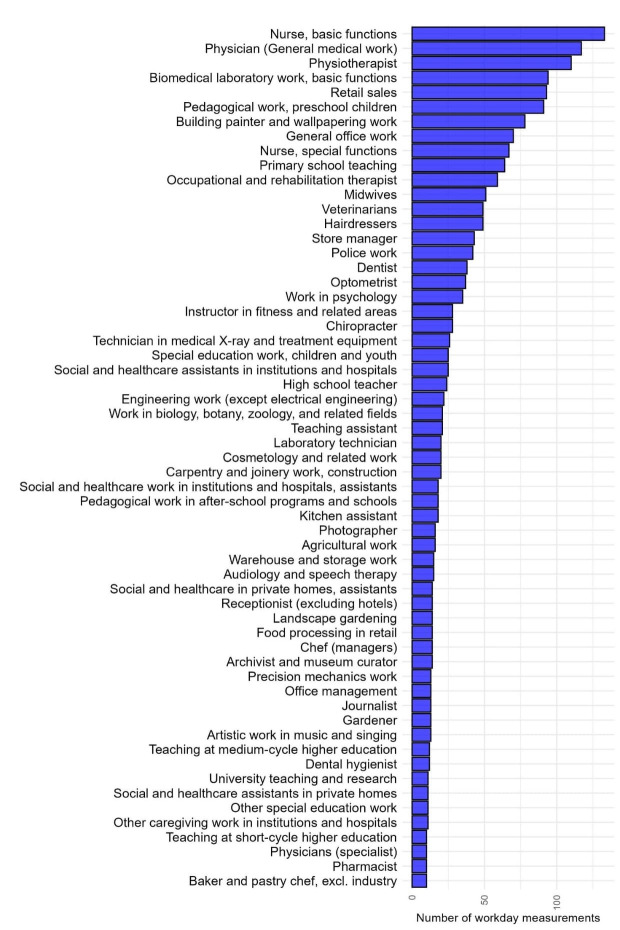 Figure 1
Peer Reviews
No public reviews on file for this paper yet. If you reviewed it on a platform where reviews are public (OpenReview, ICLR, NeurIPS, ICML), you can paste yours below so the community can read it here.
Videos
No videos yet. Explain this paper in a talk, walkthrough, or lecture? Add one.
Taxonomy
TopicsPregnancy-related medical research · Occupational Health and Performance