NaHMDS/B(C6F5)3-promoted diastereoselective Friedel–Crafts alkylation of indoles/pyrroles with N-tert-butanesulfinylimines: towards the asymmetric synthesis of bisindole alkaloid Calcicamide B
Guangshuai Zhang, Xin Chen, Yan Liu, Rui Peng, Mengwei Xu, Si Yan, Jin Xiao, Zishu Liu, Qing Min, Gang Liao, Xiaoji Wang, Shuanglin Qin

TL;DR
The paper introduces a new method for asymmetric Friedel–Crafts alkylation to synthesize chiral compounds, including the anti-tumor alkaloid Calcicamide B.
Contribution
A novel diastereoselective Friedel–Crafts alkylation method using NaHMDS/B(C6F5)3 and chiral imines for asymmetric synthesis.
Findings
Enantioenriched α-(3-indolyl)glycine and α-(2-pyrrolyl)glycine derivatives were effectively produced.
The method enabled the first asymmetric total synthesis of the bisindole alkaloid Calcicamide B.
Abstract
This study proposed an innovative and pragmatic approach to the asymmetric Friedel–Crafts reaction by employing indoles/pyrroles and chiral N-tert-butanesulfinylimines promoted by NaHMDS/B(C6F5)3. This method effectively produces enantioenriched α-(3-indolyl)glycine and α-(2-pyrrolyl)glycine derivatives, which can be readily transformed into the crucial chiral diamine skeletons. The first successful asymmetric total synthesis of marine-derived anti-tumor bisindole alkaloid Calcicamide B was achieved by employing this reaction as a crucial chiral control step. This study proposed an innovative and pragmatic approach to the asymmetric Friedel–Crafts reaction by employing indoles/pyrroles and chiral N-tert-butanesulfinylimines promoted by NaHMDS/B(C6F5)3.
Genes, proteins, chemicals, diseases, species, mutations and cell lines named across the full text — each resolved to its canonical identifier and authoritative record.
Click any figure to enlarge with its caption.
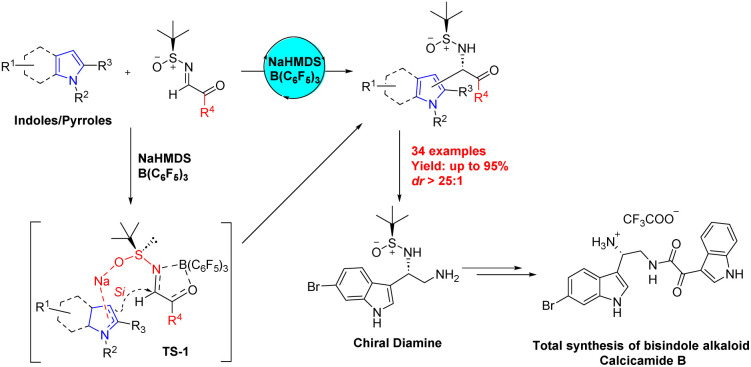 Scheme 1
 Scheme 2
 Scheme 3
|
| ||||||
|---|---|---|---|---|---|---|
| Entry | Catalyst (mol%) | Base (mol%) | Solvent | Temp. | Yield | dr |
| 1 | BF3·Et2O(15) | — | MeCN | r.t. | 36 | 5 : 1 |
| 2 | Cu(OTf)2(15) | — | MeCN | r.t. | 66 | 15 : 1 |
| 3 | AlCl3(15) | — | MeCN | r.t. | 0 | n.d. |
| 4 | B(C6F5)3(15) | — | MeCN | r.t. | 79 | 16 : 1 |
| 5 | B(C6F5)3(15) | NaHMDS(100) | MeCN | r.t. | 83 | >25 : 1 |
| 6 | B(C6F5)3(15) | LiHMDS(100) | MeCN | r.t. | 80 | 17 : 1 |
| 7 | B(C6F5)3(15) | KHMDS(100) | MeCN | r.t. | 81 | >25 : 1 |
| 8 | B(C6F5)3(15) |
| MeCN | r.t. | 73 | >25 : 1 |
| 9 | — | NaHMDS(100) | MeCN | r.t. | 0 | n.d. |
| 10 | B(C6F5)3(15) | NaHMDS(100) | DMF | r.t. | 72 | >25 : 1 |
| 11 | B(C6F5)3(15) | NaHMDS(100) | THF | r.t. | 65 | >25 : 1 |
| 12 | B(C6F5)3(15) | NaHMDS(100) | MeOH | r.t. | 66 | 10 : 1 |
| 13 | B(C6F5)3(15) | NaHMDS(100) | EtOH | r.t. | 63 | 12 : 1 |
| 14 | B(C6F5)3(15) | NaHMDS(100) | DMSO | r.t. | 82 | 7 : 1 |
| 15 | B(C6F5)3(15) | NaHMDS(100) | Acetone | r.t. | 70 | 15 : 1 |
| 16 | B(C6F5)3(15) | NaHMDS(100) | MeCN | 50 °C | 79 | >25 : 1 |
| 17 | B(C6F5)3(15) | NaHMDS(100) | MeCN | 0 °C | 85 | >25 : 1 |
| 18 | B(C6F5)3(15) | NaHMDS(100) | MeCN | −20 °C | 80 | >25 : 1 |
| 19 | B(C6F5)3(12) | NaHMDS(100) | MeCN | 0 °C | 86 | >25 : 1 |
| 20 | B(C6F5)3(10) | NaHMDS(100) | MeCN | 0 °C | 81 | >25 : 1 |
| 21 | B(C6F5)3(5) | NaHMDS(100) | MeCN | 0 °C | 79 | >25 : 1 |
| 22 | B(C6F5)3(12) | NaBF4(100) | MeCN | 0 °C | 82 | >25 : 1 |
| 23 | B(C6F5)3(12) |
| MeCN | 0 °C | 80 | >25 : 1 |
|
|
|
|
|
|
- —National Natural Science Foundation of China10.13039/501100001809
- —China Postdoctoral Science Foundation10.13039/501100002858
- —Science Fund for Distinguished Young Scholars of Hunan Province10.13039/501100019092
- —Natural Science Foundation of Hunan Province10.13039/501100004735
Peer Reviews
No public reviews on file for this paper yet. If you reviewed it on a platform where reviews are public (OpenReview, ICLR, NeurIPS, ICML), you can paste yours below so the community can read it here.
Videos
No videos yet. Explain this paper in a talk, walkthrough, or lecture? Add one.
Taxonomy
TopicsSynthesis of Indole Derivatives · Asymmetric Synthesis and Catalysis · Marine Sponges and Natural Products
Introduction
Indoles and pyrroles, key members of the nitrogen heterocycles, have garnered considerable interest in the realms of medicinal, synthetic, and natural product chemistry due to their extensive bioactivity spectrum.^1–6^ These compounds have been integral to pharmaceutical science since its inception, especially in the realm of drug development. The current focus in this field lies on optically active non-proteinogenic amino acids, renowned for their significant biological functions and their role in organic synthesis and pioneering drug discovery. Particularly, α-(3-indolyl)glycine and α-(2-pyrrolyl)glycine, along with their variants, are prevalent in a myriad of biologically relevant natural and synthetic products, drawing substantial scientific interest.^7–9^ This has led to a focused effort towards developing stereoselective methods for their production.^10–12^ Typically, the asymmetric Friedel–Crafts interaction of indoles/pyrroles with glyoxylate imines is considered the most straightforward and accessible method, considering the ease of obtaining reactants.^13–15^ Nevertheless, there is a scarcity of techniques with wide substrate adaptability that efficiently produce these compounds in a highly enantioenriched form. The challenges in using unprotected indole substrates, controlling reaction stereoselectivity, and removing amine N-substituents are under active investigation. Boron catalysis has recently emerged as a focal point, especially since the advent of frustrated Lewis pairs (FLPs) in metal-free catalysis and the activation of small molecules.^16,17^ Among boron-based catalysts, B(C_6_F_5_)3 has received much attention owing to its highly electrophilic but sterically protected nature, and has the ability to reversibly bond with oxygen or nitrogen.^18–25^ In this vein, we present a novel and practical asymmetric Friedel–Crafts reaction using indoles/pyrroles and chiral N-tert-butanesulfinimines under NaHMDS/B(C_6_F_5_)3 promotion. This method efficiently yields enantioenriched α-(3-indolyl)glycines and α-(2-pyrrolyl)glycines. Utilizing this reaction as a pivotal step in chiral control, we have successfully accomplished the first asymmetric total synthesis of marine-derived anti-tumor bisindole alkaloid Calcicamide B^26,27^ (Scheme 1).
Overview.
Results and discussion
Initially, Friedel–Crafts reaction of simple indole (1a) with (S,E)-N-benzyl-2-((tert-butylsulfinyl)imino)acetamide (2a) was conducted in the presence of different Lewis acids including BF_3_·Et_2_O, Cu(OTf)2, AlCl_3_, and B(C_6_F_5_)3 at room temperature (Table 1, Entries 1–4). Despite the lack of satisfactory results, B(C_6_F_5_)3 served as the most effective catalyst for synthesizing product 3, yielding 79% with a diastereomeric ratio (dr) of 16 : 1 (Table 1, Entry 4). Inspired by the authors' previous research,^28,29^ bases containing alkali metal ions, such as NaHMDS, LiHMDS, KHMDS, and t-BuOK, were introduced into the reaction (Table 1, Entries 5–8). Fortunately, NaHMDS resulted in a higher yield (83%) and enhanced diastereoselectivity (dr > 25 : 1) (Table 1, Entry 5). However, when no catalyst is added to the reaction, the reaction cannot be carried out (Table 1, Entry 9). Various solvents were examined (Table 1, Entries 11–15), revealing that the diastereoselectivity and yields of product 3 were typically low in protic solvents (Table 1, Entries 12 and 13). Additionally, it was observed that no solvent outperformed MeCN (Table 1, Entry 8). Further testing in MeCN at different temperatures revealed that both high (Table 1, Entry 16) and low temperatures (Table 1, Entry 18) were unfavorable, with the optimal yield achieved at 0 °C (Table 1, Entry 17), maintaining high diastereoselectivity (dr > 25 : 1). Variations in the equivalents of B(C_6_F_5_)3 (Table 1, Entries 19–21) indicated that the most effective catalyst amount was 0.12 equivalents (Table 1, Entry 19). In summary, the conditions outlined in Entry 19 of Table 1 were optimal. Under these conditions, the reaction was completed in 3 hours, yielding 3 with an 86% yield and high diastereoselectivity (dr > 25 : 1). Other sodium salts were also used in the reaction, showing high yield and high stereoselectivity (dr > 25 : 1) (Table 1, Entries 22 and 23).
The studies of Friedel–Crafts reaction conditions indicated that the reaction could be further investigated in terms of substrate scope, covering various indoles/pyrroles with different N-tert-butanesulfinylimines.
As depicted in Table 2, we first screened the different indole substrates. We found that electron-donating group substitution on indole promoted the reaction (4–6), while electron-withdrawing groups on indole reduced the reaction yield (7, 8). Using indoles with halogens as substituents on the benzenic ring, the reaction could proceed well (9–13, yield 79–88%, dr > 25 : 1). Methyl substitution at position 2 of indole did not affect yield and stereoselectivity (14). Indeed, an electron-donating group (e.g. methyl, phenyl) on the nitrogen atom of indole resulted in a good reaction results (15–16, yield 82–93%, dr > 25 : 1), but when there were electron-withdrawing substitutions (e.g. TS, Boc) on the nitrogen atom of indole, the reaction failed to proceed (17, 18).
Subsequently, this study focused on investigating the applicability of the novel Friedel–Crafts reaction with various imines, as detailed in Table 3. To facilitate comparative analysis, all reactions were performed under standardized conditions. The outcomes demonstrated that when the R groups of the substrates were aliphatic amines (19–24) and aromatic amines (25, 26), the reactions consistently yielded high efficiency (79–91%) and pronounced stereoselectivity (dr > 25 : 1).
Encouraged by above success, we extended our approach to include pyrroles as substrates (Table 4). The reactions using pyrroles as substrates demonstrated a similar trend to that observed with indole substrates (27–30). Reactions proceeded smoothly without substitution or with electron-donating groups on the nitrogen atom of pyrrole, yielding high stereoselectivity and high yield (27–29). Conversely, the presence of an electron-withdrawing group on the nitrogen atom of pyrrole hindered the reaction (30).
Fortunately, under standard conditions, we utilized pyrrole as a substrate and reacted it with a range of chiral imines (Table 4), R groups including aliphatic amines (31–37) and aromatic amines (38–39) to synthesize a series of α-(2-pyrrolyl)glycine derivatives, achieving high yields and pronounced stereoselectivity. These outcomes demonstrate the versatility and general applicability of the reaction conditions.
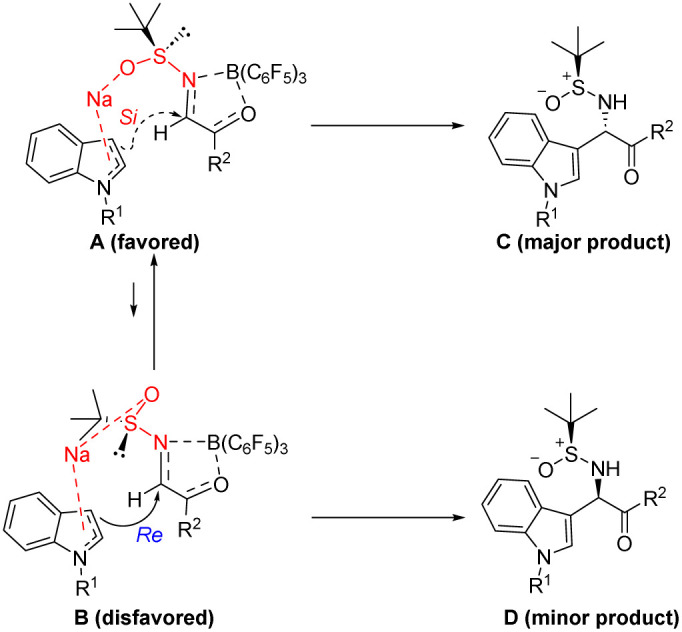
Based on prior studies and literature,^28–31^Scheme 2 elucidates the proposed mechanism. Here, B(C_6_F_5_)3 coordinates with the imine nitrogen and carbonyl oxygen. This configuration promotes the transition state A, with the N-sulfinyl group adopting a synperiplanar (s-cis) conformation.^32–36^ The Na^+^ coordinate with the oxygen of the N-sulfinyl group, while the indole coordinate with Na^+^ by p-π activation of the delocalized π bond, thereby enhancing the reaction's stereoselectivity.^37–40^ Specifically, with (S)-N-tert-butylsulfinyl substrates, indole attacks from the less hindered Si-side of the C
<svg xmlns="http://www.w3.org/2000/svg" version="1.0" width="13.200000pt" height="16.000000pt" viewBox="0 0 13.200000 16.000000" preserveAspectRatio="xMidYMid meet"><metadata> Created by potrace 1.16, written by Peter Selinger 2001-2019 </metadata><g transform="translate(1.000000,15.000000) scale(0.017500,-0.017500)" fill="currentColor" stroke="none"><path d="M0 440 l0 -40 320 0 320 0 0 40 0 40 -320 0 -320 0 0 -40z M0 280 l0 -40 320 0 320 0 0 40 0 40 -320 0 -320 0 0 -40z"/></g></svg>
N bond, avoiding steric hindrance with the bulky tert-butyl group, resulting in the (S)-product C formation (Scheme 2).
Possible mechanism.
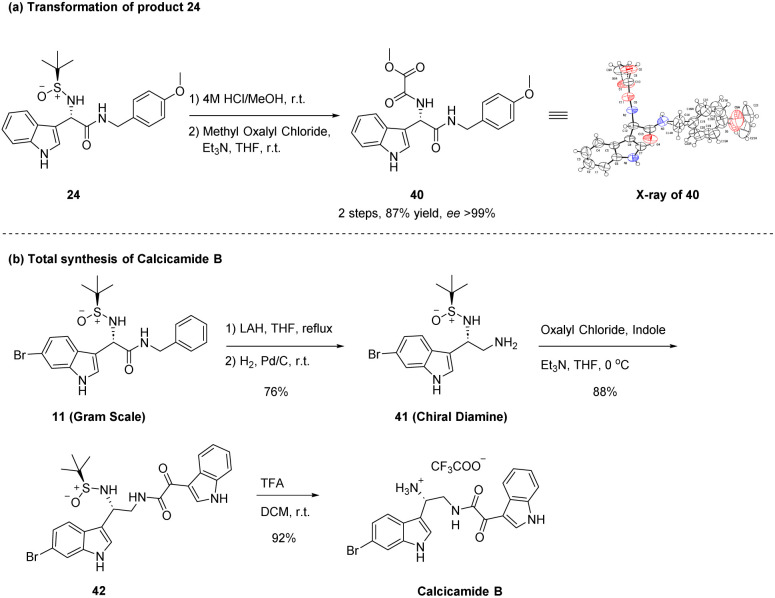
All of the above products from the Friedel–Crafts reaction, as described in [Tables 2–4](#tab2 tab3 tab4), were not crystalline. Therefore, we derivatized these products to yield compounds that could readily form single crystals. As illustrated in Scheme 3a, compound 24 underwent removal of the tert-butylsulfinyl group from its chiral nitrogen atom under acidic conditions, followed by a reaction with oxalyl methyl chloride in an alkaline environment to synthesize compound 40 (ee > 99%). Fortunately, we successfully obtained the single crystal structure of compound 40 (CCDC 2322830), confirming the stereoselectivity of this Friedel–Crafts reaction (Scheme 3a).
(a) Preparation of compound 40 from product 24. The ee value of 40 were determined by chiral HPLC. (b) Total synthesis of the bisindole alkaloid Calcicamide B.
It is noteworthy that α-(3-indolyl)glycines and α-(2-pyrrolyl)glycines synthesized by this asymmetric Friedel–Crafts reaction can be easily converted into chiral diamines, which are important intermediates in the synthesis of natural products and pharmaceuticals. To delve deeper into the feasibility of this Friedel–Crafts reaction, this study employed it as a crucial step in the chiral induction for the total synthesis of marine-derived anti-tumor bisindole alkaloid Calcicamide B. As illustrated in Scheme 3b, compound 11, which was successfully synthesized on a gram scale (Table 2), was reduced using LiAlH_4_, then benzyl group was removed to form chiral diamine 41. Indole upon reaction with oxalyl chloride and subsequent condensation with intermediate 41 could yield precursor 42, and subsequently, TFA-catalyzed hydrolysis was performed to remove the tert-butylsulfinyl group, resulting in anti-tumor bisindole alkaloid Calcicamide B (Scheme 3b).
Conclusions
In summary, we have developed a highly diastereoselective Friedel–Crafts alkylation for both protected and unprotected indoles/pyrroles using N-tert-butanesulfinylimines, directly yielding various enantioenriched α-(3-indolyl)glycine and α-(2-pyrrolyl)glycine derivatives. This reaction proceeds easily in the presence of NaHMDS/B(C_6_F_5_)3, achieving high yields and exhibiting excellent functional group tolerance. This method holds great potential for future applications of optically active α-(3-indolyl)glycine and α-(2-pyrrolyl)glycine derivatives in medicinal chemistry and organic synthesis. Furthermore, the crucial chiral diamine skeleton can be obtained through a straightforward conversion of the product derived from the reaction. Utilizing this reaction as a key chiral control step, we accomplished the first asymmetric total synthesis of marine-derived anti-tumor bisindole alkaloid Calcicamide B.
Author contributions
All authors have read and agreed to the published version of the manuscript. Conceptualization, G. Z. and X. C.; methodology, G. Z., X. C. and Y. L.; validation, R. P., M. X., S. Y., J. X., Z. L. and Q. M.; writing—original draft preparation, G. Z., X. C. and Y. L.; writing—review and editing, G. Z., G. L., X. W. and S. Q.; supervision, G. L., X. W. and S. Q.; funding acquisition, G. L., X. W. and S. Q.
Conflicts of interest
There are no conflicts to declare.
Supplementary Material
RA-015-D5RA06138E-s001
RA-015-D5RA06138E-s002
The reference list from the paper itself. Each links out to its DOI / PubMed record.
- 1Kochanowska-Karamyan A. J. Hamann M. T. Chem. Rev.20101104489449710.1021/cr 900211 p 20380420 PMC 2922063 · doi ↗ · pubmed ↗
- 2Shaveta Singh A. Kaur M. Sharma S. Bhatti R. Singh P. Eur. J. Med. Chem.20147718519210.1016/j.ejmech.2014.03.00324631898 · doi ↗ · pubmed ↗
- 3Singh T. P. Singh O. M. Mini Rev. Med. Chem.20171892510.2174/138955751766617080712320128782480 · doi ↗ · pubmed ↗
- 4Xu D. Xu Z. Curr. Top. Med. Chem.2020201938194910.2174/156802662066620062215032532568021 · doi ↗ · pubmed ↗
- 5Hirose Y. Sato S. Hashiya K. Bando T. Sugiyama H. J. Med. Chem.202366120591206810.1021/acs.jmedchem.3c 0061337606185 · doi ↗ · pubmed ↗
- 6Ahmed S. Mital A. Akhir A. Saxena D. Ahmad M. N. Dasgupta A. Chopra S. Jain R. Eur. J. Med. Chem.202326011575710.1016/j.ejmech.2023.11575737659197 · doi ↗ · pubmed ↗
- 7Kawasaki T. Enoki H. Matsumura K. Ohyama M. Inagawa M. Sakamoto M. Org. Lett.200023027302910.1021/ol 006394 g 10986099 · doi ↗ · pubmed ↗
- 8Silvestri R. MarfèG. Artico M. La Regina G. Lavecchia A. Novellino E. Morgante M. Di Stefano C. Catalano G. Filomeni G. Abruzzese E. Ciriolo M. R. Russo M. A. Amadori S. Cirilli R. La Torre F. Sinibaldi Salimei P. J. Med. Chem.2006495840584410.1021/jm 060271616970408 · doi ↗ · pubmed ↗