Specific auxin and medium combinations alter Saccharomyces cerevisiae growth
Neta Nnabuenyi, Morgan A Sands, Nicole J Camlin

TL;DR
This study shows that auxin and medium combinations affect yeast growth, suggesting the need for careful controls in experiments using auxin.
Contribution
The novel finding is that auxin affects yeast growth independently of the degradation system, depending on the medium.
Findings
Natural and synthetic auxin impair yeast growth in minimal but not rich media.
Auxin effects are observed regardless of the auxin-inducible degradation system's presence.
Proper controls are essential when using auxin-inducible degradation methods.
Abstract
Auxin-inducible degradation is an increasingly popular protein-targeting reverse genetics approach. Use of this method has revolutionized the types of questions cell and molecular biologists can answer, however, a growing number of studies point to auxin alone impacting different cellular phenotypes. This study investigated the impact of different medium and auxin combinations on Saccharomyces cerevisiae growth. We observed that both natural and synthetic auxin (Indole-3-acetic acid (IAA) and 1-Naphthaleneacetic acid (NAA) respectively) impaired budding yeast growth in nutrient minimal but not nutrient rich media. This finding was true across different yeast strains with or without an intact auxin-inducible degradation system. Ultimately, this study highlights the need for proper controls when using auxin-inducible degradation.
Genes, proteins, chemicals, diseases, species, mutations and cell lines named across the full text — each resolved to its canonical identifier and authoritative record.
Click any figure to enlarge with its caption.
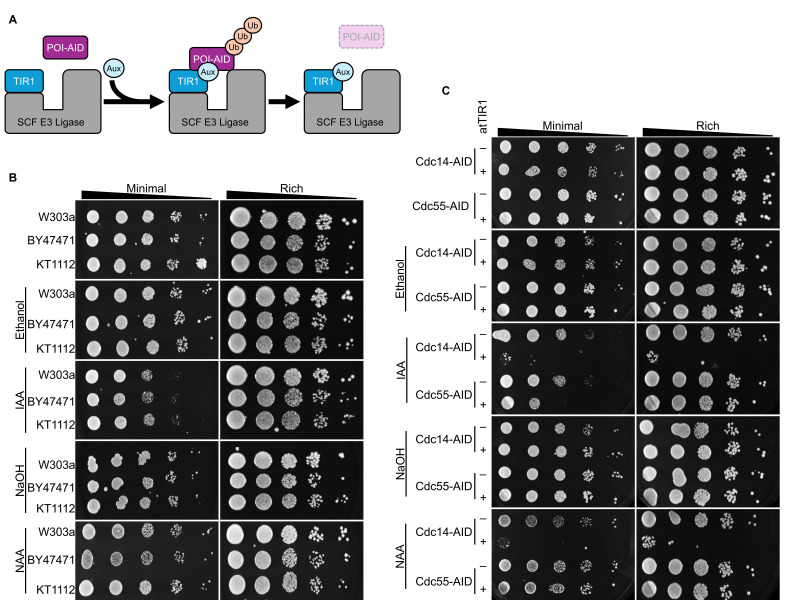 Figure 1
|
| ||
|
|
|
|
|
W303a |
|
Horizon Discovery - YSC1058 |
|
BY4741 |
|
Horizon Discovery - YSC1048 |
|
KT1112 |
|
Kelly Tatchell (Stuart et al., 1994) |
|
YKA890 |
W303
|
Mark Hall (Powers & Hall, 2017) |
|
YKA892 |
W303
|
Mark Hall (Powers & Hall, 2017) |
|
YKA1223 |
W303
|
Mark Hall |
|
YKA1229 |
W303
|
Mark Hall |
|
| ||
|
|
|
|
|
Yeast Extract |
Fisher Scientific |
BP1422 |
|
Peptone |
Fisher Scientific |
BP1420 |
|
Dextrose |
Fisher Scientific |
D16 |
|
Synthetic complete amino acid supplement w/o Yeast Nitrogen Base |
USBiological |
D9515 |
|
Yeast Nitrogen Base without Amino Acids |
Research Products International Corp |
Y20040 |
|
1-Naphthaleneacetic acid |
Sigma Aldrich |
N0640 |
|
Indole-3-acetic acid |
Gold Biotechnology |
I-110-25 |
|
Agar, Powder |
Fisher Scientific |
BP1423 |
- —National Institutes of Health (United States)https://ror.org/01cwqze88
- —National Institutes of Health (United States)https://ror.org/01cwqze88
Peer Reviews
No public reviews on file for this paper yet. If you reviewed it on a platform where reviews are public (OpenReview, ICLR, NeurIPS, ICML), you can paste yours below so the community can read it here.
Videos
No videos yet. Explain this paper in a talk, walkthrough, or lecture? Add one.
Taxonomy
TopicsPlant Molecular Biology Research · Fungal and yeast genetics research · Plant-Microbe Interactions and Immunity
Description
Protein-targeting reverse genetic approaches are becoming increasingly popular. Auxin-inducible degradation represents one of the most widespread methodologies to quickly and temporally remove proteins-of-interest (POI). This system has three parts. First, the plant F-box TIR1 (from Oryza sativa (osTIR1) or from Arabidopsis thaliana (atTIR1)) is exogenously expressed in non-plant eukaryotic cells. TIR1 is able to form a functional SCF E3 ligase with endogenous proteins ( Figure 1A ). Secondly, POI are tagged with the TIR1 recognition motif, auxin-inducible degron (AID). Finally, the plant hormone auxin is added to the system. This induces TIR1-AID-tagged POI interaction leading to polyubiquitination and proteasomal degradation of the POI (Nishimura et al., 2009). Use of this system is becoming increasingly widespread in diverse fields of cell biology and across model organisms (Brown et al., 2017; Camlin & Evans, 2019; Holland et al., 2012; Kanke et al., 2011; Kreidenweiss et al., 2013; Nishimura et al., 2009; Zhang et al., 2015). As a result, auxin-inducible degradation has led to significant advancements in our understanding of cellular functions. However, like all methodological approaches, this system is not without its drawbacks. A growing number of papers have found that auxin is not as inert to non-plant eukaryotic cells as initially believed. For example, in Drosophila auxin was found to alter gene expression (Fleck et al., 2024). Furthermore, in Saccharomyces cerevisiae , the naturally occurring auxin Indole-3-acetic acid (IAA) has been found to impair cell growth, alter the TORC1 pathway, induce filamentation, and impair mRNA movement (Domeni Zali & Moriel-Carretero, 2023; Nicastro et al., 2021; Prusty et al., 2004).
While there is precedent for auxin impacting S. cerevisiae growth, to date no systematic assessment has been performed. Recently our laboratory noticed a previously unpublished phenomenon, variable *S. cerevisiae * growth with specific auxin and medium combinations. Therefore, we set out to systematically test this phenotype across multiple budding yeast strains to determine if this was a universal impact across multiple yeast strains or if this was specific to certain backgrounds. Experiments compared the impact of different auxin types (IAA or 1-Naphthaleneacetic acid (NAA)) on cell growth in nutrient rich (YPD medium) or minimal (SCD medium) conditions ( Figure 1B ). Initial experiments compared three commonly used wildtype yeast strains W303a, BY4741, and KT1112. Auxin (500 µM IAA or NAA) or their vehicle controls (ethanol or NaOH) had no impact on yeast growth compared to control plates (no auxin or vehicle) in nutrient rich medium. Conversely, both IAA and NAA reduced yeast growth on minimal media plates for all wild type strains tested.
To determine if this phenotype was also observed in S. cerevisiae with a functional auxin-inducible degradation system, a second set of experiments were conducted using yeast strains with AID-tagged endogenous proteins with and without integrated atTIR1 ( Figure 1C ). Of note, an essential ( CDC14 ) and non-essential ( CDC55 ) gene was chosen for this assay (Powers & Hall, 2017; Visintin et al., 1998; Yellman & Burke, 2006) . As expected, auxin-inducible degradation of Cdc14-AID significantly impaired yeast growth as previously observed (Powers & Hall, 2017). Conversely, loss of Cdc55-AID led to a modest reduction of growth in minimal medium with IAA. Cdc55-AID loss on rich medium plus IAA or NAA rich or minimal media with NAA had no impact on yeast growth. However, as with wildtype strains, addition of auxin (IAA or NAA) to minimal medium impaired growth in all cells, whether an essential protein was degraded or not. Taken together these results clearly show that choice of auxin medium combination is extremely important for auxin-inducible degradation experiments. Therefore, care should be taken to ensure adequate control for auxin impact is included when using auxin-inducible degradation.
Recently, a new auxin-inducible degradation system, AID2, has been developed. AID2 uses a modified TIR1 and the bulky auxin analog 5-phenyl-indole-3-acetic acid (5-Ph-IAA) (Yesbolatova et al., 2020). A major advantage of AID2 is auxin concentration can be lowered from 500 µM to 1 µM. And importantly, two 2024 studies observed no obvious growth defects with 1 µM 5-Ph-IAA (Gameiro et al., 2024; Valenti et al., 2024). Ultimately, a shift from the original auxin-inducible degradation system to the AID2 system is likely to minimize the negative impact of auxin on S. cerevisiae.
Methods
S. cerevisiae were grown to stationary phase at 30°C in YPD (yeast, peptone, dextrose) medium. Cells were diluted to an OD600 of 1 with sterile water. Ten-fold serial dilutions were spotted onto agar plates (YPD or SCD (synthetic complete + dextrose)) with 500 µM IAA or NAA, vehicle (ethanol for IAA and NaOH for NAA), or with no additive. Plates were grown at 30°C for 48 h with images taken on a ChemiDoc MP Imaging System (BioRad) at 24 and 48 h.
Reagents
**: **
**: **
The reference list from the paper itself. Each links out to its DOI / PubMed record.
- 1Brown Kevin M. Long Shaojun Sibley L. David 201775 Plasma Membrane Association by N-Acylation Governs PKG Function in Toxoplasma gondii m Bio 832161-212910.1128/mbio.00375-17PMC 541400428465425 · doi ↗ · pubmed ↗
- 2Camlin Nicole J Evans Janice P 2019712 Auxin-inducible protein degradation as a novel approach for protein depletion and reverse genetic discoveries in mammalian oocytes†Biology of Reproduction 10140006-336370471810.1093/biolre/ioz 11331299080 PMC 6863966 · doi ↗ · pubmed ↗
- 3Domeni Zali G Moriel-Carretero M 2023222 Auxin alone provokes retention of ASH 1 m RNA in Saccharomyces cerevisiae mother cells.Micro Publ Biol 202310.17912/micropub.biology.00075236908309 PMC 9996310 · doi ↗ · pubmed ↗
- 4Fleck Sophie A Biswas Puja De Witt Emily D Knuteson Rebecca L Eisman Robert C Nemkov Travis D'Alessandro Angelo Tennessen Jason M Rideout Elizabeth Weaver Lesley N 2024119 Auxin exposure disrupts feeding behavior and fatty acid metabolism in adult Drosophilae Life 122050-084X 10.7554/elife.91953 PMC 1094560138240746 · doi ↗ · pubmed ↗
- 5Gameiro Eduardo Juárez-Núñez Karla A. Fung Jia Jun Shankar Susmitha Luke Brian Khmelinskii Anton 20241218 Genome-wide conditional degron libraries for functional genomics Journal of Cell Biology 22420021-952510.1083/jcb.202409007 PMC 1165423539692735 · doi ↗ · pubmed ↗
- 6Holland Andrew J. Fachinetti Daniele Han Joo Seok Cleveland Don W. 20121112 Inducible, reversible system for the rapid and complete degradation of proteins in mammalian cells Proceedings of the National Academy of Sciences 109490027-842410.1073/pnas.1216880109 PMC 352384923150568 · doi ↗ · pubmed ↗
- 7Kanke Mai Nishimura Kohei Kanemaki Masato Kakimoto Tatsuo Takahashi Tatsuro S Nakagawa Takuro Masukata Hisao 2011211 Auxin-inducible protein depletion system in fission yeast BMC Cell Biology 1211471-212110.1186/1471-2121-12-8PMC 304857421314938 · doi ↗ · pubmed ↗
- 8Kreidenweiss Andrea Hopkins Annika V. Mordmüller Benjamin 201311132 A and the Auxin-Based Degron System Facilitate Control of Protein Levels in Plasmodium falciparum P Lo S ONE 8111932-6203 e 78661 e 7866110.1371/journal.pone.007866124236031 PMC 3827281 · doi ↗ · pubmed ↗