Scope and Synthetic Applications of the Aryl-Alcohol Oxidase from Streptomyces hiroshimensis (ShAAO)
Christian Ascaso-Alegre, Paula Cinca-Fernando, Tom L. Roberts, Pablo López-Fernández, Raquel P. Herrera, Sebastian C. Cosgrove, Patricia Ferreira, Juan Mangas-Sánchez

TL;DR
This paper explores a new enzyme from Streptomyces hiroshimensis that efficiently produces carbonyl compounds, useful in industry and research.
Contribution
The study reveals the unique activity profile and industrial potential of ShAAO in synthesizing chiral compounds.
Findings
ShAAO showed distinct activity across diverse alcohols compared to other AAOs.
It enabled the synthesis of a paroxetine intermediate with high yields and turnover numbers over 65000.
Immobilization improved ShAAO's stability for potential industrial use.
Abstract
The sustainable production of carbonyl compounds is of growing interest due to their broad academic and industrial interest. Herein, we explored the aryl-alcohol oxidase from Streptomyces hiroshimensis (ShAAO), mapping its activity across diverse alcohols, revealing a distinct profile from other natural AAOs. Integrated into tandem organocatalytic processes, ShAAO enabled the synthesis of various chiral compounds, including an intermediate for paroxetine. Gram-scale reactions delivered high yields and turnover numbers exceeding 65000. Immobilization further enhanced stability, highlighting ShAAO as an efficient and industrially relevant biocatalyst.
Genes, proteins, chemicals, diseases, species, mutations and cell lines named across the full text — each resolved to its canonical identifier and authoritative record.
Click any figure to enlarge with its caption.
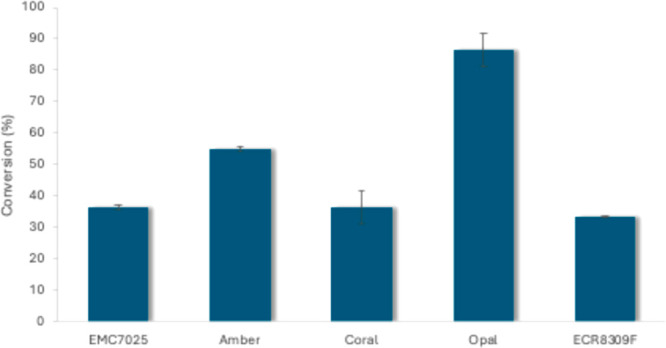 Figure 1
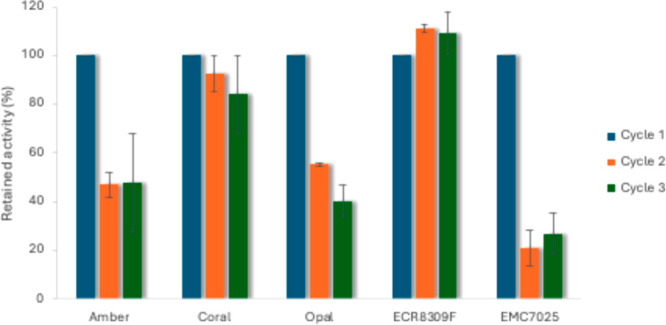 Figure 2
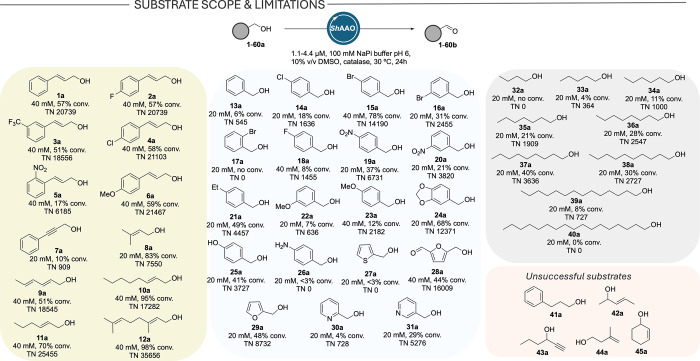 Figure 3
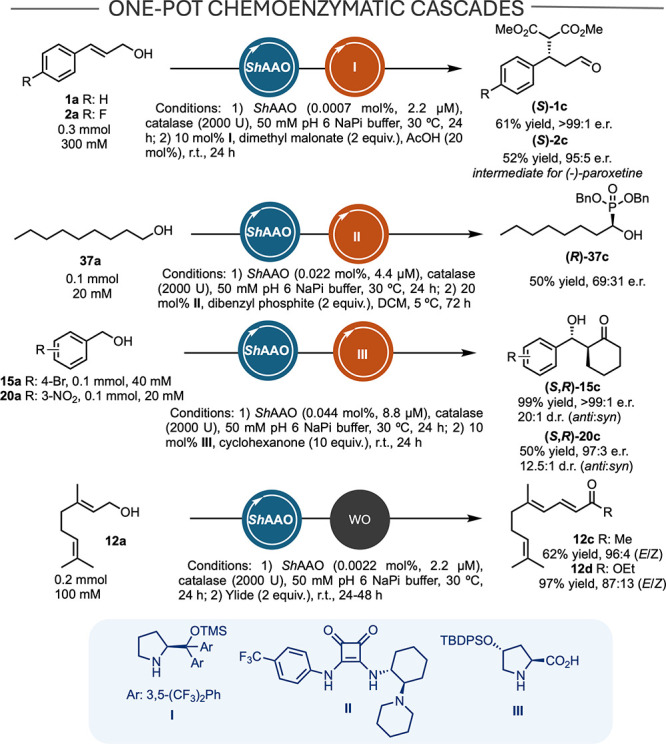 Figure 4
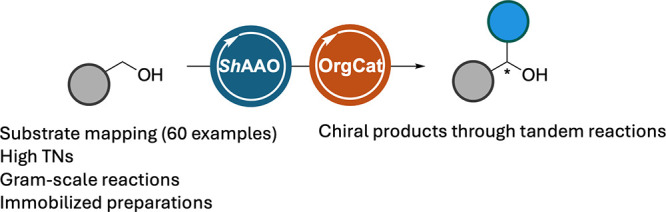 Figure 5
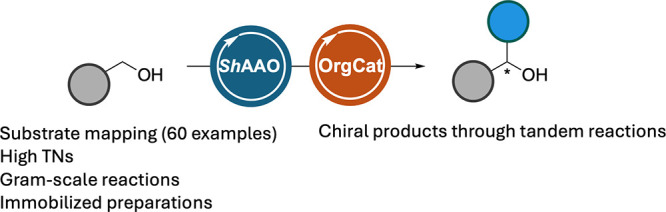 Figure 6
- —Ministerio de Ciencia, Innovación y Universidades10.13039/100014440
- —Ministerio de Ciencia, Innovación y Universidades10.13039/100014440
- —Ministerio de Ciencia, Innovación y Universidades10.13039/100014440
- —Ministerio de Ciencia, Innovación y Universidades10.13039/100014440
- —Ministerio de Ciencia, Innovación y Universidades10.13039/100014440
- —NextGenerationEU10.13039/100031478
- —Keele University10.13039/501100005044
- —European Regional Development Fund10.13039/501100008530
- —Gobierno de Aragón10.13039/501100010067
Peer Reviews
No public reviews on file for this paper yet. If you reviewed it on a platform where reviews are public (OpenReview, ICLR, NeurIPS, ICML), you can paste yours below so the community can read it here.
Videos
No videos yet. Explain this paper in a talk, walkthrough, or lecture? Add one.
Taxonomy
TopicsEnzyme Catalysis and Immobilization · Microbial Metabolic Engineering and Bioproduction · Chemical synthesis and alkaloids
Alcohol oxidation is a central reaction in synthetic chemistry, and enzymatic approaches offer practical and environmental advantages over classical methods. ?−? ? ? ? ? ? ? For instance, ketoreductases (KREDs) catalyze reversible alcohol oxidation via hydride transfer to nicotinamide cofactors, but the reaction is thermodynamically unfavorable and requires cofactor recycling. ?,? Besides KREDs, laccases are blue copper oxidases that have also shown to be useful to mediate alcohol oxidation, ?−? ? but their low redox potential necessitates mediators, complicating large-scale use. Conversely, flavin-dependent alcohol oxidases (FAD-AOx) oxidize alcohols via hydride transfer to FAD, which is then regenerated by oxygen, producing H_2_O_2_ without requiring added cofactors since the FAD is typically tightly bound to the enzyme upon production. ?−? ? ? ? These advantages have led to an increased interest in the use of these enzymes for synthetic purposes. ?−? ? ? To date, a variant of the choline oxidase from Arthrobacter chlorophenolicus (AcCO6)? and different isoforms and engineered variants of the aryl-alcohol oxidase (AAO) from Pleurotus eryngii (PeAAO) have been extensively studied. ?,?,?−? ? ? Their remarkable efficiency coupled with their ability to operate at high substrate loadings makes them highly promising tools for industrial biotechnology. Their substrate scope covers the oxidation of a broad range of electron-rich benzylic alcohols and aliphatic allylic alcohols such as trans-2-hexen-1-ol. The groups of Hollmann and Urlacher demonstrated the potential of PeAAO for alcohol oxidation at scale, ?,? although these biocatalysts often require complex expression systems or labor-intensive refolding procedures, limiting their applicability. To address this, we have recently described two bacterial AAOs which represent a promising alternative due to their ease of production and scalability. ?,? In this study, we extend our investigation into the scope of bacterial AAO from Streptomyces hiroshimensis (ShAAO) and its application to the scalable synthesis of aldehydes and chiral synthons through the construction of chemoenzymatic cascades.
To determine the scope of ShAAO, we examined its activity with a panel of 60 primary and secondary alcohols in analytical scale biotransformations (Scheme, full list in Figure S1). Generally, ShAAO displayed a strong preference for aliphatic and aromatic allylic alcohols such as cinnamyl alcohol (1a) or 2,4-hexadiene-1-ol (9a), with turnover numbers (TNs) ranging from 15000 to 35000 under these initial conditions. Cinnamyl alcohol derivatives (2a–6a) displayed similar TNs, except for the o-NO_2_-substituted derivative 5a, which was obtained in 59% conversion using 2.2 μM (6185 TN) probably due to steric constraints. Notably, the propargylic alcohol 7a was also converted, although at lower rates (TN 909). Aliphatic allylic alcohols 8a–12a were also efficiently oxidized, with particularly high TNs in the case of sorbic alcohol (9a), trans-2-hexen-1-ol (11a) and geraniol (12a), with near-complete conversion to 12b and a TN of 35656. Interestingly, the enzyme displayed no activity toward structurally similar compounds such as 47a or 49a (Figure S1). Good performances were found with aryl alcohol derivatives 13a–31a. The fungal AAO scope includes electron-rich aryl alcohols 22a–25a with TNs, in this case, ranging from 636 for the m-OMe derivative to a remarkable TN of 12371 for 24a. Concerning halogenated compounds 14a–18a, a preference toward para-substituted derivatives was found, with conversion decreasing from 78% for p-bromobenzyl alcohol 15a, to 31% for m-bromobenzyl alcohol 16a and 0% for o-bromobenzyl alcohol 17a. Remarkable differences were found in the p-F, p-Cl, and p-Br series. While ShAAO demonstrated high activity toward 15a, a 10- and 20-fold decrease in TN was found for the p-chlorobenzyl and the p-fluorobenzyl derivatives 14a and 18a, respectively, suggesting a strong influence of the active site architecture in specificity and catalytic efficiency. ShAAO was also studied toward nitro aromatics 19a–20a. Similarly, a preference toward the para-derivative was found with moderate activities (3820 and 6731 TNs for the meta and para compounds, respectively). The presence of hydroxy and amino groups in the aromatic ring was evaluated, finding activity toward phenol derivative 25a (41% conversion) but not aniline 26a. Heteroaromatic alcohols 27a–31a were also studied. Furan derivatives, which are promising building blocks for bioplastics, ?−? ? were well tolerated with a remarkable TN of 16000 for HMF 28a. Unlike PeAAO,? no activity was found toward 27a. Interestingly, while 3-pyridinemethanol 31a was oxidized in 29% conversion (TN 5726), only traces of the product were detected when 2-pyridinemethanol 30a was used. We also investigated the scope toward nonactivated alcohols. ShAAO showed activity toward linear aliphatic alcohols starting from 1-pentanol 33a (TN 364), with activity increasing up to 1-nonanol 37a (40% conversion, TN 3636). For longer-chain alcohols, activity declined and became undetectable beyond 1-heptadecanol 40a. To the best of our knowledge, ShAAO represents the first naturally occurring AAO capable of oxidizing alkanols. We also tested a comprehensive list of primary and secondary alcohols that were not accepted by ShAAO (selected examples in Scheme and full list in Figure S1). Given the similarity between the active sites of ShAAO and PeAAO,? steric hindrance likely prevents secondary alcohols from adopting a catalytically competent orientation for hydride transfer, which results in their oxidation being significantly impaired or totally restricted. Moreover, these results show that ShAAO possesses a substrate scope comparable to that of AcCO6, despite the latter not belonging to the AAO family. However, previous kinetic data,? together with the high TNs obtained for allylic, benzylic, and cinnamyl alcohol derivatives, indicate that ShAAO exhibits higher catalytic activity.
Artificial cascades combine consecutive reactions to produce complex molecules without intermediate purification, enabling rapid conversion of unstable or toxic intermediates like aldehydes while improving safety and efficiency. ?−? ? ? ? ? ? ? ? Following on our experience, ?,? we tested the use of ShAOO in the synthesis of chiral synthons and other relevant compounds via one-pot cascade processes combining the biooxidation process with organocatalytic reactions and the Wittig olefination (Scheme). Initially, since aeration is crucial for oxygen-dependent biocatalysis, ?,? the effect of vessel size was tested in the oxidation of 1a, 9a, and 12a. Larger 10 mL vials improved conversions compared with 2 mL tubes, likely from enhanced oxygen transfer (Scheme S2). Also, with the potential of DMSO to interfere with organocatalytic transformations, we assessed the oxidation reaction under DMSO-free conditions, finding minimal impact (Scheme S3).
We started by investigating a one-pot process combining aerobic oxidation with the organocatalyzed asymmetric conjugate addition of dimethyl malonate via iminium ion activation. For the organocatalytic step, we evaluated the Hayashi-Jørgensen catalyst I
?,? starting from 1a, obtaining (S)-1c in 61% isolated yield and an e.r. > 99:1 using 2.2 μM ShAAO in the initial oxidation step. Since the 4-fluoro derivative (S)-2c is a synthetic precursor of (−)-paroxetine,? the cascade was also performed starting from 2a, yielding (S)-2c in 52% yield and 95:5 e.r. ShAAO displays a distinct scope to fungal oxidases, as these are not capable of oxidizing saturated aliphatic alcohols. In our previous report on the synthesis of chiral α-hydroxyphosphonates, access to saturated compounds was restricted due to limitations in the scope of FX9.? With this in mind, nonanol 37a was chosen as the substrate, and optimal conditions previously described were applied.? Using 4.4 μM ShAAO and squaramide II as catalysts, product (R)-37c was obtained in 50% yield with an er of 69:31. We also applied this combined approach with catalysts operating via enamine catalysis to access chiral hydroxy ketones. Among the different species described for aldol reactions in water,? we selected proline-derivative III ? and Singh’s catalyst? due to their synthetic ease and excellent potential in the addition of cyclohexanone to benzaldehyde derivatives. Starting from 20a, catalyst III demonstrated superior performance, isolating (S,R)-20c in 50% yield, a 97:3 er, and a dr of 12.5:1. We also evaluated 4-Br benzyl alcohol 15a, obtaining (S,R)-15c after the tandem process in 99% isolated yield, >99:1 e.r., and 20:1 d.r.
Finally, the biooxidation process was coupled with a Wittig reaction, establishing a cascade analogous to the one recently described by Wahart et al.? We chose geraniol 12a (100 mM) and two phosphorus ylides, obtaining 12c and 12d in 62% and 97% yields, respectively. The use of ShAAO enabled the process to be performed at higher substrate concentrations with lower catalyst loadings than those required in previously reported cascades.
We also evaluated ShAAO for preparative-scale reactions using 1a as the substrate (Table S1). Initially, 1 mL biotransformations were conducted in 10 mL reaction vials at increasing concentrations of 1a with 1.1 μM enzyme and 2000 U/mL catalase, achieving 48% conversion at 120 mM (16 g/L) of 1a. Increasing catalyst loading to 4.4 μM resulted in complete conversion, with 92% conversion at 240 mM (32 g/L) and 48% conversion at 500 mM (69 g/L), corresponding to a TN of 51349 and a TOF of 349 min^–1^ (Table S2, Figure S53). Considering the importance of oxygen concentration and transfer rate, ?,? we investigated the effect of catalase concentration, reaction vessel volume (25 mL), and use of O_2_ atmosphere, although no significant improvement was found. However, stepwise addition of catalase (2 × 8000 U/mL) slightly increased conversion to 57% (TN 64390), with no further gains observed using more catalase. Under these conditions, we performed a gram-scale process in a 2 × 10 mL reaction volume using 100 mL baffled flasks for improved aeration. After 6 h, we observed a 42% conversion and obtained 422 mg of 2a after column chromatography (33% isolated yield and productivity of 168 g of product/g of enzyme). We then switched to cell-free extracts (CFE). Based on enzyme expression and purification data, we estimated that 4.3 μM ShAAO corresponds to 2 mg/mL CFE. The process using CFE led to a 61% conversion and a 53% yield (17.1 g product/g CFE). This suggests that the stabilizing effect of CFE has a positive effect on the catalyst performance. To maximize yield, we finally increased CFE concentration to 4 mg/mL, achieving 94% and 91% conversion after 6 h. The combined reaction crudes were purified obtaining 2a in 75% yield (0.96 g, 12 g product/g CFE).
To improve and demonstrate the synthetic utility of ShAAO as a reusable biocatalyst, enzyme immobilization was explored. A range of affinity resins (EziG Amber, Coral, and Opal), an aminoglutaraldehyde resin (ECR8309F), and an epoxy resin (EMC7025) were tested. ?−? ? ? ? Immobilization at r.t. was unsuccessful due to enzyme precipitation, which was accelerated in the presence of the resins. Instead, immobilization was done at 4 °C. Initial conversion on Opal and Amber appeared most promising at 86% and 55% conversion, respectively (Figure); however, retained activity across two subsequent reaction cycles showed a loss in activity (Figure). It was evident that ECR8309F was the most suitable carrier for reuse and subsequent scale up experiments, with no demonstratable loss of activity observed across three ninety-minute reactions.
The use of baffled flasks with high concentration (500 mM 1a)/low volume (<10 mL) reactions was attempted using immobilized enzyme; however, issues with separation of the immobilizate from the solution led to poor conversions (12%). Falcon tubes were instead attempted, but presumed low oxygen availability also led to low conversion (13%). In subsequent reactions conducted in 100 mL Erlenmeyer flasks, the results were more promising at 29% conversion. Higher catalase concentrations caused difficulties in separation of the carrier between subsequent reactions, so subsequent reactions were instead completed at a lower 40 mM concentration of 1a, with a 25 mL reaction volume in a 50 mL Falcon tube. Initial conversions showed an 81% conversion to 2a. The immobilized biocatalyst retained full activity for a second cycle (86%) before a loss in activity during cycle 3 (44%). The loss in activity could be due to several deactivation methods, including enzyme unfolding. The nature of the amino resin also means leaching via imine hydrolysis could be occurring to a small extent. Despite this drop in activity, when combined, this amounts to a TN of 67267 and permitted the same sample of enzyme to be isolated and reused three times (Table S7).
In summary, we demonstrated the broad substrate tolerance, high catalytic efficiency, and scalable applicability of ShAAO in the selective oxidation of primary alcohols. ShAAO exhibited remarkable TNs (up to >50000) for allylic and benzylic alcohols and, notably, is the first naturally occurring AAO reported to oxidize alkanols, expanding the known substrate scope of this enzyme class. The biooxidation was successfully integrated into multiple chemoenzymatic cascade reactions, enabling the efficient synthesis of valuable chiral compounds. Importantly, ShAAO also demonstrated a strong potential for preparative-scale applications. Gram-scale oxidations were achieved with high productivity using purified enzyme and CFEs. Although PeAAO exhibits higher TN values for certain substrates, ?,?
ShAAO offers a more practical alternative thanks to its simple production and effective use in semipurified form. We have also shown increased stability upon immobilization, which permitted reuse for three subsequent reaction cycles, achieving a total TN > 65000. The unique properties of ShAAO highlight its utility as a versatile biocatalyst for sustainable synthetic applications.
Supplementary Material
The reference list from the paper itself. Each links out to its DOI / PubMed record.
- 1Sheldon R. A.Woodley J. M.Role of Biocatalysis in Sustainable Chemistry Chem. Rev.201811880183810.1021/acs.chemrev.7b 0020328876904 · doi ↗ · pubmed ↗
- 2Dong J. J.Fernández-Fueyo E.Hollmann F.Paul C. E.Pesic M.Schmidt S.Wang Y.Younes S.Zhang W.Biocatalytic Oxidation Reactions: A Chemist’s Perspective Angew. Chem., Int. Ed.2018579238926110.1002/anie.201800343 PMC 609926129573076 · doi ↗ · pubmed ↗
- 3Puetz H.Puchl’ováE.VrankováK.Hollmann F.Biocatalytic Oxidation of Alcohols Catalysts 20201095210.3390/catal 10090952 · doi ↗
- 4Bell E. L.Finnigan W.France S. P.Green A. P.Hayes M. A.Hepworth L. J.Lovelock S. L.Niikura H.Osuna S.Romero E.Ryan K. S.Turner N. J.Flitsch S. L.Biocatalysis Nat. Rev. Methods Prim.202114610.1038/s 43586-021-00044-z · doi ↗
- 5Winkler C. K.Schrittwieser J. H.Kroutil W.Power of Biocatalysis for Organic Synthesis ACS Cent. Sci.20217557110.1021/acscentsci.0c 0149633532569 PMC 7844857 · doi ↗ · pubmed ↗
- 6Sheldon R. A.Brady D.Green Chemistry, Biocatalysis, and the Chemical Industry of the Future Chem Sus Chem 202215 e 20210262810.1002/cssc.20210262835026060 · doi ↗ · pubmed ↗
- 7Lozano P.García-Verdugo E.From Green to Circular Chemistry Paved by Biocatalysis Green Chem.2023257041705710.1039/D 3GC 01878 D · doi ↗
- 8Falcioni F.Humphreys L.Lloyd R. C.Wu H.Martinez I.Jones J.Mc Kenna S.Neufeld K.Phelan R. M.Rosenthal T.Szczepaniak C. J.Yamamoto K.France S. P.Fryszkowska A.The Evolving Landscape of Industrial Biocatalysis in Perspective from the ACS Green Chemistry Institute Pharmaceutical Roundtable ACS Catal.202515107801079410.1021/acscatal.5c 01646 · doi ↗