Cytotoxic Effects of “25.2% Boscalid + 12.8% Pyraclostrobin” Fungicide
Yasin Eren

TL;DR
This study examines the toxic effects of a fungicide containing boscalid and pyraclostrobin on wheat and MDBK cells, finding significant growth and mitotic inhibition at higher concentrations.
Contribution
The study provides new EC50 and mitotic index data for a specific fungicide blend on wheat and MDBK cells.
Findings
The fungicide's EC50 value for root and stem growth inhibition in wheat was 2500 ppm.
Higher concentrations (5000 ppm and above) significantly reduced mitotic activity in wheat.
All concentrations showed cytotoxic effects on MDBK cells, with 10,000 ppm being the most toxic.
Abstract
It is known that different pesticides used against domestic or agricultural pests have toxic effects. In this study, 25.2% boscalid and 12.8% pyraclostrobin were used in the test material. Kate A1 Russian wheat variety was used for Triticum growth inhibition tests. According to the Triticum root and stem growth test, the concentration value that halves the root and stem length is known as the “EC50 value” According to the test, the root length of the control group was 6.98 ± 0.65 cm and the length of the stem was 9.36 ± 0.71 cm. According to the Triticum test, the EC50 value of the fungicide was determined as 2500 ppm. The value that halves the stem length of the control group was determined as 1250 ppm. Some doses of this fungicide (625, 1250, 2500, 5000, and 10,000 ppm) were observed to inhibit root and stem growth, and these concentrations' results were statistically significant…
Genes, proteins, chemicals, diseases, species, mutations and cell lines named across the full text — each resolved to its canonical identifier and authoritative record.
Click any figure to enlarge with its caption.
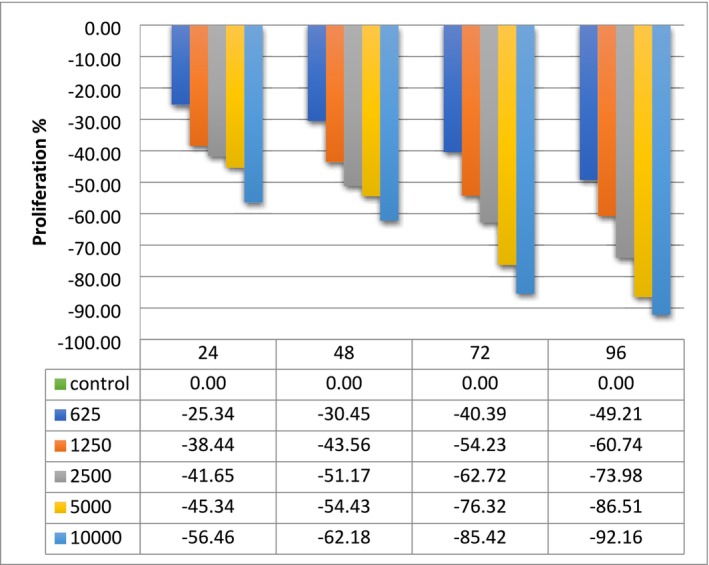 FIGURE 1
| Dose | Root length | Stem length | Root mitotic index |
|---|---|---|---|
| Control | 6.98 ± 0.65 | 9.36 ± 0.71 | 35.6 ± 5.88 |
| 625 ppm | 6.57 ± 0.84 | 8.97 ± 1.65 | 34.52 ± 4.42 |
| 1250 ppm | 4.17 ± 0.42 | 4.24 ± 0.63 | 22.53 ± 2.64 |
| 2500 ppm | 3.53 ± 0.47 | 3.23 ± 0.60 | 19,86 ± 3.02 |
| 5000 ppm | 3.26 ± 0.40 | 1.26 ± 0.34 | 17,32 ± 3.18 |
| 10.000 ppm | 1.70 ± 0.33 | 0.53 ± 0.18 | 9.02 ± 1.85 |
| Dose | Exposure time | |||
|---|---|---|---|---|
| ppm | 24 h | 48 h | 72 h | 96 h |
| 625.00 | 0.05 ± 0.03 | 0.07 ± 0.05 | 0.10 ± 0.09 | 0.14 ± 0.04 |
| 1250.00 | 0.17 ± 0.08 | 0.19 ± 0.04 | 0.26 ± 0.08 | 0.30 ± 0.07 |
| 2500.00 | 0.22 ± 0.07 | 0.28 ± 0.10 | 0.34 ± 0.13 | 0.41 ± 0.12 |
| 5000.00 | 0.46 ± 0.18 | 0.50 ± 0.21 | 0.54 ± 0.23 | 0.63 ± 0.25 |
| 10.000.00 | 0.62 ± 0.28 | 0.70 ± 0.31 | 0.74 ± 0.32 | 0.82 ± 0.26 |
| Control | 0 | 0 | 0 | 0 |
- —Türkiye Bilimsel ve Teknolojik Araştırma Kurumu (TÜBİTAK‐ULAKBİM)
Peer Reviews
No public reviews on file for this paper yet. If you reviewed it on a platform where reviews are public (OpenReview, ICLR, NeurIPS, ICML), you can paste yours below so the community can read it here.
Videos
No videos yet. Explain this paper in a talk, walkthrough, or lecture? Add one.
Taxonomy
TopicsPesticide and Herbicide Environmental Studies · Insect and Pesticide Research · Fungal Plant Pathogen Control
Introduction
1
The boscalid‐based fungicides Endura (70% boscalid) and Pristine (25.2% boscalid and 12.8% pyraclostrobin) were registered in the United States in 2003 (Landschoot et al. 2017). Fungicides are a type of pesticide that is frequently used in agricultural lands to control pathogenic fungi on plants. Fungicides are used to treat and preserve maize, wheat, olive, pistachio, and fruit, as well as other plants (Chen et al. 2008; Avenot et al. 2008; Temiz 2019). The 25.2% boscalid and 12.8% pyraclostrobin fungicide is one of the pesticides that have been increasingly used in recent years in Turkey to control pistachio, olive, and pomegranate pests. Boscalid is a novel broad‐spectrum fungicide that belongs to the anilide family of fungicides. Its action mode and range are different from those of strobilurins and most of the other fungicides. Boscalid inhibits complex II in the mitochondrial electron transport chain, whereas pyraclostrobin inhibits complex III (Avenot et al. 2008; Lagunas‐Allué et al. 2015; Ozkılınc and Kurt 2017; Aksakal 2020). There is emerging correlative and epidemiological evidence that at least some fungicides can be harmful to bee health (McArt et al. 2017).
The 25.2% boscalid + 12.8% pyraclostrobin fungicide is very toxic to fish, to aquatic invertebrates, and acutely toxic for aquatic plants (OECD Guideline 2022). LC50 (96 h) value is 0.042 mg/L for Oncorhynchus mykiss (OECD Guideline 203, 2022), EC50 (48 h) value is 0.08 mg/L for Daphnia magna (OECD Guideline 202, 2022), and EC50 (72 h) value is 4.99 mg/L (growth rate) for Pseudokirchneriella subcapitata aquatic plant (OECD Guideline 201, 2022).
This fungicide is slightly toxic after single ingestion, slightly toxic after short‐term skin contact, and relatively nontoxic after short‐term inhalation. Oral toxicity for rat is LD50 1490 mg/kg, LC50 for rat > 5.4 mg/L with inhalation and no mortality was observed with inhalation in 4 h exposure period, and LD50 value for dermal toxicity is > 2000 mg/kg (OECD Guideline 2022).
Materials and Methods
2
The 25.2% boscalid + 12.8% pyraclostrobin fungicide was purchased from BASF Turk. Triticum tests were carried out with Kate A1 Russian wheat and different concentrations of the 25.2% boscalid + 12.8% pyraclostrobin fungicide (625, 1250, 2500, 5000, and 10,000 ppm) that were used for the root and stem growth inhibition test.
Root and Stem Growth Inhibition Test (EC50 Determination)
2.1
Various concentrations of the 25.2% boscalid + 12.8% pyraclostrobin (625, 1250, 2500, 5000, and 10,000 ppm) were used for the root and stem growth inhibition test. The wheats were grown in freshly made distilled water for 24 h and then exposed for 96 h to the control group and other concentrations of 25.2% boscalid + 12.8% pyraclostrobin. In order to determine efficient concentration (EC50) values, 10 roots from each wheat were cut off at the end of the treatment period, and the root and stem's lengths were measured. The concentration that decreased root growth about 50% when compared to the negative control group (distilled water) was accepted as the EC50 value.
Mitotic Index (MI) Determination
2.2
At the end of 72 h, root tips were cut and fixed in ethanol: glacial acetic acid (3:1); they were hydrolyzed in 1 N HCl at 60°C for 7 min. Root tips from each concentration treatment were stained with Feulgen dye for 1 h. Five slides were prepared for each concentration, and 1000 cells per slide were counted. A total of 5000 cells were evaluated for each concentration. In the MI study, about 5000 cells were counted, and MI% was determined with the following formulation:
MTT Assay
2.3
This test was performed with MDBK cells (Madin‐Darby Bovine Kidney) (Sigma) according to Mosmann (1983), and the test was repeated three times. Cells were incubated with different concentrations of fungicide. Then test materials were removed at the end of the incubation period. Cells were incubated with 5 mg/mL MTT solution (Sigma) about 2 h in a CO_2_ incubator for the transformation of MTT dye to formazan salt (not dissolve in water). Then MTT dyes were removed, and 100 μL DMSO was added to the wells in order to dissolve the formazan salts that were only formed by alive cells. Plates were analyzed by ELISA at a 540‐nm wavelength. Cell proliferation of the control group was accepted as “0” (Mosmann 1983).
Results and Discussion
3
The boscalid and pyraclostrobin residues were found in some fruit samples (Balkan and Yılmaz 2023). This shows that this fungicide should be considered in terms of human health. It was aimed to carry out this study with this perspective. The findings of the present study demonstrate that the Triticum root elongation assay is a simple and inexpensive method when used empirically for the screening of novel chemical compounds. The MTT (Tetrazolium Blue) colorimetric assay has been reported in previous studies to evaluate the reduction of cell viability in the presence or absence of tested materials (Betancur‐Galvis et al. 1999). It has been stated that cell proliferation can be determined using the MTT assay, which is a useful method for measuring cell viability through mitochondrial dehydrogenase activity (Mosmann 1983).
Previous study about in vitro unscheduled DNA synthesis (primary rat hepatocytes) indicated negative response up to 50 μg/mL, but cytotoxicity was observed at 100–500 μg/mL. In this study also, gene mutation bacterial reverse mutation assay showed that negative without and with S‐9 activation up to limit dose of 5000 μg/plate. So fungicide combination has positive mutagenic effects in and above 5000 μg/plate (EPA 2003). According to the studies conducted with the Triticum test to determine the MI and stem and root growth test, dose‐dependent decrease was observed. Tested fungicide reduced the MI to max 9.02 cm, and EC50 concentration was found 2500 ppm. However, when compared to the control values, whole of the concentrations were also found to cause toxic effects, except 625 ppm. The toxic effect values are provided in Table 1. The lowest MI was found in 10,000 ppm concentration. According to the MTT test results conducted with the MDBK cell line, it was determined that fungicide exhibited cytotoxic effects at all concentrations except for 625 and 1250 ppm after 24 h of application. When compared to the control group, the most significant negative effect on MDBK cell proliferation was observed with the 10,000 ppm concentration after 96 h of application. It was found that concentrations of 1250 ppm and above have a toxic effect. Figure 1 and Table 2 demonstrated the 25.2% boscalid + 12.8% pyraclostrobin fungicide MTT test results. Although manufacturers recommend a maximum concentration of 1000 ppm for the application of fungicide, the results of this study indicate that when fungicide is applied at high concentrations, cytotoxic effects may be observed on the cells.
The 25.2% boscalid + 12.8% pyraclostrobin fungicide MTT test results.
Conflicts of Interest
The author declares no conflicts of interest.
The reference list from the paper itself. Each links out to its DOI / PubMed record.
- 1Aksakal, F. I. 2020. “Evaluation of Boscalid Toxicity on Daphnia magna by Using Antioxidant Enzyme Activities, the Expression of Genes Related to Antioxidant and Detoxification Systems, and Life History Parameters.” Comparative Biochemistry and Physiology Part C: Toxicology & Pharmacology 237, no. 108: 830.10.1016/j.cbpc.2020.10883032535132 · doi ↗ · pubmed ↗
- 2Avenot, H. , D. P. Morgan , and T. J. Michailides . 2008. “Resistance to Pyraclostrobin, Boscalid and Multiple Resistance to Pristine® (Pyraclostrobin + Boscalid) Fungicide in Alternaria alternata Causing Alternaria Late Blight of Pistachios in California.” Plant Pathology 57: 135–140.
- 3Balkan, T. , and Ö. Yılmaz . 2023. “Determinatıon of Pesticide Residues in Pomegranates Grown İn Antalya and Health Risk Assessment.” Gida the Journal of Food 48, no. 5: 993–1003.
- 4Betancur‐Galvis, A. , J. Saez , H. Granados , and A. Salazar . 1999. “Antitumor and Antiviral Activity of Colombian Medicinal Plant Extracts.” Memórias do Instituto Oswaldo Cruz 94: 531–535.10446015 10.1590/s 0074-02761999000400019 · doi ↗ · pubmed ↗
- 5Chen, P. J. , T. Moore , and S. Nesnow . 2008. “Cytotoxic Effects of Propiconazole and Its Metabolites in Mouse and Human Hepatoma Cells and Primary Mouse Hepatocytes.” Toxicology In Vitro 22: 1476–1483.18585002 10.1016/j.tiv.2008.05.001 · doi ↗ · pubmed ↗
- 6EPA . 2003. “Pesticide Fact Sheet.” EPA Office of Pesticide Programs 7501 C: 1–18.
- 7Lagunas‐Allué, L. , J. Sanz‐Asensio , and M. T. Martínez‐Soria . 2015. “Mobility and Distribution of Eight Fungicides in Surface, Skin and Pulp in Grapes. An Application to Pyraclostrobin and Boscalid.” Food Control 51: 85–93.
- 8Landschoot, S. , J. Carrette , M. Vandecasteele , et al. 2017. “Boscalid‐Resistance in Alternaria alternata and Alternaria solani Populations: An Emerging Problem in Europe.” Crop Protection 92: 49–59.