Effectiveness of Text Message Outreach to Promote Enrollment in a Government Food Assistance Program: Pilot Randomized Trial
Emily M Melnick, Francesco Acciai, Nicole Vaudrin O’Reilly, Mindy Jossefides, A Bea Ronan, Punam Ohri-Vachaspati

TL;DR
A pilot study found that sending text messages to eligible households in Arizona did not effectively increase enrollment in the WIC food assistance program.
Contribution
This study evaluates the effectiveness of text message outreach for promoting enrollment in a government food assistance program.
Findings
Outreach text messages did not significantly increase WIC enrollment among eligible households.
The pilot trial involved 916 households in Arizona.
Results suggest that text messaging may not be an effective strategy for this purpose.
Abstract
Findings from a pilot randomized trial of 916 households indicated that outreach text messages were not an effective strategy to increase enrollment in the United States Special Supplemental Nutrition Program for Women, Infants, and Children (WIC) among eligible households in Arizona.
Genes, proteins, chemicals, diseases, species, mutations and cell lines named across the full text — each resolved to its canonical identifier and authoritative record.
Click any figure to enlarge with its caption.
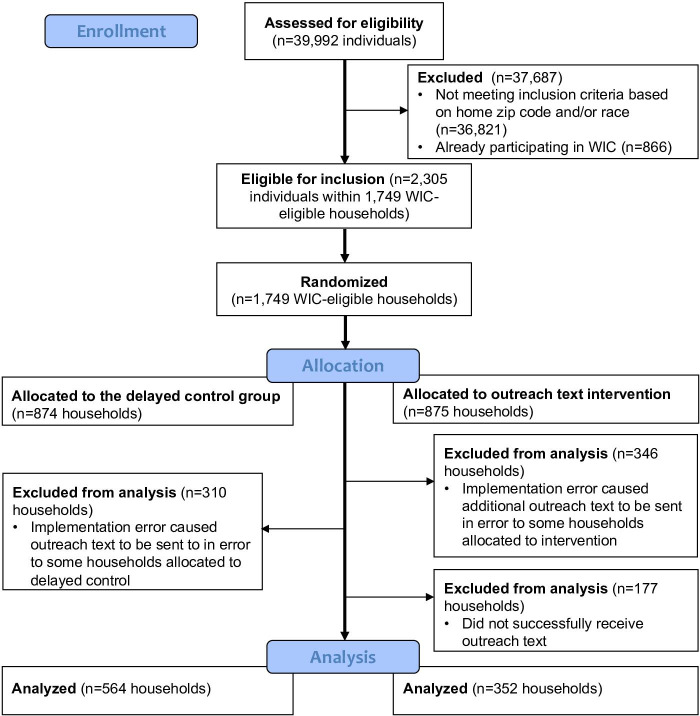 Figure 1
Peer Reviews
No public reviews on file for this paper yet. If you reviewed it on a platform where reviews are public (OpenReview, ICLR, NeurIPS, ICML), you can paste yours below so the community can read it here.
Videos
No videos yet. Explain this paper in a talk, walkthrough, or lecture? Add one.
Taxonomy
TopicsFood Security and Health in Diverse Populations · Obesity, Physical Activity, Diet · Child Nutrition and Water Access
Introduction
The Special Supplemental Nutrition Program for Women, Infants, and Children (WIC) provides nutritious food packages, nutrition education, breastfeeding support, and health care referrals for pregnant and postpartum women and children aged 0‐4 years from low-income households in the United States [1]. WIC participation improves dietary and health outcomes and reduces health disparities [2]. However, many eligible households do not participate. Among those eligible for both WIC and the Supplemental Nutrition Assistance Program (SNAP) [3], another US food assistance program, about half participate in only SNAP and miss the additional benefits WIC provides [4]. In response, US agencies have called for outreach efforts to boost enrollment among SNAP-participating households eligible but not participating in WIC [5]. Increasing WIC participation is particularly important among American Indians who face higher rates of food insecurity [6], alongside declining WIC participation [7].
Text message outreach may offer a low-cost, scalable approach to encourage WIC enrollment among eligible SNAP-participating households [2]. No studies have evaluated impacts of such outreach in American Indian populations. This study evaluated a pilot randomized text message intervention aimed at increasing enrollment in the Inter Tribal Council of Arizona, Inc. (ITCA) WIC program. We hypothesized that households receiving persuasive outreach texts would be more likely to enroll in ITCA WIC than those who did not.
Methods
Study Overview
We conducted a pilot randomized trial among likely-WIC-eligible SNAP households in the ITCA WIC service area, including urban areas and tribal lands. The Arizona Department of Economic Security, which administers SNAP, provided the target population list. After eligibility screening, households were randomized in a 1:1 ratio to intervention and delayed control groups using a computerized random number generator. Participants were blinded to trial arm allocation, while evaluators were not. The study adhered to CONSORT (Consolidated Standards of Reporting Trials) guidelines (Checklist 1).
In February 2024, intervention households were sent a persuasive outreach text message via Teletask (Fair Oaks) that included the message, “Want healthy foods for your family? WIC is just a click away. With SNAP, you may already qualify.” The text message was developed by the study team in partnership with a communication specialist then field-tested with ITCA WIC local agency staff and low-income adults to assess persuasiveness and relevance for the target audience. Control households did not receive any texts during the 3-month (February-April 2024) evaluation period. To assess intervention effects, we conducted a per-protocol analysis, excluding 177 households in the intervention group that did not successfully receive the text message. Excluded households were demographically similar to those that successfully received the message, which, in turn, were similar to the delayed control group.
All analyses were run in Stata 16 (StataCorp). We used the command “proportion*”* to obtain group-specific enrollment proportions, estimated standard errors, and logit-transformed confidence intervals. A Pearson χ^2^ test (α=.05, two-tailed) compared enrollment rates across groups. The final analytical sample included 916 likely-WIC-eligible households with no missing data.
Ethical Considerations
The intervention was implemented by ITCA WIC using data shared through an agreement with the Arizona Department of Economic Security. Because the text messages were sent as a part of programmatic improvement efforts and data shared were per a data sharing agreement protocol, consent to participate in this study was not required. All data were de-identified prior to analysis. Households did not receive compensation. The Arizona State University Institutional Review Board approved study protocols.
Results
A CONSORT diagram (Figure 1) outlines intervention allocation and participant flow. Over half of the sample (516/916, 56.3%) identified as American Indian and 85.2% (780/916) lived in urban areas. During the 3-month follow-up, 54 of the 916 households (5.9%) enrolled in ITCA WIC. Enrollment was 4.3% (95% CI 2.6%‐7.0%) among households that received the text, while it was 6.9% (95% CI 5.1%‐9.3) among delayed controls. The difference was not statistically significant (P=.097, Pearson χ^2^ test).
CONSORT flow diagram.
Discussion
This pilot study found no evidence that a text message increased WIC enrollment among likely-eligible SNAP households. This finding is consistent with results from pilot studies in Colorado, Montana, and Virginia [8]. While text interventions have improved outcomes such as retention of current WIC participants [9] and enrollment among WIC-eligible Medicaid participants [10], more intensive or multi-pronged approaches may be needed to increase WIC enrollment among eligible non-participating SNAP households. Notably, enrollment rates were low in both intervention and delayed control households. Possible reasons include children aging out of WIC eligibility before receiving the text and families already receiving services from another WIC agency in the state. Given this study’s focus on American Indian communities, future research should explore whether similar text-based interventions are effective in other populations and countries offering similar programs. We did not conduct a power calculation prior to the trial as we enrolled all eligible households; post-hoc analyses confirm the study was adequately powered to detect group differences. We also cannot rule out the possibility that intervention households shared messages with others. Future randomized trials should address the potential for cross-contamination between study arms. Trials with longer follow-up periods and those that test effects of multiple messages are also warranted.
Supplementary material
10.2196/78907Checklist 1CONSORT checklist
The reference list from the paper itself. Each links out to its DOI / PubMed record.
- 1Special supplemental nutrition program for women, infants, and children (WIC)US Department of Agriculture, Food and Nutrition Service UR Lhttps://www.fns.usda.gov/wic Accessed 21-01-2023
- 2Colman S Nichols-Barrer IP Redline JE Devaney BL Ansell SV Joyce T Effects of the special supplemental nutrition program for women, infants, and children (WIC): a review of recent research US Department of Agriculture, Food and Nutrition Service, Office of Research and Analysis 012012 WIC-12-WMUR Lhttps://fns-prod.azureedge.us/sites/default/files/WIC Medicaid Lit Rev.pdf Accessed 20-10-2025
- 3Supplemental nutrition assistance program (SNAP)US Department of Agriculture, Food and Nutrition Service UR Lhttps://www.fns.usda.gov/snap Accessed 21-01-2023
- 4Neuberger Z WIC coordination with medicaid and SNAP Center on Budget and Policy Priorities UR Lhttps://www.cbpp.org/research/food-assistance/wic-coordination-with-medicaid-and-snap-1Accessed 25-02-2025
- 5WIC policy memorandum #2023-5: data sharing to improve outreach and streamline certification in WICUS Department of Agriculture, Food and Nutrition Service UR Lhttps://www.fns.usda.gov/wic/data-sharing Accessed 15-07-2025
- 6Nikolaus CJ Johnson S Benally T et al Food Insecurity among American Indian and Alaska Native People: A Scoping Review to Inform Future Research and Policy Needs Adv Nutr Oct 2202213515661583 doi 10.1093/advances/nmac 008Medline 35092417 PMC 9526849 · doi ↗ · pubmed ↗
- 7WIC participant and program characteristics 2018 US Department of Agriculture, Food and Nutrition Service 2018 UR Lhttps://www.fns.usda.gov/research/wic/participant-program-characteristics-2018 Accessed 25-02-2025
- 8Maneely J Neuberger Z Using data matching and targeted outreach to enroll families with young children in WIC Center on Budget and Policy Priorities UR Lhttps://www.cbpp.org/research/food-assistance/using-data-matching-and-targeted-outreach-to-enroll-families-with-young Accessed 25-02-2025