Lower limb joints’ contributions to ballet turnout during unipodal and bipodal jumps in fifth position in pre-professional dancers
Luciana C. Manfrim, Maria Isabel V. Orselli, Bianca M. Portela, Matheus O. Moutinho, Paolo Caravaggi, Isabel C.N. Sacco

TL;DR
This study examines how hip, knee, and ankle joints contribute to turnout during two types of ballet jumps, revealing that the ankle and hip are key for maintaining turnout in different phases.
Contribution
The study provides new insights into the dynamic contributions of lower limb joints to turnout during ballet jumps in fifth position.
Findings
The ankle and hip joints are pivotal for maintaining turnout during Assemblé and Sissone jumps, respectively.
The knee contributes little to external rotation in turnout during these jumps.
Joint rotation peaks occur at different times depending on the jump phase and type.
Abstract
Turnout, a large external rotation of the lower limb joints, is a key element of jumps and of other postures in classical ballet technique. Correct transverse-plane alignment of body segments in turnout is critical to reduce technical errors and injury risk. Although many studies have examined turnout in static positions, there is a need for a deeper understanding of this element dynamically, particularly during uni- and bipodal jumps with body displacements in fifth position. Such insights could help improve the technique and the training protocols. This study investigated the external rotations of the hip, knee, and ankle in turnout during three phases (preparation, flight, and landing) of two jumps with displacement performed in the fifth position: one unipodal, the Sissone Ouvert, and one bipodal, the Assemblé Dessus. Twenty-eight pre-professional ballet dancers were analyzed with…
Genes, proteins, chemicals, diseases, species, mutations and cell lines named across the full text — each resolved to its canonical identifier and authoritative record.
Click any figure to enlarge with its caption.
 Figure 1
 Figure 2
 Figure 3
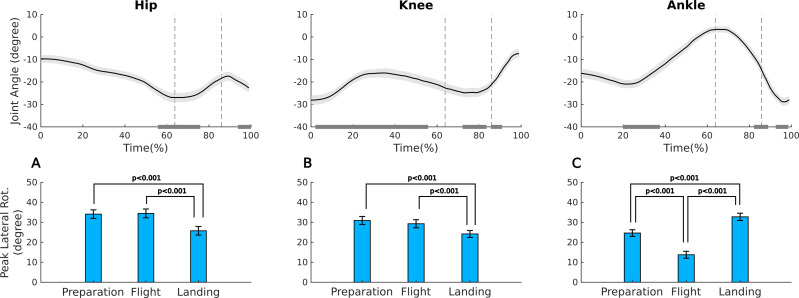 Figure 4
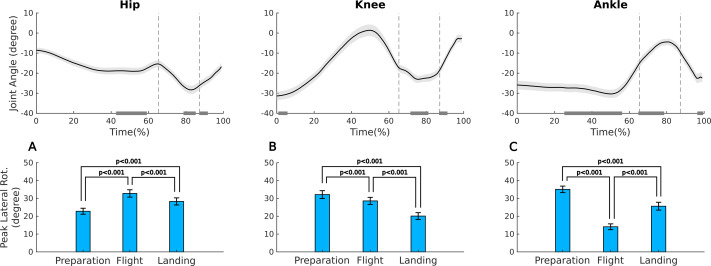 Figure 5
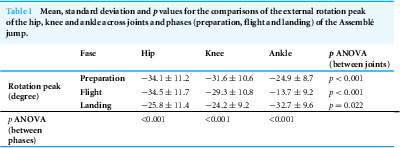 Figure 6
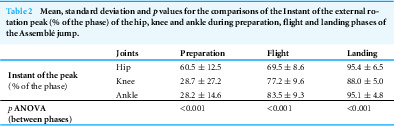 Figure 7
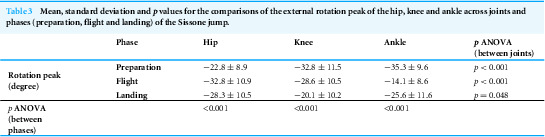 Figure 8
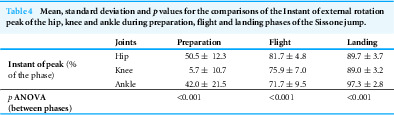 Figure 9
Peer Reviews
No public reviews on file for this paper yet. If you reviewed it on a platform where reviews are public (OpenReview, ICLR, NeurIPS, ICML), you can paste yours below so the community can read it here.
Videos
No videos yet. Explain this paper in a talk, walkthrough, or lecture? Add one.
Taxonomy
TopicsDiversity and Impact of Dance · Winter Sports Injuries and Performance · Human Motion and Animation