Comparison of amyloid chronicity and EYO in autosomal dominant Alzheimer's disease
Julie K. Wisch, Nicole S. McKay, Matthew Zammit, Bradley T. Christian, Stephanie A. Schultz, Peter R. Millar, Natalie S. Ryan, David M. Cash, Christopher R. S. Belder, Patricio Chrem, Carlos Cruchaga, Laura Ibanez, Mathias Jucker, Igor Yakushev, Gregory S Day, Mei Murphy

TL;DR
The study compares amyloid chronicity and estimated years to onset in autosomal dominant Alzheimer's disease to understand preclinical phases and symptom progression.
Contribution
The study introduces SILA, a method to estimate age at amyloid positivity with high accuracy in autosomal dominant Alzheimer's disease.
Findings
SILA estimates age at amyloid positivity with a mean absolute error of less than 2 years.
Estimated years to symptom onset (EYO) better predicts symptom onset than amyloid chronicity.
APP mutation carriers show atypical amyloid accumulation patterns.
Abstract
Preclinical Alzheimer's disease (AD) can be described relative to biomarker positivity onset time. We estimated time from amyloid positivity (A+) using sampled iterative local approximation (SILA) in a longitudinal autosomal dominant AD (ADAD) sample (N = 379) with amyloid positron emission tomography. We compared (1) predicted age at A+ to imputed age, (2) estimated age at A+ to estimated age at symptom onset, and (3) variance in cognitive performance explained. Mean error between imputed and SILA‐estimated age at A+ (N = 26) was 1.15 years. Age at A+ explained 39% of estimated years to symptom onset (EYO) variance. Time from A+ explained 19% of cognitive composite variance and 14% of Clinical Dementia Rating Sum of Boxes CDR‐SB variance; EYO explained 43% and 57%, respectively. SILA estimates A+ age in ADAD with reasonably good accuracy. SILA‐estimated time from A+ describes the…
Genes, proteins, chemicals, diseases, species, mutations and cell lines named across the full text — each resolved to its canonical identifier and authoritative record.
Click any figure to enlarge with its caption.
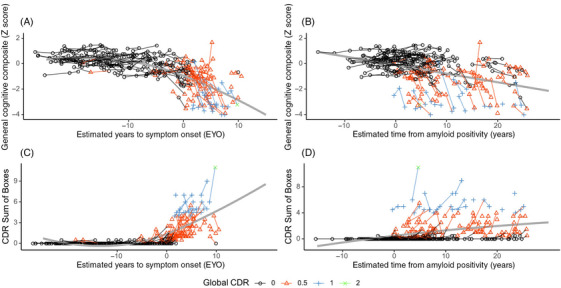 Figure 1
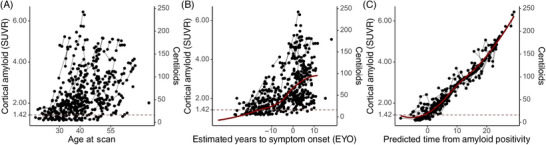 Figure 2
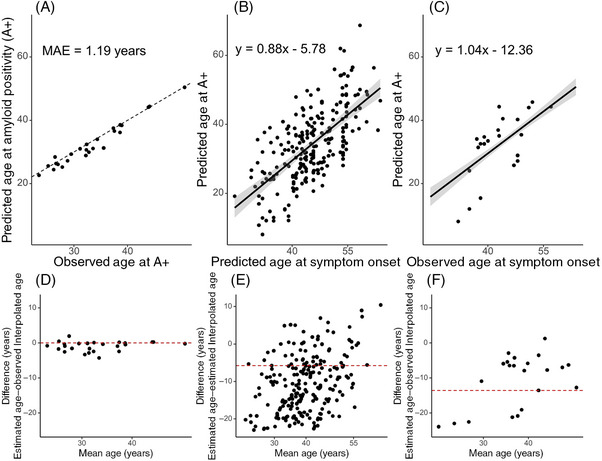 Figure 3
Peer Reviews
No public reviews on file for this paper yet. If you reviewed it on a platform where reviews are public (OpenReview, ICLR, NeurIPS, ICML), you can paste yours below so the community can read it here.
Videos
No videos yet. Explain this paper in a talk, walkthrough, or lecture? Add one.
Taxonomy
TopicsDementia and Cognitive Impairment Research · Alzheimer's disease research and treatments · Functional Brain Connectivity Studies