Treatment persistence and overall survival in myelofibrosis treated with ruxolitinib were not affected by the covid-19 pandemic, despite the reduced starting dose: Analysis of AIFA registries
Massimo Breccia, Simone Celant, Francesca Palandri, Francesco Passamonti, Pier Paolo Olimpieri, Valentina Summa, Annalisa Guarcello, Giuseppe Alberto Palumbo, Fabrizio Pane, Paola Guglielmelli, Pierluigi Zinzani, Paolo Corradini, Pierluigi Russo

TL;DR
The study found that the COVID-19 pandemic did not impact treatment persistence or survival in myelofibrosis patients taking ruxolitinib, even with a lower starting dose.
Contribution
This is the first study to show that the pandemic did not negatively affect treatment outcomes for myelofibrosis patients on ruxolitinib.
Findings
Patients treated after the pandemic had similar overall survival compared to those treated before.
The likelihood of stopping treatment was not significantly different between the two groups.
Despite a reduced starting dose post-pandemic, treatment persistence remained unaffected.
Abstract
We analyzed the outcome of 2229 patients with myelofibrosis (MF) treated with ruxolitinib before and after the COVID-19 pandemic. Two populations of MF were defined from the AIFA web monitoring registries: the pre-COVID-19 (1703, 76.4%) and the post-COVID-19 (526, 23.6%) cohorts. The two populations were balanced using the Inversity Probability of Treatment Weighting. The median age was 69 years and 73 years in the pre- and post- COVID-19 era, respectively. There were no differences in spleen diameters at baseline prior to ruxolitinib in the two groups, but a difference in median spleen volume was noted (961 cm3 in the pre-era and 788.3 cm3 in the post-era). Overall, intermediate-2 IPSS risk were 67.2% in the pre- and 72% in the post-era, whereas the high-risk category was 32.7% and 27.9%, respectively. More patients started on a reduced dose in the post-COVID-19 era (73.5% versus 65%…
Genes, proteins, chemicals, diseases, species, mutations and cell lines named across the full text — each resolved to its canonical identifier and authoritative record.
Click any figure to enlarge with its caption.
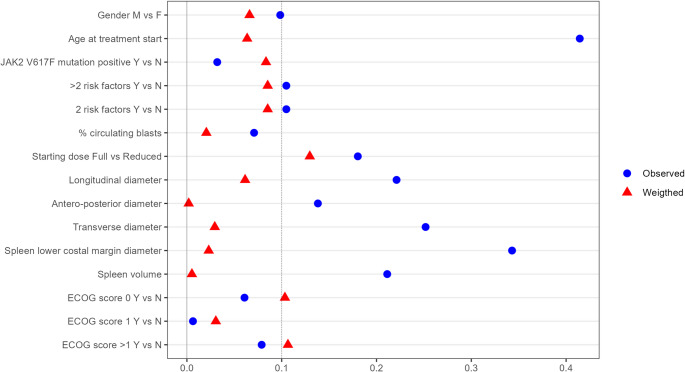 Figure 1
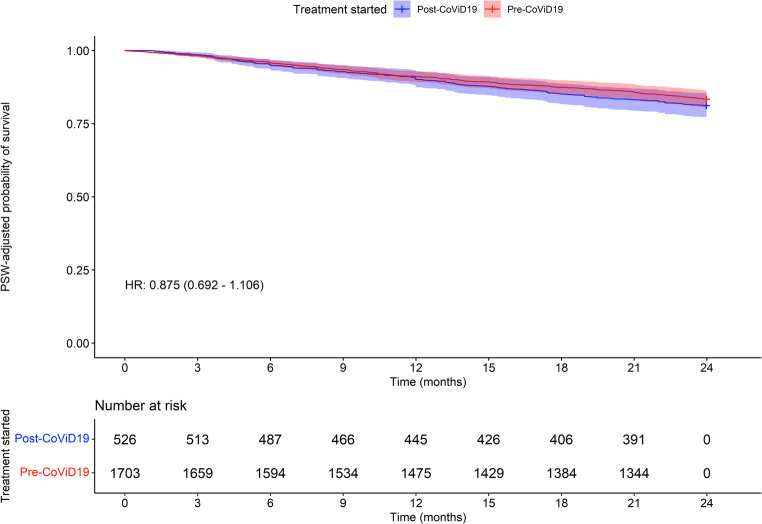 Figure 2
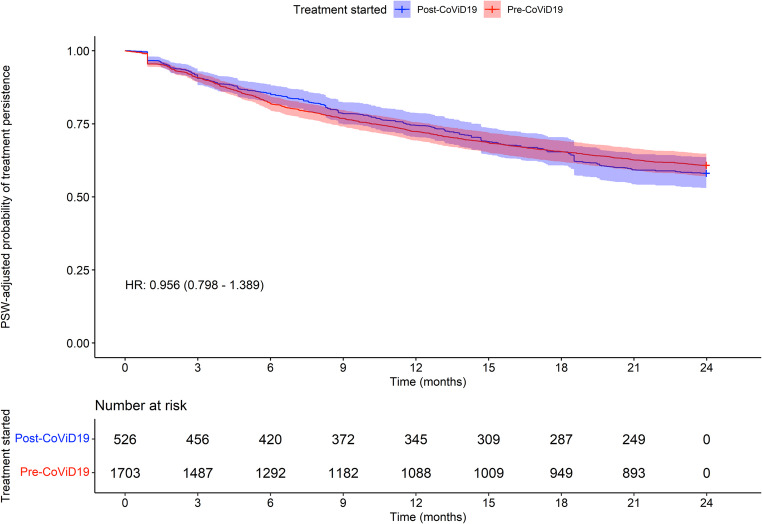 Figure 3
Peer Reviews
No public reviews on file for this paper yet. If you reviewed it on a platform where reviews are public (OpenReview, ICLR, NeurIPS, ICML), you can paste yours below so the community can read it here.
Videos
No videos yet. Explain this paper in a talk, walkthrough, or lecture? Add one.
Taxonomy
TopicsMyeloproliferative Neoplasms: Diagnosis and Treatment · Venous Thromboembolism Diagnosis and Management · Hemoglobinopathies and Related Disorders