Inhibition of acn-1 , an ACE ortholog, reduces intestinal GST-4 expression in Caenorhabditis elegans
Josiah King, Kristopher Schmidt

TL;DR
This study shows that inhibiting a worm version of a human enzyme reduces antioxidant production in the worm's intestine.
Contribution
The novel finding is that acn-1 positively regulates gst-4 expression in C. elegans.
Findings
acn-1 RNAi exposure reduces GST-4 reporter expression in C. elegans.
The reduction in GST-4 expression is most notable in the intestine.
acn-1 positively influences gst-4 expression in C. elegans.
Abstract
We investigated the role of acn-1 , the C. elegans ortholog of human ACE and ACE2, on the expression of GST-4 , an antioxidant molecule produced in response to oxidative stress. acn-1 RNAi exposure significantly reduced GST-4 reporter expression after 24 and 48 hours. The difference in gst-4 expression appears most prevalent in the intestine. Our findings suggest that acn-1 function positively influences gst-4 expression in C. elegans .
Genes, proteins, chemicals, diseases, species, mutations and cell lines named across the full text — each resolved to its canonical identifier and authoritative record.
Click any figure to enlarge with its caption.
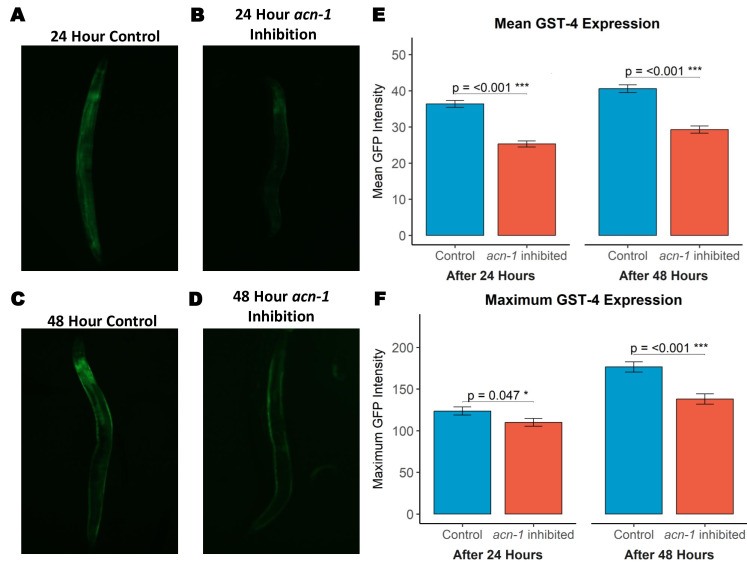 Figure 1
|
|
|
|
|
|
|
CGC (
|
|
|
|
|
|
|
Wild type used as a food source. |
CGC |
|
|
|
Kornfeld Lab, Washington University in St. Louis |
|
|
|
Addgene or CGC RNAi library |
|
|
|
|
|
pPD129.36 |
|
Standard L4440-based RNAi control plasmid used for feeding RNAi. |
|
|
|
|
|
ImageJ |
|
NIH |
|
UCSC Genome Browser |
|
UCSC Genomics Institute |
|
NCBI BioProject |
|
NCBI |
- —U.S. National Science Foundation (United States)https://ror.org/021nxhr62
Peer Reviews
No public reviews on file for this paper yet. If you reviewed it on a platform where reviews are public (OpenReview, ICLR, NeurIPS, ICML), you can paste yours below so the community can read it here.
Videos
No videos yet. Explain this paper in a talk, walkthrough, or lecture? Add one.
Taxonomy
TopicsGenetics, Aging, and Longevity in Model Organisms · Redox biology and oxidative stress · Endoplasmic Reticulum Stress and Disease
Description
While previous studies have linked * acn-1 * to life extension and stress resistance in * C. elegans * , the mechanism by which this is done remains unclear. Inhibition of * acn-1 * is reported to increase lifespan and oxidative stress resistance. There is a significant gap in scientific literature in regard to interactions between * acn-1 * and regulatory reporters, like GST-4 . GST-4 is an antioxidant that is released in response to oxidative stress (Pohl et al., 2019).
Our quantitative image analysis revealed a drastic decrease in GFP mean fluorescence after 24 hours (p < 1e ^-14^ ; N=80 control, N=82 * acn-1 * RNAi, 3 experiments) and an even larger difference after 48 hours (p < 1e ^-11^ ; N=76 control, N=72 * acn-1 * RNAi, 2 experiments) (Figure 1). To determine whether the signal reduction was more localized or uniform, we also analyzed the maximum intensities of fluorescence. A similar reduction was observed after both 24 hours (p < 4.68e ^-02^ ) and 48 hours (p < 6.10e ^-06^ ), with the brightest signals frequently being located in the caudal intestine region.
Our experimental results reveal that when * acn-1 * is inhibited, * gst-4 * is expressed less. This indicates that * acn-1 * regulates * gst-4 * expression, but the pathways and interactions through which it does so are still not clear. Despite being frequently used as a marker of oxidative stress, * gst-4 * can be expressed through multiple pathways that are not all exclusively induced by oxidative challenge (Detienne et al., 2016). While the mechanism by which * acn-1 * regulates * gst-4 * is unclear, literature indicates life extension mediated by * acn-1 * requires the transcription factor * daf-16 * . * gst-4 * is known as a target gene of * daf-16 * . However, based on current evidence, * acn-1 * does not appear to impact the nuclear localization of DAF-16 (Kumar et al., 2016). This suggests that * acn-1 * either affects specific target genes of * daf-16 * or works in parallel with * daf-16 * . Because of the compensatory nature of detoxification molecules (Back et al., 2010), we suspect that the decreased * gst-4 * expression during * acn-1 * inhibition reflects a redistribution of stress response gene expression where * gst-4 * is reduced and offset by the increase of other * daf-16 * target genes like * gst-10 * , which increases lifespan when overexpressed (Shields et al., 2021).
In summary, inhibition of * acn-1 * decreases * gst-4 * expression, and this suggests a positive regulatory role. This reduction in * gst-4 * may reflect a compensatory shift in gene expression where other * daf-16 * regulated genes associated with life extension are upregulated (Back et al., 2010; Park et al., 2009). * acn-1 * shows some homology with human ACE, and ACE inhibitors affect aging in various organisms (Brar et al., 2018; Egan et al., 2022). These findings may point to a conserved mechanism worth further investigation. Despite being homologous to human ACE at the sequence levelc, however, ACN-1 lacks several histidine residues that are necessary for the peptide-cleaving functions of ACE. ACN-1 plays an essential yet unclear role in nematode larval molting, a functionality that is unrelated to the role of human ACE in the renin-angiotensin system (Egan et al., 2022). Due to the functional differences, these results should not be interpreted as directly applicable to human ACE functions and human ACE inhibitors. Further investigation in mammalian models is required to establish any potential parallels.
Methods
** RNAi inhibition of * acn-1 * **
A CL2166 strain of * C. elegans * with * gst-4 p * ::GFP reporter was ordered from the University of Minnesota's Caenorhabditis Genetics Center ( Genotype: dvls19 III. 2024 ). Samples of E. coli containing * acn-1 * RNAi clones from the Ahringer RNAi library were received from the Kornfeld Lab (Egan et al., 2024). Gravid * C. elegans * populations were synchronized using a bleaching protocol (Stiernagle, 2006). The resulting eggs were allowed to hatch on NGM plates with no food for 30 hours. Simultaneously, *E. coli * was induced for 30 hours with 1 mM IPTG. The E. coli containing * acn-1 * was grown alongside E. coli containing pPD129.36, an empty vector used for control. After 30 hours, the hatched L1s were washed onto NGM plates containing E. coli ( OP50-1 ). After 25 hours, the now synchronized L3-L4s were washed to the IPTG NGM plates containing RNAi. Half of the worms were transferred to plates of E. coli containing * acn-1 * RNAi, and the other half were transferred to plates of E. coli containing pPD129.36.
** Fluorescent assessment of GST-4 expression **
gst-4 * expression was assessed under the Leica M205 FCA fluorescence stereo microscope. * C. elegans * were imaged under NaN₃ (20 mM) on NGM plates. A set of worms was analyzed after 24 hours of * acn-1 * RNAi exposure (N=80 control, N=82 * acn-1 * inhibited), and another set was analyzed after 48 hours of RNAi exposure (N=76 control and N=72 * acn-1 * inhibited). 24-hour procedures were replicated on 3 different days, and 48-hour procedures were replicated on 2 different days. ImageJ was used to analyze all the images by first splitting the images into separate color channels and selecting out only green fluorescence. The entirety of each worm body was selected using the polygon tool. Then the fluorescent intensity was assessed on a normalized scale of 0-255. Finally, the mean and maximum fluorescent intensity were measured and analyzed statistically using Pearson's t-test.
Reagents
**: **
The reference list from the paper itself. Each links out to its DOI / PubMed record.
- 1Back Patricia Matthijssens Filip Vlaeminck Caroline Braeckman Bart P. Vanfleteren Jacques R. 201081 Effects of sod gene overexpression and deletion mutation on the expression profiles of reporter genes of major detoxification pathways in Caenorhabditis elegans Experimental Gerontology 457-80531-556560361010.1016/j.exger.2010.01.01420096764 · doi ↗ · pubmed ↗
- 2Brar Sandeep Ye Feng James Matthew T. Hemmelgarn Brenda Klarenbach Scott Pannu Neesh for the Interdisciplinary Chronic Disease Collaboration 2018121 Association of Angiotensin-Converting Enzyme Inhibitor or Angiotensin Receptor Blocker Use With Outcomes After Acute Kidney Injury JAMA Internal Medicine 178122168-61061681168110.1001/jamainternmed.2018.474930422153 PMC 6583606 · doi ↗ · pubmed ↗
- 3Detienne Giel Van de Walle Pieter De Haes Wouter Schoofs Liliane Temmerman Liesbet 2016831 SKN-1-independent transcriptional activation of glutathione S-transferase 4 (GST-4) by EGF signaling Worm 2162-4054000010.1080/21624054.2016.1230585 PMC 519014528090393 · doi ↗ · pubmed ↗
- 4Egan Brian M. Scharf Andrea Pohl Franziska Kornfeld Kerry 2022914 Control of aging by the renin–angiotensin system: a review of C. elegans, Drosophila, and mammals Frontiers in Pharmacology 131663-981210.3389/fphar.2022.938650 PMC 951865736188619 · doi ↗ · pubmed ↗
- 5Egan Brian M. Pohl Franziska Anderson Xavier Williams Shoshana C. Gregory Adodo Imienreluefe Hunt Patrick Wang Zuoxu Chiu Chen-Hao Scharf Andrea Mosley Matthew Kumar Sandeep Schneider Daniel L. Fujiwara Hideji Hsu Fong-Fu Kornfeld Kerry 202421 The ACE inhibitor captopril inhibits ACN-1 to control dauer formation and aging Development 15130950-199110.1242/dev.202146 PMC 1091112638284547 · doi ↗ · pubmed ↗
- 6Kaletsky Rachel Yao Victoria Williams April Runnels Alexi M. Tadych Alicja Zhou Shiyi Troyanskaya Olga G. Murphy Coleen T. 2018810 Transcriptome analysis of adult Caenorhabditis elegans cells reveals tissue-specific gene and isoform expression PLOS Genetics 1481553-7404 e 1007559 e 100755910.1371/journal.pgen.100755930096138 PMC 6105014 · doi ↗ · pubmed ↗
- 7Kumar Sandeep Dietrich Nicholas Kornfeld Kerry 2016226 Angiotensin Converting Enzyme (ACE) Inhibitor Extends Caenorhabditis elegans Life Span PLOS Genetics 1221553-7404 e 1005866 e 100586610.1371/journal.pgen.100586626918946 PMC 4769152 · doi ↗ · pubmed ↗
- 8Park Sang‐Kyu Tedesco Patricia M. Johnson Thomas E. 2009526 Oxidative stress and longevity in Caenorhabditis elegans as mediated by SKN‐1 Aging Cell 831474-971825826910.1111/j.1474-9726.2009.00473.x 19627265 PMC 2762118 · doi ↗ · pubmed ↗