Systematically lower aEEG amplitude values in neurologically healthy children using an automated algorithm compared to a semi-manual method
Sandra Greve, Pia Brensing, Luisa Paul, Christian Dohna-Schwake, Julia Wichlacz, Ursula Felderhoff-Mueser, Nora Bruns

TL;DR
This study compares automated and semi-manual methods for measuring aEEG amplitudes in children and finds that automated methods yield systematically lower values.
Contribution
The study introduces a systematic comparison of automated versus semi-manual aEEG amplitude measurements in pediatric patients.
Findings
Semi-manual amplitude measurements were consistently higher than automated assessments.
Mean differences in upper amplitudes ranged from 23.7 to 29.3 μV across channels.
Age-related trends in aEEG amplitudes were observed despite differing absolute values between methods.
Abstract
The objective of this study was to compare different modes of amplitude-integrated EEG (aEEG) assessment (semi-manual vs. automated) in children. A total of 450 unremarkable pediatric EEGs from children aged 6 months to 17.9 years were converted into aEEGs and the medians and means of the upper and lower amplitudes (C3–P3, C4–P4, C3–C4, P3–P4, Fp1–Fp2) were determined. The agreement of the semi-manual and automated measurements was assessed via the Pearson correlation coefficients (PCC) and Bland-Altman plots. Mean differences between the methods and age-specific percentiles (5th−95th) were calculated. Semi-manually measured amplitudes were systematically greater than automated assessments. Mean differences of the means ranged between 23.7 and 29.3 μV for the upper and between 2.4 and 4.4 μV for the lower amplitudes depending on the channel. The PCC ranged between 0.68 and 0.92 for…
Genes, proteins, chemicals, diseases, species, mutations and cell lines named across the full text — each resolved to its canonical identifier and authoritative record.
Click any figure to enlarge with its caption.
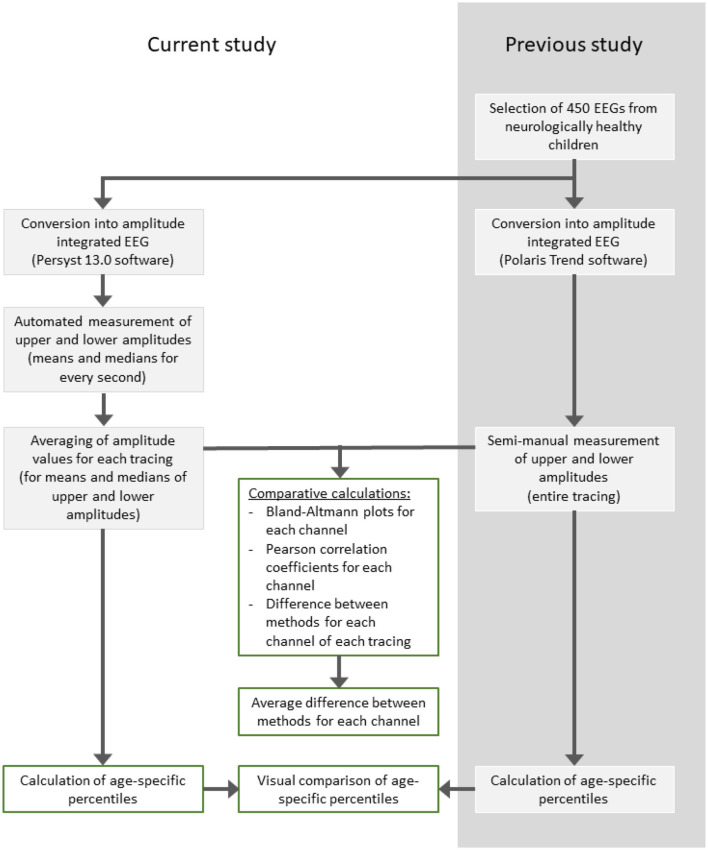 Figure 1
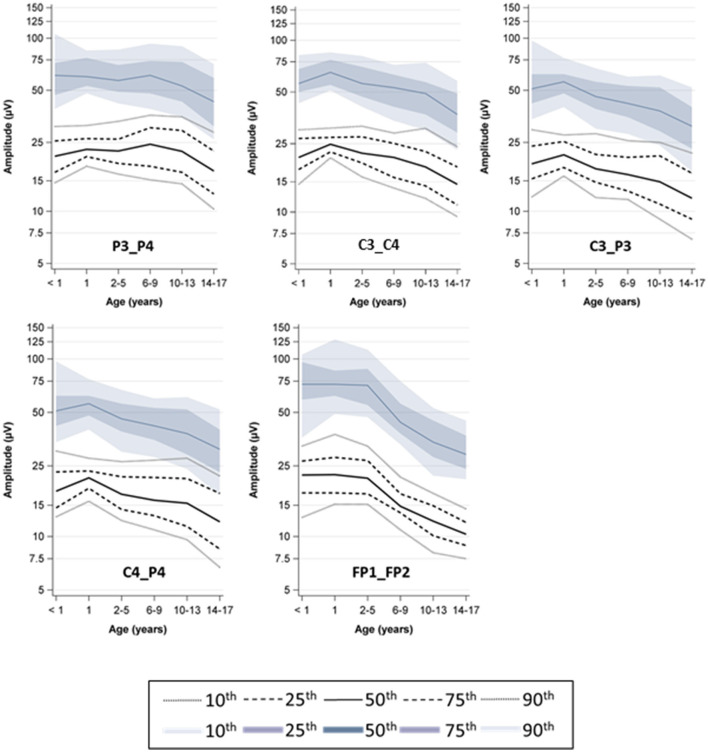 Figure 2
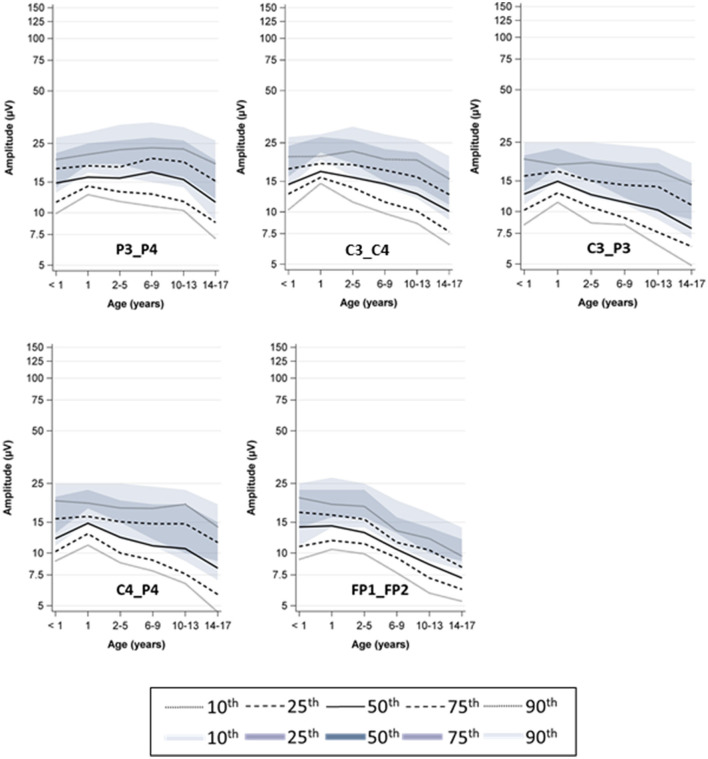 Figure 3
Peer Reviews
No public reviews on file for this paper yet. If you reviewed it on a platform where reviews are public (OpenReview, ICLR, NeurIPS, ICML), you can paste yours below so the community can read it here.
Videos
No videos yet. Explain this paper in a talk, walkthrough, or lecture? Add one.
Taxonomy
TopicsNeonatal and fetal brain pathology · EEG and Brain-Computer Interfaces · Non-Invasive Vital Sign Monitoring