Cutaneous clues to a rare osseous manifestation of paracoccidioidomycosis: The importance of early diagnosis
Márcio Fellipe Menezes Viana, Rafael Fantelli Stelini, Andréa Fernandes Eloy da Costa França, Daniela Tsukumo Mitti, Luiz Fernando Monte Borella, Fabiano Reis

TL;DR
This case report highlights a rare bone manifestation of a fungal infection in a man, emphasizing the importance of early diagnosis through skin and bone evaluation.
Contribution
The report presents a rare case of PCM with osteocutaneous involvement and underlines the role of dermatological assessment in diagnosis.
Findings
A 47-year-old man was diagnosed with PCM through biopsy and fungal examination.
Osteocutaneous PCM is rare and often mistaken for other conditions.
Long-term antifungal treatment and follow-up are essential for management.
Abstract
Paracoccidioidomycosis (PCM), the most prevalent systemic mycosis in Brazil, is caused by dimorphic fungi of the genus Paracoccidioides and is acquired primarily through inhalation. PCM is associated with a high mortality, particularly among men living in rural areas. This case report describes a 47-year-old man with osteocutaneous involvement diagnosed by biopsy and direct fungal examination. The osseous form of PCM is rare and should be differentiated from other infections and neoplasms. Management involves prolonged antifungal therapy and follow-up for at least two years. This case highlights the diagnostic value of dermatological assessments in atypical presentations of PCM.
Genes, proteins, chemicals, diseases, species, mutations and cell lines named across the full text — each resolved to its canonical identifier and authoritative record.
Click any figure to enlarge with its caption.
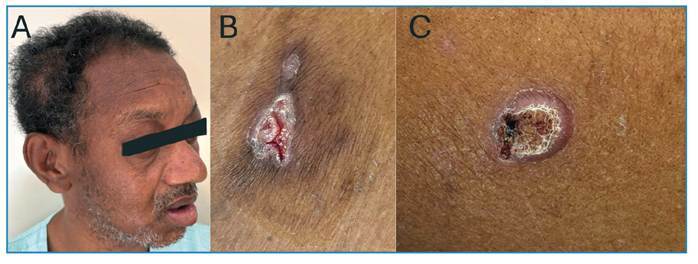 Figure 1
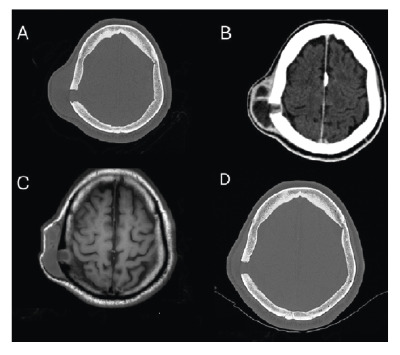 Figure 2
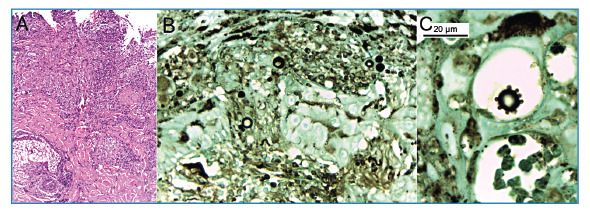 Figure 3
Peer Reviews
No public reviews on file for this paper yet. If you reviewed it on a platform where reviews are public (OpenReview, ICLR, NeurIPS, ICML), you can paste yours below so the community can read it here.
Videos
No videos yet. Explain this paper in a talk, walkthrough, or lecture? Add one.
Taxonomy
TopicsFungal Infections and Studies · Antifungal resistance and susceptibility · Nail Diseases and Treatments
INTRODUCTION
Paracoccidioidomycosis (PCM) is the most prevalent systemic mycosis in Brazil and is caused by dimorphic fungi of the genus Paracoccidioides, primarily P. brasiliensis and P. lutzii. The fungus exists in a filamentous form in moist soil, with transmission occurring via inhalation of airborne propagules. This disease predominantly affects men living in rural areas. The incubation period is highly variable, ranging from days to several decades, owing to the organism’s ability to establish latent infection1 ^-^ 5.
PCM can affect any organ, and its clinical spectrum is typically classified into acute, subacute, and chronic forms. The acute/subacute (juvenile) form, more common in children and young adults primarily involves the mononuclear phagocytic system. Chronic PCM, which accounts for approximately 80% of cases, presents with slowly, progressive pulmonary involvement and mucocutaneous lesions, particularly affecting the upper aerodigestive tract and skin1 ^-^ 5.
Osseous involvement in PCM is uncommon. It typically appears as a round, well-demarcated, osteolytic lesion, with or without a sclerotic rim. Lesions may be multifocal and can mimic bacterial osteomyelitis or neoplastic processes. The clavicle, scapula, ribs, sternum, and vertebrae, are the most frequently affected bones, whereas calvarial involvement is extremely rare. A systematic search of several databases (Cochrane Library, LILACS, MEDLINE, PubMed, PubMed Central, and SciELO) revealed only a few case reports of cranial bone involvement, all in immunocompromised patients such as individuals with systemic lupus erythematosus. To our knowledge, such cases have not been reported in immunocompetent individuals5 ^-^ 7.
This report describes a rare case of PCM involving an osteolytic lesion of the calvarium in an immunocompetent adult with histopathological confirmation and a favorable clinical response to antifungal therapy. The unusual anatomical site in a patient with no known immunosuppression and the diagnostic challenges it posed, underscore the importance of considering PCM in the differential diagnosis of cranial osteolytic lesions, even in atypical clinical contexts.
CASE REPORT
A 47-year-old man from an urban area in southeastern Brazil was referred to a tertiary hospital with a progressively enlarging parietal mass, reaching approximately 6 cm in diameter over six months (Figure 1). During this period, the patient experienced weight loss exceeding 10% of his baseline body weight. Brain computed tomography revealed a right parietal lytic bone lesion involving the entire thickness of the calvarium, with adjacent soft tissue swelling, fluid accumulation, and peripheral contrast enhancement (Figure 2).
FIGURE 1: (A) Swelling in the right parietal region. (B) Cutaneous ulcer with well-defined borders and a granular base in the lateral region of the left 9th-10th costal arch. (C) Ulcerated plaque on the lateral middle third of the left arm, with raised and well-defined borders, a granular base with hemorrhagic dots, and no evident exudate.
FIGURE 2: (A) Brain computed tomography, bone window, axial, showing a right parietal lytic bone lesion affecting the entire thickness of the shell: external board, diploe and internal board. There is also enlargement of adjacent soft tissues. (B) Brain computed tomography, parenchyma window, axial, showing fluid accumulation with peripheral enhancement in the soft tissues and involving the bone plane. (C) Brain magnetic resonance imaging (axial T1) showing fluid accumulation (hypointense on T1) in the soft tissues and in the bone of the right parietal region. (D) Brain computed tomography, bone window, axial, showing evident regression of adjacent soft tissues in the right parietal region after only three months of treatment.
The patient was admitted for further investigation with a preliminary suspicion of neoplasia. Additional laboratory investigations were conducted to rule out alternative etiologies, including serum lactate dehydrogenase, carcinoembryonic antigen, beta-human chorionic gonadotropin, alpha-fetoprotein, serum and urinary protein electrophoresis, and beta-2 microglobulin. Autoimmune screening for antinuclear antibody, quantitative immunoglobulin levels (IgA, IgG, and IgM), and serological testing for HIV, hepatitis B and C, and syphilis were also performed. All results were within the normal reference ranges.
A thorough physical examination revealed two skin ulcers with raised, well-defined borders on the chest and left arm (Figure 1). A dermatological consultation was requested, and direct examination of a smear of the skin lesions with 10% potassium hydroxide revealed yeast-like fungal structures. Histopathological analysis revealed dermal granulomas and fungal structures with multiple budding forms on Grocott staining consistent with Paracoccidioides spp. (Figure 3). Bacterial, mycobacterial, and fungal cultures were negative, whereas serological results for PCM were positive.
FIGURE 3: (A) Histology showing chronic granulomatous ulcerated dermatitis with microabscesses. Hematoxylin-eosin staining; magnification, ×100. (B) Yeast-like fungal structures of varying diameters. Grocott methenamine silver staining; magnification, ×400. (C) Oil-immersion image highlighting a fungal structure with multiple narrow-based budding daughter cells. Grocott methenamine silver staining; magnification: ×1000.
Despite a 28-day hospitalization, a definitive diagnosis was established only after a dermatological evaluation. The patient was subsequently discharged with 200 mg/day of itraconazole. The patient exhibited significant clinical improvement, with complete healing of the ulcerated lesions on the chest and left arm, and progressive reduction of the parietal mass. Serological testing for total antibodies against Paracoccidioides spp. showed a titer of 1:16 prior to the initiation of antifungal therapy, which declined to 1:4 at two months and became nonreactive after six months of treatment.
Although a biopsy of the parietal bone lesion was not performed because of the invasiveness of the procedure, the marked radiological improvement observed after only three months of antifungal therapy (Figure 2) strongly supported the interpretation that the cranial lesion shared the same etiological agent as the cutaneous lesions.
DISCUSSION
Osseous involvement in PCM is rare and primarily affects both children and young adults. PCM typically manifests as osteolytic lesions, usually without periosteal involvement or marginal sclerosis, and predominantly involves the long bones. Skull bone involvement has been rarely reported in the literature, with documented cases mainly involving transplant recipients. Bone involvement may lead to secondary osteomyelitis and soft-tissue infections8.
An early and accurate diagnosis is crucial for preventing long-term complications. A high index of clinical suspicion combined with fast and cost-effective diagnostic methods is essential for timely management. Accurate diagnosis relies on clinical and epidemiological correlations supported by complementary tests such as mucocutaneous lesion biopsy, fungal culture, and direct fungal examination, which typically reveal round budding yeast cells9.
Treatment was continued until the cure criteria were met, with itraconazole as the first-line therapy because of its superior efficacy and shorter treatment duration. Sulfamethoxazole-trimethoprim is an alternative, whereas amphotericin B is reserved for severe cases. Voriconazole is recommended for central nervous system involvement10 ^,^ 11. Follow-up should extend for at least two years post-cure and include clinical, radiological, serological, and mycological assessments. Monitoring is advised for at least one year after serological negativization12.
The characteristics of this case indicate that PCM should be considered in the differential diagnosis of skeletal lesions, particularly in patients from endemic regions or those with relevant epidemiological exposure12.
The reference list from the paper itself. Each links out to its DOI / PubMed record.
- 1Bocca AL Amaral AC Teixeira MM Sato PK Shikanai-Yasuda MA Soares Felipe MS Paracoccidioidomycosis: eco-epidemiology, taxonomy and clinical and therapeutic issues Future Microbiol 2013891177119110.2217/fmb.13.68Future Microbiol. 2013;8(12):163624020744 · doi ↗ · pubmed ↗
- 2Morris AJ Kim HY Nield B Dao A Mc Mullan B Alastruey-Izquierdo A Talaromyces marneffei, Coccidioides species, and Paracoccidioides species-a systematic review to inform the World Health Organization priority list of fungal pathogens Med Mycol 2024626 myad 133myad 13310.1093/mmy/myad 13338935909 PMC 11210613 · doi ↗ · pubmed ↗
- 3Amstalden EM Xavier R Kattapuram SV Bertolo MB Swartz MN Rosenberg AE Paracoccidioidomycosis of bones and joints: a clinical, radiologic, and pathologic study of 9 cases Medicine Baltimore 199675421322510.1097/00005792-199607000-000048699961 · doi ↗ · pubmed ↗
- 4França AF Velho PE Reis F Spinal cord and cutaneous involvement in paracoccidioidomycosis Rev Soc Bras Med Trop 202154 e 0115202110.1590/0037-8682-0115-2021 PMC 808389333950124 · doi ↗ · pubmed ↗
- 5Mendes RMT Oliveira MS Costa FAM Silva LC Martins GMR Souza JVL Paracoccidioidomycosis with atypical manifestation: disseminated infection with arterial thrombosis and osteomyelitis Int J Dermatol 2024631 e 45-e 4810.1111/ijd.16837 · doi ↗
- 6Savarese LG Monsignore LM Hernandes MA Martinez R Nogueira-Barbosa MH Magnetic resonance imaging findings of paracoccidioidomycosis in the musculoskeletal system Trop Med Int Health 201520101346135410.1111/tmi.1255226138054 · doi ↗ · pubmed ↗
- 7Beltrão LO Pangracio M Souza CS Sarcoid-like paracoccidioidomycosis in a female urban dweller: reviewing a rare clinical condition in Brazil Mycopathologia 2018183584785210.1007/s 11046-018-0266-529737451 · doi ↗ · pubmed ↗
- 8Pereira FV Alves KP Altemani AM Reis F Disseminated paracoccidioidomycosis with skull and mandible involvement in a heart transplant recipient Rev Soc Bras Med Trop 202255 e 0110202210.1590/0037-8682-0110-2022 PMC 917672835674557 · doi ↗ · pubmed ↗