Switchable pathways of multicomponent heterocyclizations of 5-amino-1,2,4-triazoles with salicylaldehydes and pyruvic acid
Yana I Sakhno, Oleksander V Buravov, Kostyantyn Yu Yurkov, Anastasia Yu Andryushchenko, Svitlana V Shishkina, Valentyn A Chebanov

TL;DR
This paper shows how changing reaction conditions can switch the products formed from the same starting chemicals.
Contribution
The study demonstrates a switchable pathway in multicomponent reactions using triazoles, pyruvic acid, and salicylaldehydes.
Findings
Conventional heating produces benzotriazolooxadiazocine-5-carboxylic acids.
Ultrasonic activation or room temperature stirring yields tetrahydrotriazolopyrimidine derivatives.
Abstract
Switchable multicomponent reactions involving 3-substituted-5-amino-1,2,4-triazoles, pyruvic acid, and salicylaldehydes were studied under different conditions. Upon conventional heating, benzotriazolooxadiazocine-5-carboxylic acids were formed in the three-component reactions as single reaction products. Upon ultrasonic activation or mechanical stirring at room temperature, the multicomponent reaction of the same starting materials led to the formation of only tetrahydrotriazolopyrimidine derivatives.
Genes, proteins, chemicals, diseases, species, mutations and cell lines named across the full text — each resolved to its canonical identifier and authoritative record.
Click any figure to enlarge with its caption.
 Figure 1
 Figure 2
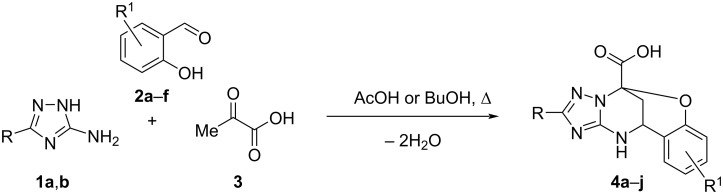 Figure 3
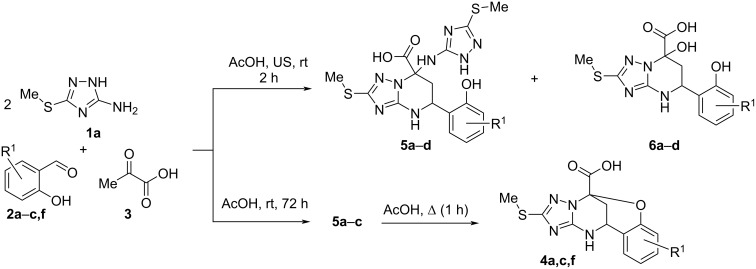 Figure 4
Peer Reviews
No public reviews on file for this paper yet. If you reviewed it on a platform where reviews are public (OpenReview, ICLR, NeurIPS, ICML), you can paste yours below so the community can read it here.
Videos
No videos yet. Explain this paper in a talk, walkthrough, or lecture? Add one.
Taxonomy
TopicsMulticomponent Synthesis of Heterocycles · Synthesis and Characterization of Heterocyclic Compounds · Synthesis and biological activity