Immune cell isolation from lymphoid and nonlymphoid organs
Jong Seok Park, Yoontae Lee

TL;DR
This editorial provides practical protocols for isolating immune cells from both lymphoid and nonlymphoid organs.
Contribution
The paper introduces concise protocols for immune cell isolation from diverse organs, including nonlymphoid tissues.
Findings
Immune cells are found in both lymphoid and nonlymphoid organs.
Protocols are provided for isolating immune cells from various tissues.
These cells play roles in local immune surveillance and response.
Abstract
Immune cells are distributed across various tissues. While a majority are concentrated in primary and secondary lymphoid organs such as the bone marrow, thymus, lymph nodes, and spleen, a subset resides in nonlymphoid organs, including the kidney, liver, and lung, as well as the peritoneal cavity, where they play critical roles in local immune surveillance and response. In this editorial, we outline concise and practical protocols for the isolation of immune cells from a range of lymphoid and nonlymphoid organs.
Genes, proteins, chemicals, diseases, species, mutations and cell lines named across the full text — each resolved to its canonical identifier and authoritative record.
Click any figure to enlarge with its caption.
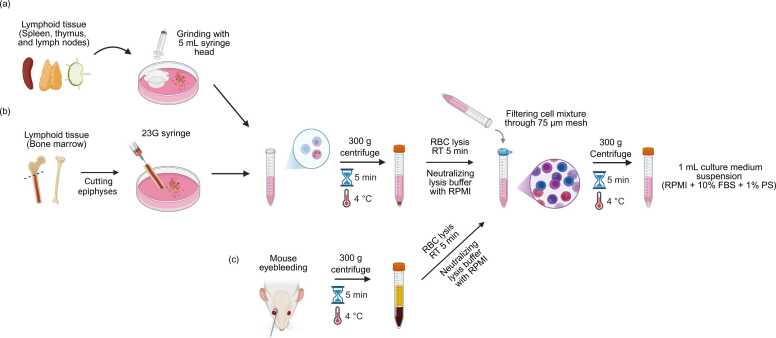 Figure 1
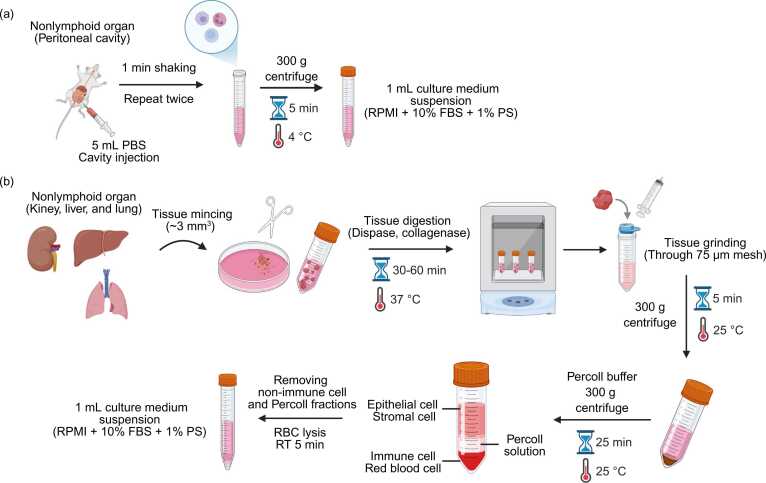 Figure 2
Peer Reviews
No public reviews on file for this paper yet. If you reviewed it on a platform where reviews are public (OpenReview, ICLR, NeurIPS, ICML), you can paste yours below so the community can read it here.
Videos
No videos yet. Explain this paper in a talk, walkthrough, or lecture? Add one.
Taxonomy
TopicsImmune Cell Function and Interaction · IL-33, ST2, and ILC Pathways · T-cell and B-cell Immunology