Complete genome sequence of mycobacteriophage Hashim76, a B13 subcluster phage, from Hanahan, South Carolina
Riley M. Polic, Isabella E. Gustafson, Hams A. Kamil, Dhruvi B. Patel, Abigail C. Davis, Kennedy A. Gohl, Maxim J. Halma, Hannah G. Korper, Hannah S. Linde, Stephanie B. Moore, Mikayla G. Sonnenfeld, Nathan E. Thompson, Ryan P. Ware, Reese M. Ziegler, Mouna S. DiBenedetto

TL;DR
This paper reports the complete genome sequence of a mycobacteriophage named Hashim76, isolated from mud in South Carolina.
Contribution
The study provides a new genome sequence for a B13 subcluster phage and identifies its genetic features and similarity to another phage.
Findings
Hashim76 has a circular double-stranded DNA genome of 70,230 bp with a GC content of 70.1%.
The genome contains 101 putative protein-coding genes but lacks tRNA sequences.
Hashim76's genome shows high similarity (93.91% identity) to the phage Zenteno07.
Abstract
Hashim76, a B13 subcluster bacteriophage extracted from mud (Hanahan, South Carolina), infects Mycobacterium smegmatis mc2155 and exhibits siphovirus morphology. It has a circular double-stranded DNA genome (70,230 bp; GC content = 70.1) containing 101 putative protein-coding genes but no tRNA sequences. Whole-genome BLASTn alignment revealed high similarity to Zenteno07 (93.91% identity, 90% query coverage).
Genes, proteins, chemicals, diseases, species, mutations and cell lines named across the full text — each resolved to its canonical identifier and authoritative record.
Click any figure to enlarge with its caption.
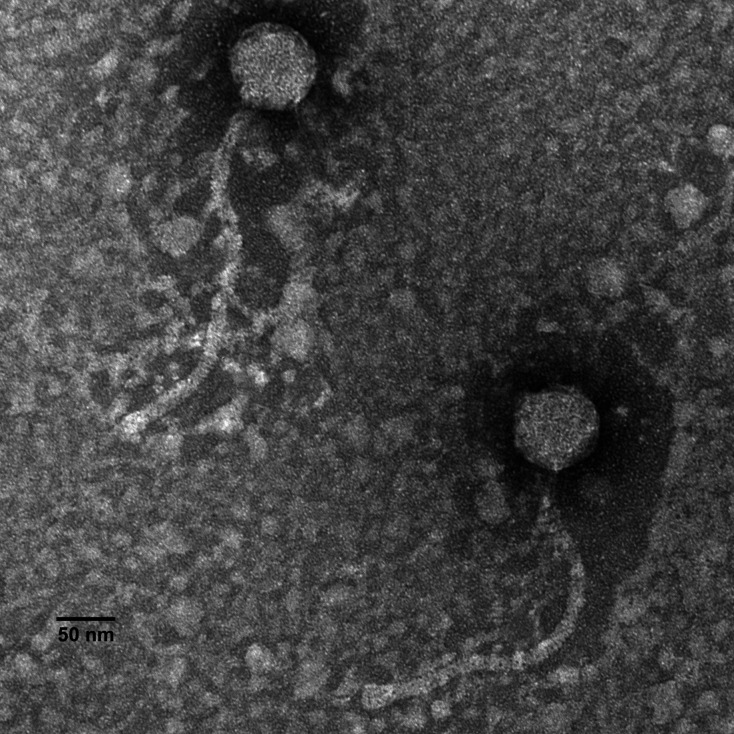 Fig 1
Fig 1| Parameter | Hashim76 data |
|---|---|
| GenBank accession no. |
|
| SRA accession no. |
|
| Collection site | Hanahan, South Carolina, USA |
| Collection site coordinates | 32.95276 N, 80.03173 W |
| Isolation host | |
| Genome size (bp) | 70,230 |
| Coverage (×) | 955 |
| GC content (%) | 70.1 |
| No. of predicted protein-coding genes | 101 |
| No. of tRNAs | 0 |
| No. of tmRNAs | 0 |
| Morphotype | Siphovirus |
| Subcluster | B13 |
Peer Reviews
No public reviews on file for this paper yet. If you reviewed it on a platform where reviews are public (OpenReview, ICLR, NeurIPS, ICML), you can paste yours below so the community can read it here.
Videos
No videos yet. Explain this paper in a talk, walkthrough, or lecture? Add one.
Taxonomy
TopicsBacteriophages and microbial interactions · Genomics and Phylogenetic Studies · Plant Virus Research Studies
ANNOUNCEMENT
As interest in treating mycobacterial infections with bacteriophage therapy has increased (1, 2), there has been a broad effort to isolate and sequence relevant viruses (3). Currently, 2,624 mycobacteriophage genomes have been sequenced (https://phagesdb.org/) and the viruses categorized into clusters/subclusters based on sequence similarity, with those in the same cluster sharing >50% nucleotide sequence coverage and/or >35% gene content similarity (GCS) (4–6). Hashim76 (Family Bclasvirinae) is of particular interest as a member of the understudied B13 subcluster.
Hashim76 was isolated in September 2023 from mud collected beside a pond in Hanahan, South Carolina (32.95276 N, 80.03173 W). Soil surface samples (15 mL) were placed in a 50 mL conical tube, and 7H9 broth containing 1 mM CaCl_2_ was added to 35 mL. This sample was then washed for 1 h (250 rpm, 37°C), centrifuged (2,000 × g, 10 min), and filtered (0.22 µm pore). During enrichment, filtrates were inoculated with Mycobacterium smegmatis mc^2^155 (0.5 mL bacteria/25 mL filtrate), agitated for 3 days (250 rpm, 37°C), filtered again, plated using the double-layer agar method with 7H9 agar containing M. smegmatis, and incubated at 37°C (SEA-PHAGES Discovery Guide provides details) (7). After two purification/amplification cycles, plates densely populated with plaques were flooded with phage buffer, incubated for 2–4 h at room temperature, and lysate collected. Examination of Hashim76 by transmission electron microscopy also revealed siphovirus morphology with mean capsid diameter = 73.5 nm (n = 22), tail length = 309.9 nm (n = 21), and tail width = 12.6 nm (n = 22) (Fig. 1).
Morphology of the subcluster B13 bacteriophage Hashim76 examined using a JEOL 1010 transmission electron microscope at 80 kV. High-titer lysates collected on Formvar-coated copper grids were negatively stained with 1% uranyl acetate (4). Scale bar, 50 nm.
To study the genome, DNA was extracted from lysates (8.5 × 10^7^ plaque-forming units/mL) using the Promega Wizard DNA cleanup system, and the DNA library was prepared using an NEBNext Ultra(II) DNA Library Prep kit. Sequencing was performed on an Illumina MiSeq system (MiSeq reagent kit v.3) (8), and the 472,851 single-end reads (150 bp) were assembled into a single contig using Newbler v.2.9 (9). Further editing and finishing were performed on Consed v.29.0 (10), and because there was even coverage across the genome with no selective accumulation of reads, the genome is circularly permuted. For assembly/quality control details, see reference 8.
Genome annotation was performed using the PECAAN (11) workflow tool, and final files were transferred to DNA Master v.5.23.2 (https://phagesdb.org/DNAMaster). Putative genes were identified with Glimmer v.3.02 (12), Starterator v.1.1 (13), Genemark v.3.25 (14), Phamerator Actino_prophage v.5 (15), ARAGORN v.1.2.38 (16), and tRNAscan-SE v.3.0 (17). Domains and functional assignments were detected using BLASTp v.2.8.2+ (18), HHpred v.2.1 (19), TMHMM Deep v.1.0.42 (20), SOSUI v.1.11 (21), and the NCBI Conserved Domain Database (22). Default settings were applied to all programs except as summarized in https://seaphages.org/forums/topic/5398.
The Hashim76 genome is 70,230 bp long (955× coverage, 70.1% GC content) and contains 101 predicted protein-coding genes (Table 1). Thirty-one have identified putative functions, and four are unique to Hashim76 (gp66, gp84, gp87, and gp101). Five are unique to B13 subcluster viruses, occurring in all three subcluster members (gp62, gp76, gp82, gp96, and gp97), and no tRNAs are present. Based on whole-genome comparisons using BLASTn (18) and GCS (6), the closest viral relatives to Hashim76 are the other two B13 subcluster members, Zenteno07 from Round Rock, Texas (Genbank ON392167.1; 93.91% identity, 90% coverage, and 84.1% GCS) and BirdsNest from Kruger National Park, Phalaborwa, South Africa (Genbank MN813686.1; 90.76% identity, 84% coverage, and 78.7% GCS).
The reference list from the paper itself. Each links out to its DOI / PubMed record.
- 1Diacon AH, Guerrero-Bustamante CA, Rosenkranz B, Rubio Pomar FJ, Vanker N, Hatfull GF. 2022. Mycobacteriophages to treat Tuberculosis: dream or delusion? Respiration 101:1–15. doi:10.1159/00051987034814151 · doi ↗ · pubmed ↗
- 2Nick JA, Dedrick RM, Gray AL, Vladar EK, Smith BE, Freeman KG, Malcolm KC, Epperson LE, Hasan NA, Hendrix J, et al.. 2022. Host and pathogen response to bacteriophage engineered against Mycobacterium abscessus lung infection. Cell 185:1860–1874. doi:10.1016/j.cell.2022.04.02435568033 PMC 9840467 · doi ↗ · pubmed ↗
- 3Jordan TC, Burnett SH, Carson S, Caruso SM, Clase K, De Jong RJ, Dennehy JJ, Denver DR, Dunbar D, Elgin SCR, et al.. 2014. A broadly implementable research course in phage discovery and genomics for first-year undergraduate students. M Bio 5:e 01051-13. doi:10.1128/m Bio.01051-1324496795 PMC 3950523 · doi ↗ · pubmed ↗
- 4Hatfull GF, Jacobs-Sera D, Lawrence JG, Pope WH, Russell DA, Ko C-C, Weber RJ, Patel MC, Germane KL, Edgar RH, et al.. 2010. Comparative genomic analysis of 60 mycobacteriophage genomes: genome clustering, gene acquisition, and gene size. J Mol Biol 397:119–143. doi:10.1016/j.jmb.2010.01.01120064525 PMC 2830324 · doi ↗ · pubmed ↗
- 5Hatfull GF. 2020. Actinobacteriophages: genomics, dynamics, and applications. Annu Rev Virol 7:37–61. doi:10.1146/annurev-virology-122019-07000932991269 PMC 8010332 · doi ↗ · pubmed ↗
- 6Mavrich TN, Hatfull GF. 2017. Bacteriophage evolution differs by host, lifestyle and genome. Nat Microbiol 2:17112. doi:10.1038/nmicrobiol.2017.11228692019 PMC 5540316 · doi ↗ · pubmed ↗
- 7Poxleitner M, Pope W, Jacobs-Sera D, Sivanathan V, Hatfull G. 2018. Phage discovery guide. Chevy Chase, MD Howard Hughes Medical Institute. https://seaphagesphagediscoveryguide.helpdocsonline.com/home.
- 8Russell DA. 2018. Sequencing, assembling, and finishing complete bacteriophage genomes. Methods Mol Biol 1681:109–125. doi:10.1007/978-1-4939-7343-9_929134591 · doi ↗ · pubmed ↗