Complete genome annotation of the cluster EC Microbacterium phage Nicole72 from Pittsburgh, Pennsylvania
Adam J. Ziegler, Christa P. Joby, Hams A. Kamil, Ethan Johnson, Ashlyn L. Ivey, Vanessa A. Fullante, Gautam Ghosh, Laura Leal Martinez, Gabrielle A. Tutelo, Devya Wilson, Christine A. Byrum

TL;DR
This paper reports the full genome analysis of a new microbacteriophage, Nicole72, isolated in Pittsburgh.
Contribution
The study provides a complete genome annotation of the newly identified phage Nicole72.
Findings
Nicole72 has a 55,431 bp genome with 90 predicted protein-coding genes.
The phage belongs to the siphovirus morphology and is closely related to the Megan phage with 81.5% nucleotide identity.
Abstract
Nicole72, a microbacteriophage isolated from a flowerbed in Pittsburgh, Pennsylvania, has a 55,431 bp genome containing 90 predicted protein-coding genes and no transfer RNAs or transfer-messenger RNAs. Nicole72 has siphovirus morphology and is most closely related to the EC cluster microbacteriophage Megan where BLASTn indicates 81.5% identity, 86% query coverage.
Genes, proteins, chemicals, diseases, species, mutations and cell lines named across the full text — each resolved to its canonical identifier and authoritative record.
Click any figure to enlarge with its caption.
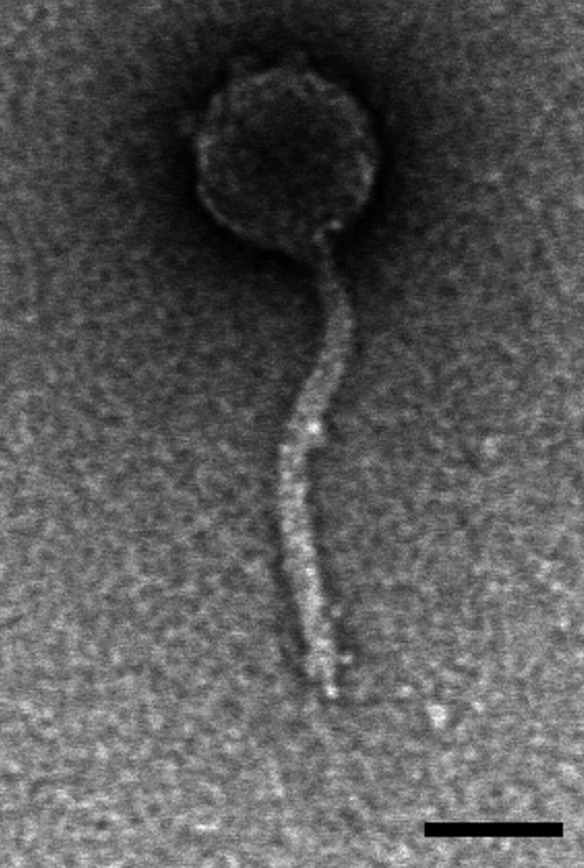 Fig 1
Fig 1| Parameter | Nicole72 data |
|---|---|
| GenBank accession no. |
|
| SRA accession no. |
|
| Isolation site | Pittsburgh, PA, USA |
| Collection site coordinates | 40.443649 N; 79.054516 W |
| Isolation host | |
| Genome size (bp) | 55,431 |
| Approximate shotgun coverage (x) | 84 |
| GC content (%) | 69.7 |
| No. of predicted protein-coding genes | 90 |
| No. of tRNAs | 0 |
| No. of tmRNAs | 0 |
| Morphotype | Siphovirus morphology |
| Cluster | EC |
| Predicted protein-coding genes only found in Nicole72 (orphams) | 3, 6, 17, 18, 19, 37, 63 (membrane protein), 70 (deoxycytidylate deaminase), 74, 76, and 89 |
| Predicted protein-coding genes (phams) unique to and conserved in at least 95% of EC cluster members | 24, 29 (tail assembly chaperone), 30, 41 (membrane protein), 43, 48, 50, 69, 72 (membrane protein), and 73 (membrane protein) |
Peer Reviews
No public reviews on file for this paper yet. If you reviewed it on a platform where reviews are public (OpenReview, ICLR, NeurIPS, ICML), you can paste yours below so the community can read it here.
Videos
No videos yet. Explain this paper in a talk, walkthrough, or lecture? Add one.
Taxonomy
TopicsBacteriophages and microbial interactions · Genomics and Phylogenetic Studies · Plant Virus Research Studies
ANNOUNCEMENT
The bacteriophage Nicole72 was studied/annotated in a broader effort to better understand actinobacteriophage genomes and evolution (1). It was discovered in 2019 in the soil of an abandoned flowerbed outside William Pitt Union, University of Pennsylvania (40.443649 N, 79.954516 W). After washing this sample (15 mL) in a conical tube filled to 35 mL with 7H9 buffer +1 mM CaCl_2_ (250 rpm, 1–2 hours, 30°C), the supernatant was collected by centrifugation and syringe-filtered (0.22 µm pore). Samples were then inoculated with 0.5 mL Microbacterium paraoxydans NWU1, incubated (250 rpm, 3–5 days, 30°C), refiltered, and plated using the double-layer method in 7H9 top agar containing Microbacterium host (full protocol in SEA-PHAGES Discovery Guide) (2). Transmission electron microscopy revealed Nicole72 (*n *= 1) has siphovirus morphology (tail length = 170.4 nm; tail width = 10.4 nm; capsid width = 67.8 nm) (Fig. 1).
Micrograph of the cluster EC microbacteriophage Nicole72. Viruses were mounted on Formvar-coated copper grids and then negatively stained with 1% uranyl acetate (2). Images were collected using a JEOL 1010 transmission electron microscope at 80 kV. Scale bar equals 50 nm.
Using the Promega Wizard DNA cleanup system, DNA was extracted from high-titer lysates (Protocol 7.1, Reference 2) and measured (Nanospec 2000), and a DNA library was prepared per manufacturer instructions using the NEBNext Ultra II DNA library prep kit. The genome was sequenced using an Illumina MiSeq system (v3 reagents) (3), and 32,570 raw reads (150 bp, single-end reads) were assembled into one contig using Newbler v2.9 (4). The genome was edited/finished with Consed v29.0 (3, 5) and this tool was utilized to assess read buildup.https://cpt.tamu.edu/computer-dresourcs/pause AceUtil (http://phagesdb.org/AceUtil) was run to detect sequence discrepancies/low-coverage sites. Finally, the genome was oriented so (i) structural genes appear on the forward strand, and (ii) base 1 is aligned similarly, where possible, with genes in other EC cluster members.
Annotation was performed using the workflow tool PECAAN (6). To predict gene functions, programs used included GLIMMER v3.02 (7), GeneMark v2.5 (8), Starterator v1.2 (https://seaphages.org/media/docs/Starterator_Guide_2016.pdf), ARAGORN v1.2.38 (9), tRNAscan-SE v3.0 (10), and Phamerator Actino_prophage v5 (11). Functional assignments were made using BLASTp v2.13.0+ (12), HHpred (13), and NCBI’s Conserved Domain Database (CDD) (14). Transmembrane domains were detected with TMHMM2 (https://services.healthtech.dtu.dk/service.php?TMHMM-2.0), SOSUI v1.11 (15), and TOPCONS v2 (16). Programs were set to default parameters, and final PECAAN files were transferred to DNA Master v5.22.2 (https://phagesdb.org/DNAMaster).
The Nicole72 genome is 55,431 bp with 69.7% GC and 84× fold coverage. Because even coverage was detected across the genome with no selective accumulation of reads, the genome is circularly permuted (3). Nicole72’s genome contains 90 predicted protein-coding genes (27 with assigned putative functions; 6 membrane proteins) but lacks transfer RNAs/transfer-messenger RNAs. Based on gene content similarity (GCS) scores, Hashim76 is an EC cluster phage (GCS = #phams shared between two genomes ÷ total #phams, where phams are predicted homologous sequences sharing >32.5% amino acid identity in CLUSTALW, BLASTp E-values <10^−50^) (17–19). To check how often each Nicole72 pham corresponded to sequences in other actinobacteriophages, a pull-down menu listing clusters containing the conserved sequence was accessed on Phamerator (11). The Nicole72 genome contains 11 unique phams (orphams) and has 10 phams conserved throughout the EC cluster (>95% of members and only occurring in the EC cluster) (Table 1). GCS scores (19) and BLASTn alignment (12) revealed that the Nicole72 genome most resembles that of microbacteriophage Megan (Genbank MN586020; 78.90% GCS, 85.08% percent identity, 81% coverage). Interestingly, both Megan and Nicole72 are predicted to transcribe preQ0 pathway proteins synthesizing queuosine and archaeosine. Although these sequences are sometimes conserved in other actinobacteriophages, Megan and Nicole72 are the only EC cluster genomes with these (20). Finally, Nicole72 is lytic, since it codes for an endolysin (LysinA) and lacks candidate lysogeny genes.
The reference list from the paper itself. Each links out to its DOI / PubMed record.
- 1Jordan TC, Burnett SH, Carson S, Caruso SM, Clase K, De Jong RJ, Dennehy JJ, Denver DR, Dunbar D, Elgin SCR, et al.. 2014. A broadly implementable research course in phage discovery and genomics for first-year undergraduate students. M Bio 5:e 01051-13. doi:10.1128/m Bio.01051-1324496795 PMC 3950523 · doi ↗ · pubmed ↗
- 2Poxleitner M, Pope W, Jacobs-Sera D, Sivanathan V, Hatfull G. 2018. Phage discovery guide. Chevy Chase, MD Howard Hughes Medical Institute. https://seaphagesphagediscoveryguide.helpdocsonline.com/home.
- 3Russell DA. 2018. Sequencing, assembling, and finishing complete bacteriophage genomes. Methods Mol Biol 1681:109–125. doi:10.1007/978-1-4939-7343-9_929134591 · doi ↗ · pubmed ↗
- 4Margulies M, Egholm M, Altman WE, Attiya S, Bader JS, Bemben LA, Berka J, Braverman MS, Chen Y-J, Chen Z, et al.. 2005. Genome sequencing in microfabricated high-density picolitre reactors. Nature 437:376–380. doi:10.1038/nature 0395916056220 PMC 1464427 · doi ↗ · pubmed ↗
- 5Gordon D, Green P. 2013. Consed: a graphical editor for next-generation sequencing. Bioinformatics 29:2936–2937. doi:10.1093/bioinformatics/btt 51523995391 PMC 3810858 · doi ↗ · pubmed ↗
- 6Rinehart, Gaffney , Smith. 2016. PECAAN: phage evidence collection and annotation network. Bowling Green, KY Western Kentucky University Bioinformatics and Information Science Center. https://seaphages.org/media/docs/PECAAN_User_Guide_Dec 7_2016.pdf.
- 7Delcher AL, Harmon D, Kasif S, White O, Salzberg SL. 1999. Improved microbial gene identification with GLIMMER. Nucleic Acids Res 27:4636–4641. doi:10.1093/nar/27.23.463610556321 PMC 148753 · doi ↗ · pubmed ↗
- 8Besemer J, Borodovsky M. 2005. Gene Mark: web software for gene finding in prokaryotes, eukaryotes and viruses. Nucleic Acids Res 33:W 451–4. doi:10.1093/nar/gki 48715980510 PMC 1160247 · doi ↗ · pubmed ↗