Exploring subthreshold processing for next-generation TinyAI
Farid Nakhle, Antoine H. Harfouche, Hani Karam, Vasileios Tserolas

TL;DR
This paper explores how subthreshold processing in biological neurons can inspire energy-efficient AI designs for TinyAI.
Contribution
The paper introduces novel AI architecture concepts inspired by subthreshold dynamics in biological systems.
Findings
Subthreshold processing in biological systems offers significant energy efficiency for AI.
Graded activation functions and hybrid systems can emulate biological energy efficiency.
Neuromorphic hardware may support subthreshold-inspired AI operations.
Abstract
The energy demands of modern AI systems have reached unprecedented levels, driven by the rapid scaling of deep learning models, including large language models, and the inefficiencies of current computational architectures. In contrast, biological neural systems operate with remarkable energy efficiency, achieving complex computations while consuming orders of magnitude less power. A key mechanism enabling this efficiency is subthreshold processing, where neurons perform computations through graded, continuous signals below the spiking threshold, reducing energy costs. Despite its significance in biological systems, subthreshold processing remains largely overlooked in AI design. This perspective explores how principles of subthreshold dynamics can inspire the design of novel AI architectures and computational methods as a step toward advancing TinyAI. We propose pathways such as…
Genes, proteins, chemicals, diseases, species, mutations and cell lines named across the full text — each resolved to its canonical identifier and authoritative record.
Click any figure to enlarge with its caption.
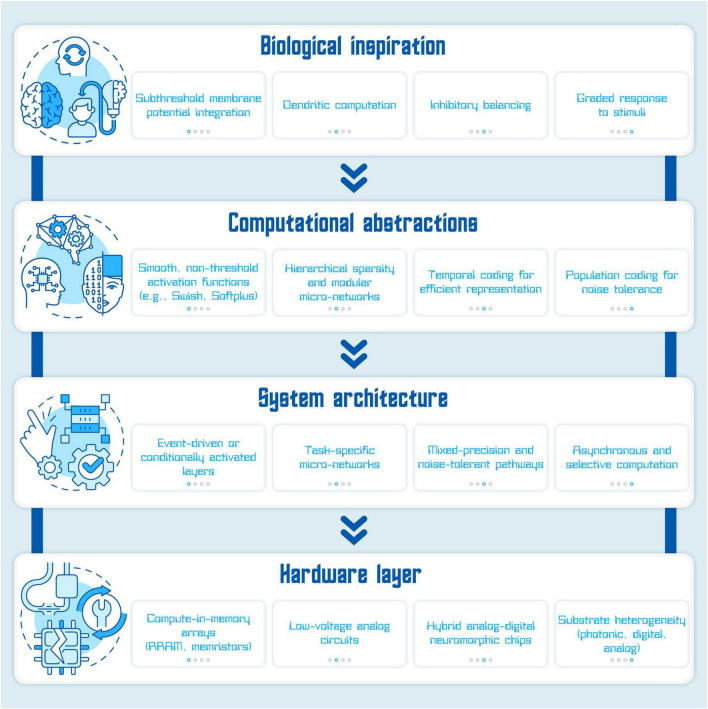 Figure 1
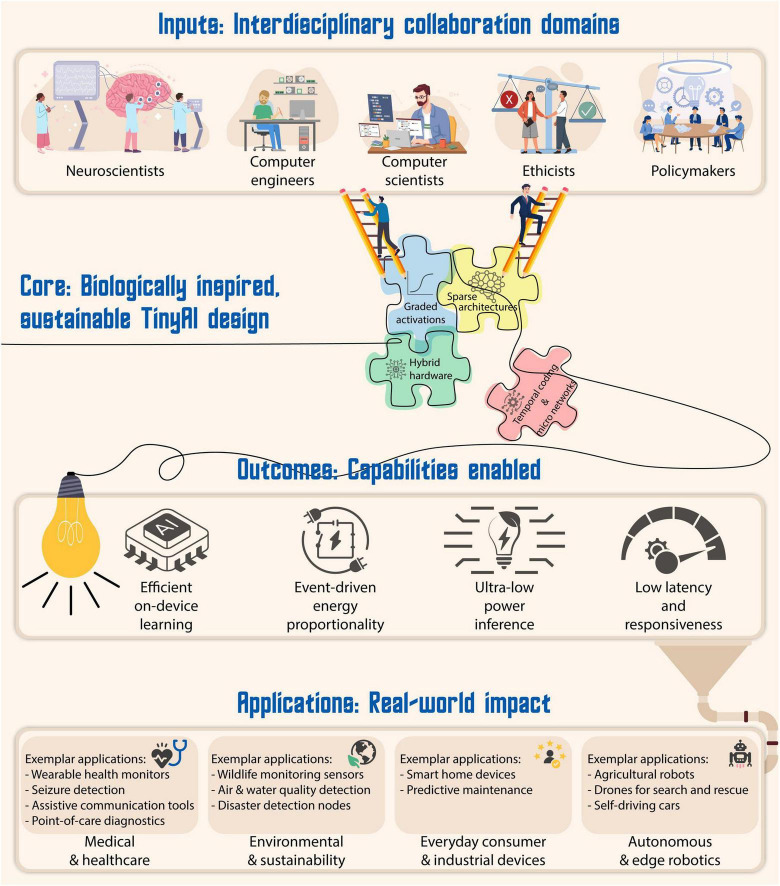 Figure 2
Peer Reviews
No public reviews on file for this paper yet. If you reviewed it on a platform where reviews are public (OpenReview, ICLR, NeurIPS, ICML), you can paste yours below so the community can read it here.
Videos
No videos yet. Explain this paper in a talk, walkthrough, or lecture? Add one.
Taxonomy
TopicsAdvanced Memory and Neural Computing · Neural dynamics and brain function · Ferroelectric and Negative Capacitance Devices