Unveiling Facklamia: detection of an emerging microbe in the skin microbiome of patients with filarial lymphedema
Danapriyaa Dharmalingam, Janani Semalaiyappan, Sankari Thirumal, Vijesh Sreedhar Kuttiatt

TL;DR
Facklamia, a rare microbe, was found in the skin of patients with filarial lymphedema, suggesting a possible link to their condition.
Contribution
This is the first report of Facklamia detection in filarial lymphedema patients.
Findings
Facklamia was detected in the skin microbiome of three filarial lymphedema patients.
This is the first known association of Facklamia with filarial lymphedema.
Further research is needed to understand Facklamia's role in skin infections.
Abstract
Facklamia is an emerging pathogen in human beings and only a few clinical cases were reported in the literature. We detected the presence of this unusual microbe among the skin flora of three patients with filarial lymphedema in a 16S rRNA-based metagenomic study on the skin microbiome. To our knowledge, this is the first report of detection of this microbe in patients affected with filarial lymphedema. Further investigations are required to elucidate the role of Facklamia in secondary skin and soft tissue infection of filarial lymphedema patients.
Genes, proteins, chemicals, diseases, species, mutations and cell lines named across the full text — each resolved to its canonical identifier and authoritative record.
Click any figure to enlarge with its caption.
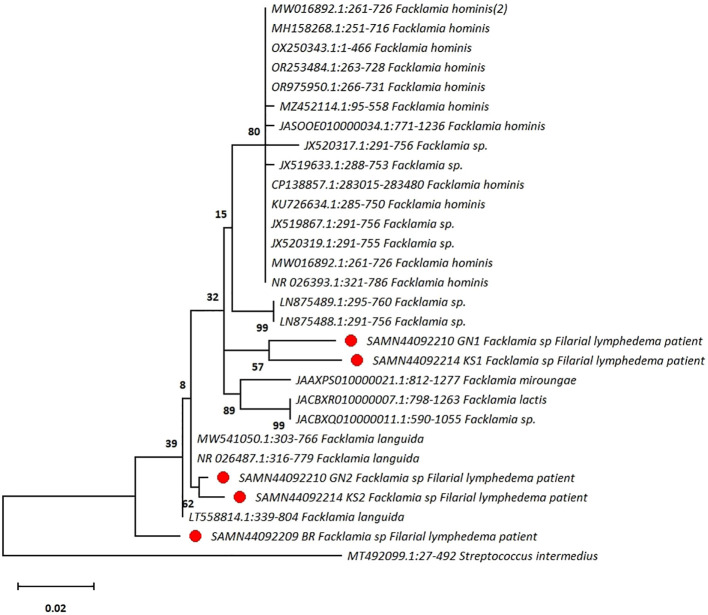 Figure 1
Peer Reviews
No public reviews on file for this paper yet. If you reviewed it on a platform where reviews are public (OpenReview, ICLR, NeurIPS, ICML), you can paste yours below so the community can read it here.
Videos
No videos yet. Explain this paper in a talk, walkthrough, or lecture? Add one.
Taxonomy
TopicsParasitic Diseases Research and Treatment · Antifungal resistance and susceptibility · Parasites and Host Interactions