Kidney transplantation between identical twins with APOL1 homozygote risk alleles – a case report
Sean Lei, Abhirami Shankar, Supreet Sethi, Erik L. Lum

TL;DR
A case report describes successful kidney transplantation between identical twins with a high-risk APOL1 gene variant.
Contribution
Demonstrates successful transplantation outcomes despite high-risk APOL1 genotype in identical twins.
Findings
Identical twins with APOL1 homozygote risk alleles underwent successful living kidney transplantation.
Short-term outcomes for both donor and recipient were excellent.
Abstract
Kidney transplantation is the optimal therapy for individuals with end-stage kidney disease. Recent studies suggest a negative impact of high-risk Apolipoprotein L1 genotypes on outcomes for both living kidney donors and kidney transplant recipients. In this case, we describe a pair of identical twins with a high-risk APOL1 genotype who underwent successful living kidney transplantation with excellent short-term outcomes.
Genes, proteins, chemicals, diseases, species, mutations and cell lines named across the full text — each resolved to its canonical identifier and authoritative record.
Click any figure to enlarge with its caption.
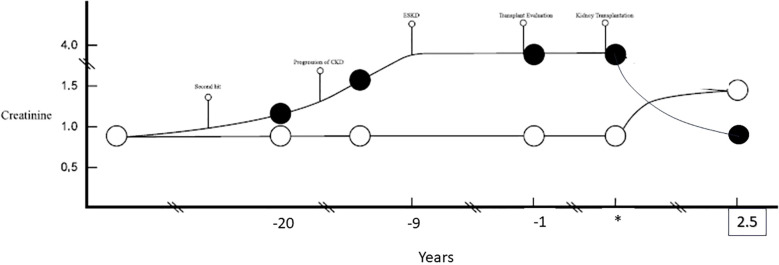 Figure 1
Peer Reviews
No public reviews on file for this paper yet. If you reviewed it on a platform where reviews are public (OpenReview, ICLR, NeurIPS, ICML), you can paste yours below so the community can read it here.
Videos
No videos yet. Explain this paper in a talk, walkthrough, or lecture? Add one.
Taxonomy
TopicsRenal Diseases and Glomerulopathies · Chronic Lymphocytic Leukemia Research · Chronic Kidney Disease and Diabetes