Evaluation of the Modified Early Warning Score (MEWS) in In-Hospital Cardiac Arrest in a Tertiary Healthcare Facility
Osakpolor Ogbebor, Sitara Niranjan, Vikram Saini, Deeksha Ramanujam, Briana DiSilvio, Tariq Cheema

TL;DR
This study evaluates how the Modified Early Warning Score (MEWS) changes before in-hospital cardiac arrests, suggesting it could help identify at-risk patients up to 6 hours in advance.
Contribution
The study provides new evidence that MEWS trends can predict cardiac arrest up to 6 hours before the event.
Findings
MEWS increased significantly from 12 hours to 1 hour before cardiac arrest (p ≤ 0.001).
Only 20.7% of patients who had a cardiac arrest survived to hospital discharge.
MEWS increased from 6 hours to 1 hour before cardiac arrest (p = 0.023).
Abstract
Background/Objective: In-hospital cardiac arrest has high incidence and poor survival rates, posing a significant healthcare challenge. It is important to intervene in the hours before the cardiac arrest to prevent poor outcomes. The modified early warning score (MEWS) is a validated tool for identifying a deteriorating patient. It is an aggregate of vital signs and level of consciousness. We retrospectively evaluated MEWS for trends that might predict patient outcomes. Methods: We performed a single-center, one-year, retrospective study. A comprehensive review was conducted for patients aged 18 years and above who experienced a cardiac arrest. Cases that occurred within an intensive care unit, emergency department, during a procedure, or outside the hospital were excluded. A total of 87 cases met our predefined inclusion criteria. We collected data at 12 h, 6 h and 1 h time periods…
Genes, proteins, chemicals, diseases, species, mutations and cell lines named across the full text — each resolved to its canonical identifier and authoritative record.
Click any figure to enlarge with its caption.
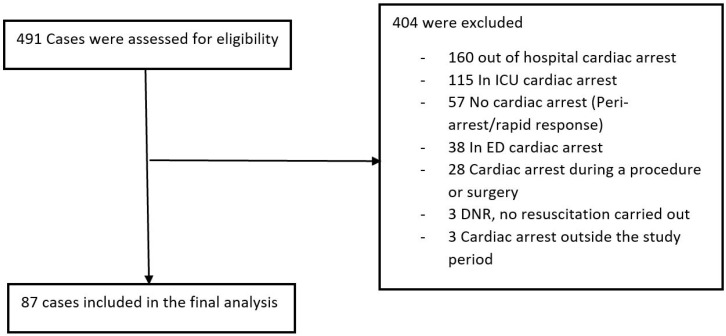 Figure 1
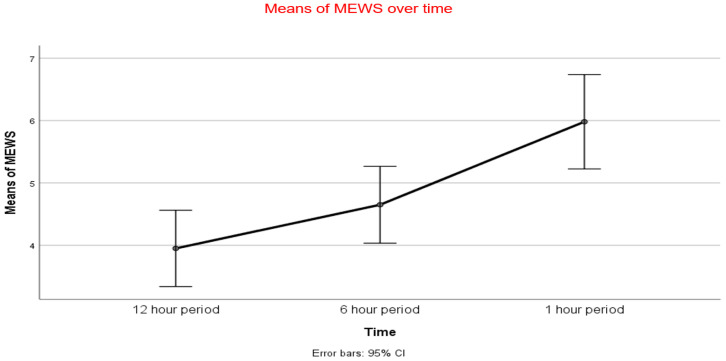 Figure 2
Peer Reviews
No public reviews on file for this paper yet. If you reviewed it on a platform where reviews are public (OpenReview, ICLR, NeurIPS, ICML), you can paste yours below so the community can read it here.
Videos
No videos yet. Explain this paper in a talk, walkthrough, or lecture? Add one.
Taxonomy
TopicsCardiac Arrest and Resuscitation · Sepsis Diagnosis and Treatment · Healthcare Technology and Patient Monitoring