Effectiveness Of The Core Activation And Rehabilitation Exercises For Knee Osteoarthritis - Program (CARE -KOA ©) Among Patients Diagnosed With Knee Osteoarthritis
Dias Tina Thomas, Charu Eapen, Atmananda S Hegde, Ajit R. Mahale, Prajwal Prabhudev Mane, Saurabh Mehta, Peeyoosha Gurudut, Varun Naik

TL;DR
A new 4-week exercise program called CARE-KOA© reduced pain and improved function in patients with knee osteoarthritis.
Contribution
The study introduces and evaluates the CARE-KOA© program, which integrates core activation and rehabilitation for knee osteoarthritis.
Findings
The program significantly reduced pain and improved patient-reported outcomes.
Most physical function tests showed significant improvement after the intervention.
Knee muscle strength in some groups did not show significant changes.
Abstract
Knee osteoarthritis (KOA) is a prevalent condition. Recent research on people with KOA has addressed kinetic chain and core muscle contribution in disease progression. This study aims to assess the efficacy of including the CARE -KOA© regimen and evaluate its effect on pain, patient-reported functional outcomes, physical function tests, knee strength, and core endurance. 15 patients above 45 were recruited and underwent a 4-week CARE -KOA© program with 12 supervised sessions over four weeks. Pre- and Post-exercise assessment included evaluating the primary outcome pain using the VAS scale and the patient-reported outcome using the KOOS scale. The secondary outcomes, knee muscle strength, core endurance, and the physical function tests, i.e., the stair climb test, the sit-to-stand test, the 40m fast-paced walking test, and the timed up-and-go test, were also evaluated. The data…
Genes, proteins, chemicals, diseases, species, mutations and cell lines named across the full text — each resolved to its canonical identifier and authoritative record.
Click any figure to enlarge with its caption.
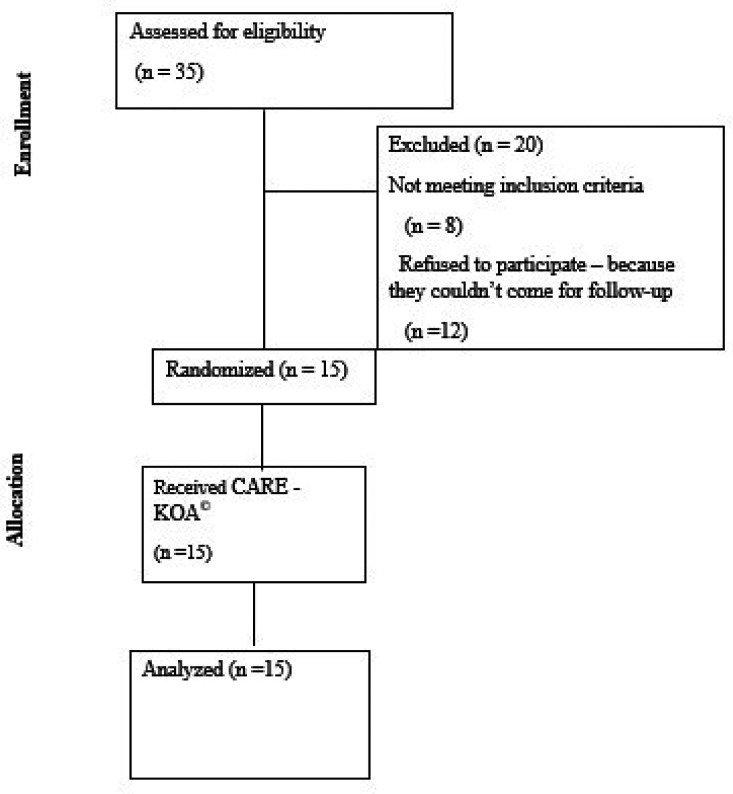 Figure 1
| Variable | Median | IQR |
|---|---|---|
| Age (year) | 54 | 50.0-56.5 |
| Height (cm) | 159 | 155-166 |
| Weight (kg) | 72 | 69.0-77.0 |
| BMI | 26.1 | 25.1-31.2 |
| Measure | Baseline Mean ± SD | Post Mean ± SD | p-value | Effect Size (Cohen's d) |
|---|---|---|---|---|
| Pain at Rest (VR) (cm) | 1.53 ± 1.30 | 0.40 ± 0.74 | 0.0006
| 1.07 |
| Pain During Activity (VA) (cm) | 6.33 ± 1.29 | 3.87 ± 1.51 | 0.000001
| 1.76 |
| KOOS Pain (KP) | 51.93 ± 12.72 | 62.27 ± 12.31 | 0.00003
| -0.83 |
| KOOS Symptoms (KS) | 55.93 ± 10.89 | 64.33 ± 8.82 | 0.0006
| -0.85 |
| KOOS ADL (KADL) | 51.60 ± 11.29 | 64.00 ± 9.43 | 0.0000009
| -1.19 |
| KOOS QOL (KQOL) | 41.27 ± 9.04 | 50.47 ± 9.80 | 0.00017
| -0.98 |
| 30-Second Sit-to-Stand (30STS) (reps) | 8.13 ± 3.04 | 9.00 ± 2.59 | 0.050
| -0.31 |
| 40-Meter Fast-paced walking test (40-MFPW) (m/sec) | 1.00 ± 0.28 | 0.96 ± 0.25 | 0.044
| -0.15 |
| Stair Climb Test (SCT) (sec) | 33.67 ± 10.10 | 30.73 ± 7.03 | 0.031
| 0.34 |
| Timed Up and Go Test (TUG) (sec) | 33.33 ± 18.68 | 31.07 ± 17.36 | 0.006
| 0.13 |
| Endurance Test (ET) (sec) | 17.73 ± 8.16 | 19.67 ± 9.80 | 0.027
| 0.21 |
| Muscle Strength - Flexors Unaffected (MSFUA) (kg) | 4.80 ± 1.93 | 5.20 ± 1.90 | 0.028
| -0.21 |
| Muscle Strength - Extensors Affected (MSEA) (kg) | 5.07 ± 2.37 | 5.53 ± 2.59 | 0.013
| -0.19 |
| Muscle Strength - Flexors Affected (MSFA) (kg) | 4.00 ± 1.93 | 4.27 ± 2.05 | 0.104 | -0.13 |
| Muscle Strength - Extensors Unaffected (MSEUA) (kg) | 6.53 ± 3.62 | 6.67 ± 3.70 | 0.433 | -0.04 |
Peer Reviews
No public reviews on file for this paper yet. If you reviewed it on a platform where reviews are public (OpenReview, ICLR, NeurIPS, ICML), you can paste yours below so the community can read it here.
Videos
No videos yet. Explain this paper in a talk, walkthrough, or lecture? Add one.
Taxonomy
TopicsOsteoarthritis Treatment and Mechanisms · Lower Extremity Biomechanics and Pathologies · Musculoskeletal pain and rehabilitation
Introduction
Knee osteoarthritis (KOA) is a widely prevalent condition resulting in persistent disability. The combined prevalence of KOA was 16% for individuals aged 15 and above, escalating to 22.9% in the demographic aged 40 and beyond worldwide. ^ 1 ^ In India, up to 28.7% of people who have knee pain and signs of KOA document being unable to perform everyday tasks. ^ 2, 3 ^
Conservative treatment for KOA emphasizes decreasing the compressive forces on the joint. It might be accomplished by strengthening the lower extremity's muscle strength, particularly the quadriceps muscle, which not only influences the initiation and progression of the disease but also plays an integral part in functional limitations in those with KOA. ^ 4– 7 ^
When compared to routine rehabilitation alone, 12 weeks of generalized core exercise with a routine rehabilitation program was superior and more efficient in reducing pain in patients who had KOA. ^ 8 ^ It has been demonstrated that various periarticular muscle exercise regimens and pharmaceutical treatments effectively minimize discomfort and improve physical function. The muscles that stabilize the knee joint are known to atrophy and lose strength because of KOA. ^ 9 ^
Core exercise can enhance trunk, pelvic, hip, and knee stability and coordination by stimulating the periarticular muscles of the knee and the lumbopelvic hip complex. ^ 10 ^ Initial implications of the proximal contributions and the kinetic chains have recently been investigated in individuals with KOA, and a link between KOA and poor core has been seen as a plausible avenue attributing to the progression of the disease. ^ 10 ^
As a result, this study explored the effectiveness of incorporating the CARE -KOA© program and evaluated its efficacy on pain, patient-reported functional outcomes, physical function tests, knee strength, and core endurance in patients diagnosed with KOA, alongside, exploring the feasibility of conducting a future randomized controlled trial, to assess the long-term effect and adherence of the patient population to the program.
Study Trial Registration: CTRI/2023/07/05480 on 05/07/2024 https://ctri.nic.in/Clinicaltrials/regtrial.php?modid=1&compid=19&EncHid=69416.70327
Methods
Study design
A prospective, single group, pre – and post-study that was presented and approved by the Kasturba Medical College Mangaluru Institutional Ethics Committee (IECKMCMLR05/2023/206) on 18/5/2023 and recruitment was carried out from June 18 2023. The study was then registered with the Clinical Trials Registry India (CTRI) (CTRI/2023/07/054805). The study was chosen to test the effectiveness of using the CARE -KOA© and to evaluate its effects on the desired outcomes in patients diagnosed with KOA. The reporting of this study was in line with the Consolidated Standards of Reporting Trials (CONSORT). Our interest in this early investigation was to maximize the exploration of study methods and performance outcomes in patients diagnosed with KOA. 4- weeks was selected as the program length for this study. Informed consent was signed by all the participants included in the study, and all ethical standards defined by the Helsinki declaration were abided by.
Participant and setting
The study was carried out in the hospital settings of Kasturba Medical College Mangalore.
Patients with a medical diagnosis of KOA, referred by the orthopaedic surgeon to the Physical Therapy Department, were included. The diagnosis was made by an orthopaedic surgeon specializing in knee conditions, based on the patient’s medical history (knee pain with crepitus during active motion, morning stiffness or bony enlargement, age, and a physical examination to rule out other causes of knee pain), along with radiographic imaging showing a K-L grade of 1-3.
Patients with severe KOA, in whom knee replacement is indicated, and those with a history of hip OA, lower limb joint replacement, inflammatory arthritis, spine surgery, lower limb surgery, or corticoid injection within the past three months, were excluded.
Procedure
The purpose of the study was explained to the patients before enrolment and a written informed consent was obtained. Pain using the Visual Analog Scale (VAS), Patient-reported Outcomes using the Knee Injury and Osteoarthritis Outcome Score (KOOS) and Physical function test i.e., 30 seconds to stand test (30STS), 40 m fast-paced walking test (40MFPW), the stair climb test (SCT) and the timed up and go test (TUG), along with knee muscle strength, core muscle strength, and endurance was recorded by a qualified assessor who was blinded to the intervention and had adequate knowledge of the assessment tool, following a standardized procedure that has been previously described and published in the literature. ^ 11 ^
Demographic and baseline data were noted on the day the patient was referred for physiotherapy and then at four weeks post-intervention. Exercises were progressed based on the CARE -KOA© program and each exercise session lasted for an hour and included a 10-minute warmup session.
Sample size determination and statistical analysis
A target sample size of n = 15 participants was achieved based on a pragmatic approach in the context of the study. Once eligibility was assessed and participants signed the informed consent form, they underwent the first evaluation and started with the four-week exercise routine.
The JAMOVI software was utilized to conduct statistical analysis, baseline data analysis, and non-parametric testing (Wilcoxon signed rank test) for within-group analysis. p < 0.05 was statistically significant.
Participant flow
The patient enrolment in the study is depicted in Figure 1 flow diagram ( Figure 1). Fifteen participants were included after screening 35 patients with KOA.
CONSORT flow diagram.
Results
15 participants over the age of 50 years were recruited ( Table 1) shows the descriptive data of the included participants.
After four weeks of intervention, the patients reported less pain both at rest and during activity, along with significant improvements in functional and patient-reported outcomes as shown in Table 2. The muscle strength of the flexors in the unaffected knee and the extensors of the affected knee demonstrated statistically significant gains ( Table 2); however, muscle strength in the flexors of the affected knee and the extensors of the unaffected knee (p = 0.104 and p = 0.433, respectively) did not show a statistically significant difference.
Discussion
The findings of this study provide increasing evidence that integrating the CARE-KOA© program into rehabilitation significantly enhances functional outcomes and reduces pain. This preliminary study indicates a notable reduction in pain and an improvement in various functional outcomes, highlighting the potential of core activation exercises in modulating pain mechanisms beyond conventional rehabilitation strategies.
A statistically and clinically significant reduction in pain at rest and during activity (d = 1.07 and d-1.76) as measured by VAS highlights the efficiency of the CARE-KOA© program in modulating pain mechanisms. Pain in KOA is multifactorial and influenced by joint degeneration, altered loading patterns, and neuromuscular imbalances. The core musculature, particularly the transverse abdominus and multifidus, contribute to trunk stability and pelvic alignment, preventing excessive strain on the knee joint. ^ 10, 12 ^
One of the most significant results of this research is the clinically meaningful improvement in patient-reported outcomes, specifically pain reduction (KOOS Pain, d = -0.83), symptomatic relief (KOOS Symptoms, d = -0.85), functional capacity (KOOS-ADL, d = -1.19), and overall quality of life (KOOS-QOL, d = -0.98). These findings underscore the critical role of kinetic chain activation in addressing biomechanical deficits associated with knee osteoarthritis (KOA).
Unlike traditional rehabilitation methods that mainly focus on strengthening the quadriceps, this study emphasizes the importance of targeting core muscle activation to enhance knee joint stability, improve load distribution, and optimize movement efficiency. The improvement in pain reduction and functional capacity can be attributed to enhanced stability resulting from the involvement of core stabilizers in the exercise regimen, which likely plays a pivotal role in offloading knee joint stress, thereby reducing pain and improving function. Furthermore, the observed changes are consistent with prior research indicating that kinetic chain impairments in KOA extend beyond the knee, affecting proximal joint coordination and motor function control. ^ 10, 14 ^
Physical function tests demonstrated meaningful improvements across the parameters assessed. The SCT and the core endurance test showed a moderate effect size, (d = 0.34) indicating that patients experienced significant functional gains in core endurance and stair negotiation. Similarly, the 30 STS and the 40MFPW showed improvements with a small effect size (d = -0.31 and d = -0.15), indicating improved mobility and walking efficiency. Additionally, the TUG (d = 0.13) showed significant improvements, reflecting better reaction time and movement efficiency. These gains indicate improved endurance, balance, and mobility, all of which are necessary for performing everyday tasks that retain independence and improve dynamic balance. ^ 13 ^ The core endurance test (ET, d = 0.21) demonstrated a small effect size, highlighting the role of core endurance in functional performance. Our findings align with previous studies highlighting exercises lead to improvements in mobility and functional performance, ultimately helping those affected to maintain their independence, reduce risk to all, and enhance overall quality of life. ^ 14 ^
The intervention’s comprehensive strategy, which emphasized strengthening core muscles, likely contributed to improved overall stability, movement mechanics, and functional capabilities For the trunk and pelvis to remain stable and to preserve joint loading patterns and lower limb biomechanics, the core muscles must provide dynamic stability. ^ 10, 12 ^ Strengthening exercises for the core muscles can help distribute forces more evenly across all joints, reducing the mechanical strain on the injured knee and relieving discomfort. Additionally, improved trunk stability and alignment may have improved joint biomechanics and reduced pain and discomfort during weight bearing. ^ 12 ^
Notably, while improvements were seen in most indicators, there were no appreciable gains in the strength of the knee flexors and extensors of the affected and unaffected knee respectively. This might be explained by the relatively brief intervention period of exercises and the nature of the muscles to adapt to load over some time, implying that longer duration and frequency of exercises are required to observe plausible strength changes. ^ 15, 16 ^
The exercise regime incorporated in our study was in line with the previous studies ^ 14, 17 ^ where a more holistic core exercise program was incorporated, whereas the current study targeted the TA and multifidus, which are considered the prime stabilizer muscles of the core. ^ 18 ^ The patients tolerated the exercises well; no adverse events were noted during the 4-week intervention. To provide a more comprehensive knowledge of the intervention's benefits, our study also examined various outcomes, such as patient-reported measures, physical function tests, knee strength, and core endurance.
Long-term follow-up examinations are necessary to assess whether outcomes may be sustained beyond the short duration of the intervention. The study establishes the foundation for further research by offering insightful information on the possible advantages of including the CARE -KOA© program in treating KOA.
Given the improvements in pain management, patient-reported outcomes, and functional performance, a complete strategy incorporating focused core exercises appears promising for treating KOA patients. A limitation noted in this study was the exclusion of patients who could not attend follow-up appointments. This highlights that access to the physiotherapy department and the ability to participate in follow-ups were essential criteria for participation in the exercise program. This ensured adherence to the program.
Our findings suggest that the CARE-KOA© program may benefit individuals with KOA by emphasizing proximal stability and biomechanical efficiency. By integrating core activation strategies into routine rehabilitation, clinicians can offer an evidence-based intervention that enhances the mobility, independence, and overall quality of life of individuals with KOA.
Conclusion
Patients who underwent a 4-week CARE-KOA© supervised rehabilitation program experienced notable improvements in multiple dimensions of KOA management. Specifically, there were significant reductions in reported pain levels and enhancements in the quality of life as evaluated by the KOOS and physical function test. Additionally, core endurance, which is crucial for maintaining stability and reducing strain on the knee, was also significantly increased.
However, while the short-term benefits are evident, further research with extended follow-up periods is essential to evaluate this intervention's sustainability and long-term impact, alongside implementing the CARE -KOA© program against routine rehabilitation in controlled trials and longer follow-up periods. This would help us understand whether the observed improvements are maintained over time and could provide insights into optimizing rehabilitation strategies for chronic knee osteoarthritis.
Ethics and consent
Ethical Approval and Consent to Participate – The independent institutional ethical committee has approved the study and has the ethical number (IECKMCMLR05/2023/206). The study was then registered with the Clinical Trials Registry India (CTRI) (CTRI/2023/07/054805). Kasturba Medical College Mangaluru Institutional Ethics Committee (IECKMCMLR05/2023/206) on 18/5/2023 and recruitment was carried out from June 18 2023.
Consent for publication - All participants included in the study signed a written informed consent form, which was approved by the institutional ethics committee.
The reference list from the paper itself. Each links out to its DOI / PubMed record.
- 1Cui A Li H Wang D : Global, regional prevalence, incidence and risk factors of knee osteoarthritis in population-based studies. E Clinical Medicine. 2020 Dec 1 [cited 2023 Nov 27];29-30:100530–100587. 10.1016/j.eclinm.2020.100587 Reference Source PMC 770442034505846 · doi ↗ · pubmed ↗
- 2Vos T Allen C Arora M : Global, regional, and national incidence, prevalence, and years lived with disability for 310 diseases and injuries, 1990–2015: a systematic analysis for the Global Burden of Disease Study 2015. Lancet. 2016 Oct 8;388(10053):1545–1602. 10.1016/S 0140-6736(16)31678-6 27733282 PMC 5055577 · doi ↗ · pubmed ↗
- 3Pal CP Singh P Chaturvedi S : Epidemiology of knee osteoarthritis in India and related factors. Indian J. Orthop. 2016 Sep 1 [cited 2022 May 4];50(5):518–522. 10.4103/0019-5413.189608 27746495 PMC 5017174 · doi ↗ · pubmed ↗
- 4Astephen JL Deluzio KJ Caldwell GE : Biomechanical changes at the hip, knee, and ankle joints during gait are associated with knee osteoarthritis severity. J. Orthop. Res. 2008 Mar;26(3):332–341. 10.1002/jor.20496 17960658 · doi ↗ · pubmed ↗
- 5Varady NH Grodzinsky AJ : Osteoarthritis year in review 2015: Mechanics. Vol. 24, Osteoarthritis and Cartilage. W.B. Saunders Ltd;2016;27–35.10.1016/j.joca.2015.08.018PMC 469314626707990 · doi ↗ · pubmed ↗
- 6Saxby DJ Lloyd DG : Osteoarthritis year in review 2016: Mechanics. Vol. 25, Osteoarthritis and Cartilage. W.B. Saunders Ltd;2017; pp.190–198.10.1016/j.joca.2016.09.02328100420 · doi ↗ · pubmed ↗
- 7Hunt MA Wrigley TV Hinman RS : Individuals with severe knee osteoarthritis (OA) exhibit altered proximal walking mechanics compared with individuals with less severe OA and those without knee pain. Arthritis Care Res (Hoboken). 2010;62(10):1426–1432. 10.1002/acr.20248 20506534 · doi ↗ · pubmed ↗
- 8Hernandez D Dimaro M Navarro E : Efficacy of core exercises in patients with osteoarthritis of the knee: A randomized controlled clinical trial. J. Bodyw. Mov. Ther. 2019;23(4):881–887. 10.1016/j.jbmt.2019.06.002 31733777 · doi ↗ · pubmed ↗