Ligands of Biological and Environmental Interest as Sequestering Agents for Fe3+ in Aqueous Solution: A Speciation Study of Natural Fluids
Anna Irto, Ileana Ielo, Clemente Bretti, Francesco Crea, Concetta De Stefano, Rosalia Maria Cigala

TL;DR
This study explores how certain natural ligands interact with Fe3+ in solution, comparing their ability to form complexes under different conditions.
Contribution
The paper introduces a detailed speciation model and compares the sequestering ability of three ligands toward Fe3+ in various environments.
Findings
AMPA2− forms stronger complexes with Fe3+ than IAA−, as indicated by higher logβ values.
The sequestering ability of ligands was quantified using an empirical pL0.5 parameter across different pH and ionic strengths.
Speciation models were validated using potentiometric and spectrophotometric methods in various electrolytes.
Abstract
The interactions of Fe3+ with some ligands (Tranexamic (TXA−), Indole-3-acetic (IAA−), and Aminomethylphosphonic (AMPA2−) acids) of biological and environmental interest were studied. The speciation studies were performed in NaNO3(aq) and NaCl(aq) using potentiometric and, only for IAA−, spectrophotometric titrations at T = 298.15 K and 0.01 ≤ I/mol dm−3 ≤ 1.0. The proposed speciation models are as follows: Fe(TXA)H3+, Fe(TXA)2+, Fe(TXA)(OH)+, and Fe(TXA)(OH)2(aq) for TXA−; Fe(IAA)2+ for IAA−; and Fe(AMPA)H23+, Fe(AMPA)H2+, and Fe(AMPA)+ for AMPA2−. A comparison of logβ for the common FeL species gives logβFeIAA = 6.56 and logβFeAMPA = 14.84 (at I = 1.00 mol dm−3 and T = 298.15 K), suggesting that AMPA2− has a higher complexing ability towards Fe3+ than IAA−. The dependence on the ionic strength of the formation constants was modeled by means of a Debye–Hückel type equation and the SIT…
Genes, proteins, chemicals, diseases, species, mutations and cell lines named across the full text — each resolved to its canonical identifier and authoritative record.
Click any figure to enlarge with its caption.
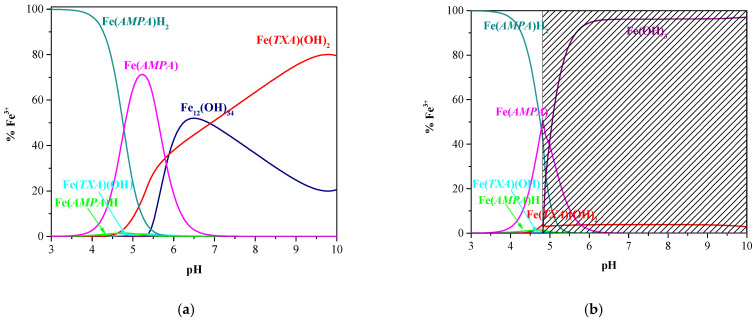 Figure 1
 Figure 2
 Figure 3
 Figure 4
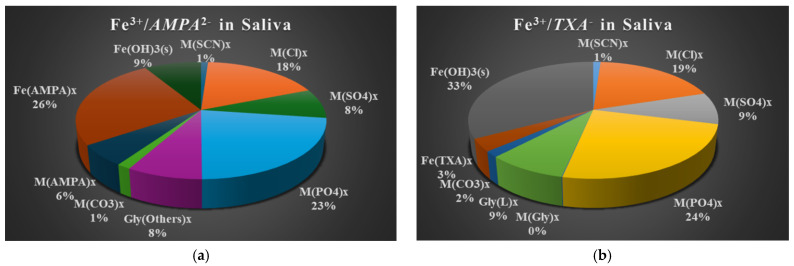 Figure 5
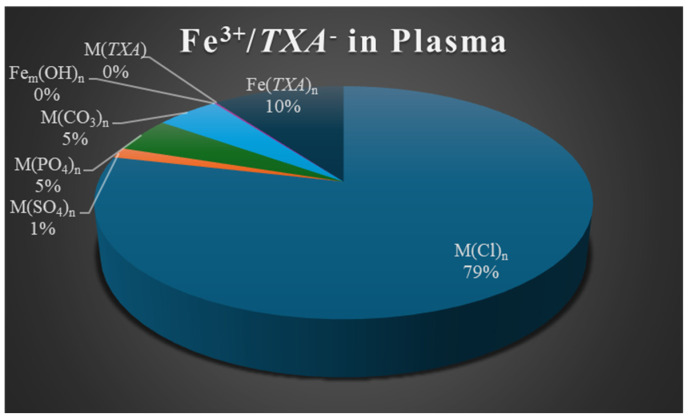 Figure 6
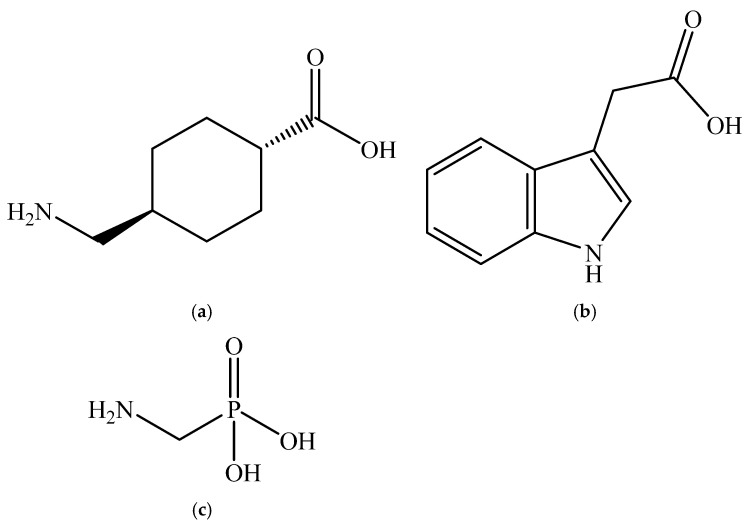 Figure 7
Peer Reviews
No public reviews on file for this paper yet. If you reviewed it on a platform where reviews are public (OpenReview, ICLR, NeurIPS, ICML), you can paste yours below so the community can read it here.
Videos
No videos yet. Explain this paper in a talk, walkthrough, or lecture? Add one.
Taxonomy
TopicsMolecular Sensors and Ion Detection · Electrochemical Analysis and Applications · Radioactive element chemistry and processing