Kinetic Resolution of BINAMs by Stereoselective Copper-Catalyzed Dehydrogenative Si–N Coupling with Prochiral Dihydrosilanes
Finn H. Gattwinkel, Martin Oestreich

TL;DR
A new method for separating BINAM molecules using copper-catalyzed reactions with chiral ligands is developed, enabling efficient resolution with good selectivity.
Contribution
A stereoselective Cu–H-catalyzed dehydrogenative Si–N coupling method for kinetic resolution of BINAMs is introduced.
Findings
The method allows atroposelective and diastereoselective N-silylation of BINAMs.
BINAMs with substituents in 6,6′- or 7,7′-positions are resolved with good selectivity factors.
The use of (R,R)-Ph-BPE as a chiral ligand is key to achieving stereoselectivity.
Abstract
A nonenzymatic kinetic resolution of monoprotected 1,1′-binaphthyl-2,2′-diamine (BINAM) derivatives is reported. This is achieved by a Cu–H-catalyzed dehydrogenative Si–N coupling with prochiral dihydrosilanes using (R,R)-Ph-BPE as a chiral ligand. The atroposelective as well as diastereoselective N-silylation enables the resolution of BINAMs with various substituents in 6,6′- or 7,7′-positions with good to synthetically useful selectivity factors.
Genes, proteins, chemicals, diseases, species, mutations and cell lines named across the full text — each resolved to its canonical identifier and authoritative record.
Click any figure to enlarge with its caption.
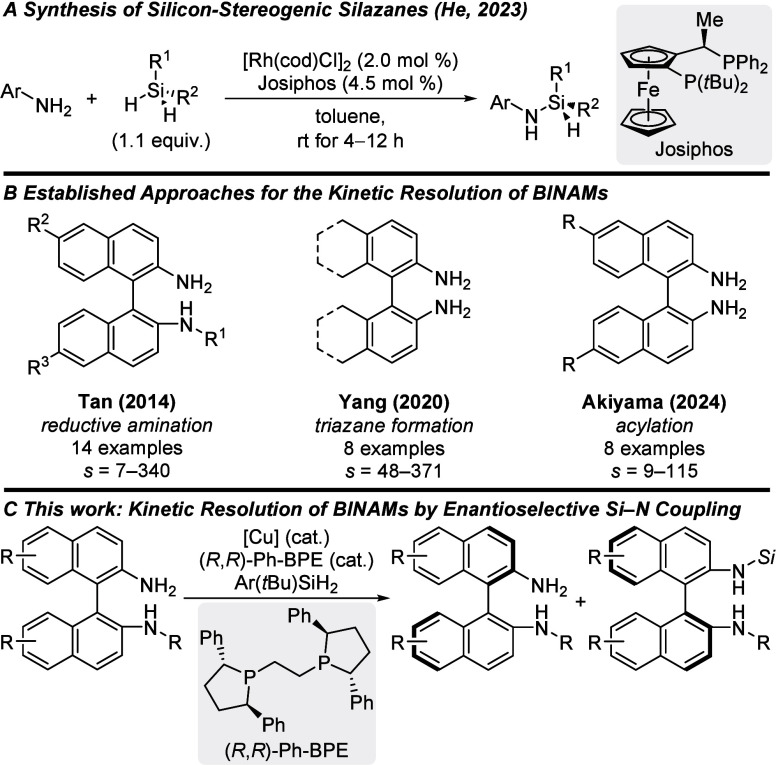 Figure 1
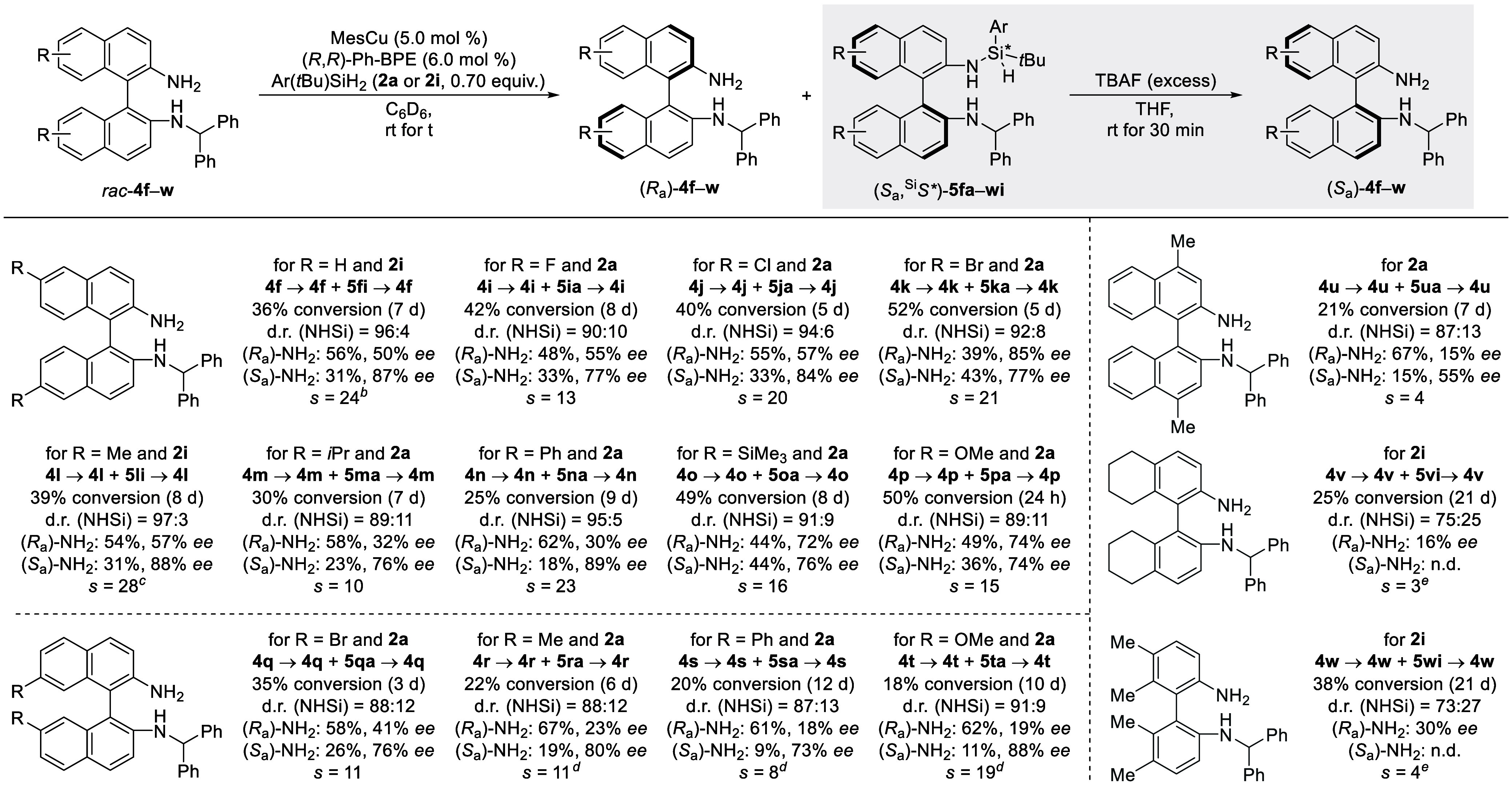 Figure 2
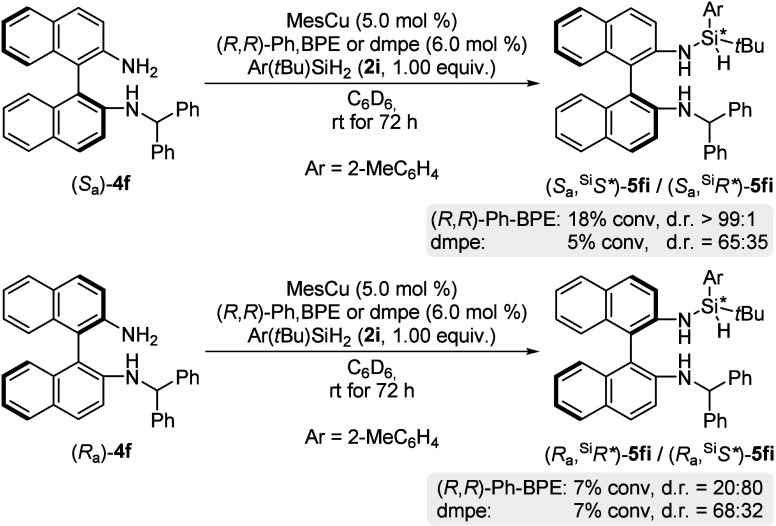 Figure 3
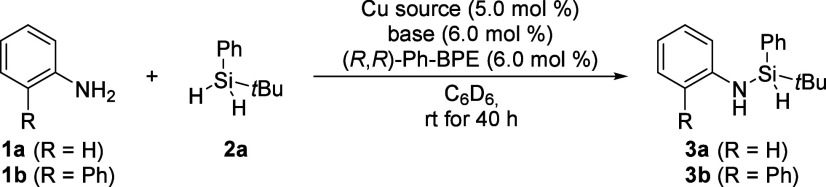 Figure 4
 Figure 5
 Figure 6
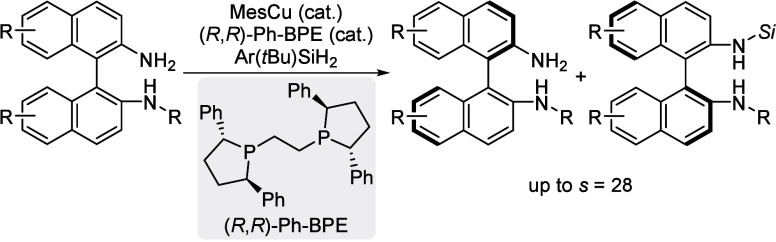 Figure 7
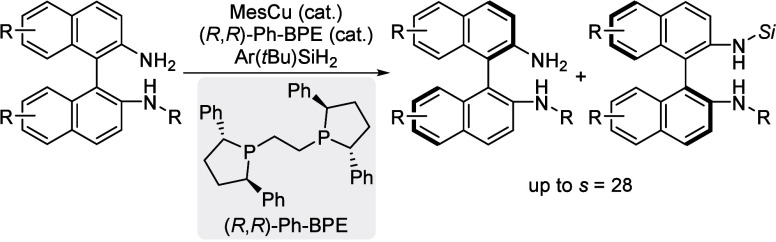 Figure 8
Peer Reviews
No public reviews on file for this paper yet. If you reviewed it on a platform where reviews are public (OpenReview, ICLR, NeurIPS, ICML), you can paste yours below so the community can read it here.
Videos
No videos yet. Explain this paper in a talk, walkthrough, or lecture? Add one.
Taxonomy
TopicsOrganoboron and organosilicon chemistry · Catalytic C–H Functionalization Methods · Catalytic Cross-Coupling Reactions