Genomic characterization of multidrug-resistant Escherichia coli with PBP3 insertions carrying blaNDM-5 carbapenemase isolated from infants in Kenya
Kevin Kariuki, Collins Kigen, James Wachira, Polycarp Mogeni, Doreen Rwigi, Benson Singa, Kirkby D. Tickell, Ferric C. Fang, Samuel Kariuki, Judd L. Walson, Patricia B. Pavlinac

TL;DR
This study reports on drug-resistant E. coli strains found in infants in Kenya, which could impact how patients are treated.
Contribution
The study identifies a specific genetic feature in E. coli linked to drug resistance in infants.
Findings
Carbapenem-resistant E. coli ST46 and 167 strains were isolated from infants in Kenya.
The isolates carried blaNDM-5 and a PBP3 insertion, indicating resistance mechanisms.
The findings suggest implications for managing patients with these resistant strains.
Abstract
We report on carbapenem-resistant Escherichia coli ST46 and 167 strains isolated from fecal samples of 4- and 8-month-old infants, respectively, in Kenya, collected at discharge after more than 4 days of hospitalization. The isolates carried blaNDM-5 carbapenemase and a PBP3 (333YRIN/K334) insertion. This finding has implications for patient management.
Genes, proteins, chemicals, diseases, species, mutations and cell lines named across the full text — each resolved to its canonical identifier and authoritative record.
Click any figure to enlarge with its caption.
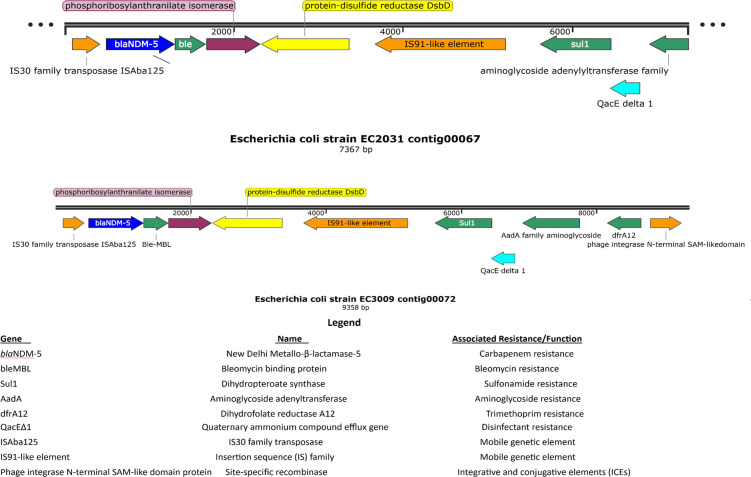 Figure 1
Peer Reviews
No public reviews on file for this paper yet. If you reviewed it on a platform where reviews are public (OpenReview, ICLR, NeurIPS, ICML), you can paste yours below so the community can read it here.
Videos
No videos yet. Explain this paper in a talk, walkthrough, or lecture? Add one.
Taxonomy
TopicsAntibiotic Resistance in Bacteria · Escherichia coli research studies · Enterobacteriaceae and Cronobacter Research