Characterization of prokaryotic communities in Puerto Rican caves using 16S rDNA amplicon sequencing
Natalia Pérez-Santos, Sebastian Javier Borrero-Villabol, Rene Nieves-Morales, Jessica Alejandra Paez-Díaz, Edwin Omar Rivera-Lopez, Josué Rodríguez-Ramos, Angel M. Nieves-Rivera, Carlos Ríos-Velazquez

TL;DR
This study explores the unique prokaryotic communities in Puerto Rican caves using DNA sequencing to better understand subterranean ecosystems.
Contribution
The study provides new insights into prokaryotic diversity in Puerto Rican caves using 16S rDNA amplicon sequencing.
Findings
Distinct prokaryotic communities were identified across seven Puerto Rican caves.
The findings enhance understanding of microbial adaptation in extreme subterranean environments.
Abstract
The cave ecosystems host microbial communities adapted to extreme environments. This study utilized 16S rDNA to investigate the prokaryotic diversity across seven caves in Puerto Rico’s northern limestone karst belt. Microbial profiling revealed distinct subterranean communities, enhancing our understanding of cave microbiology and potential applications in environmental conservation and microbial research.
Genes, proteins, chemicals, diseases, species, mutations and cell lines named across the full text — each resolved to its canonical identifier and authoritative record.
Click any figure to enlarge with its caption.
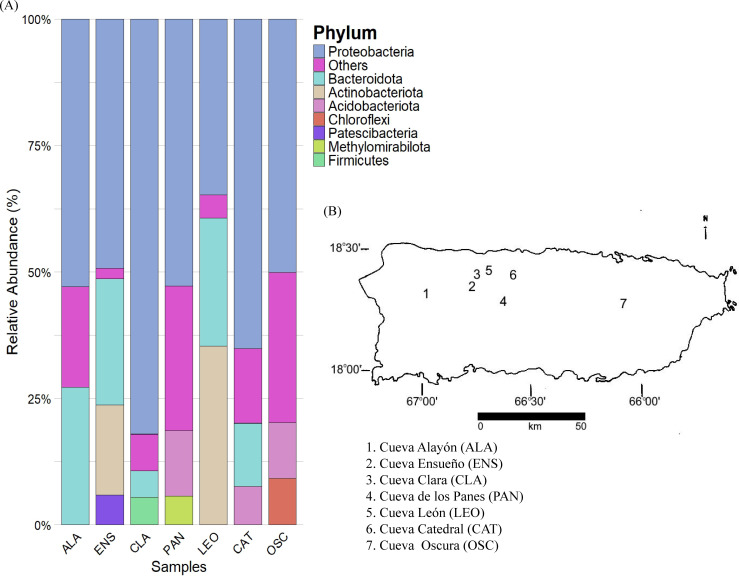 Figure 1
Peer Reviews
No public reviews on file for this paper yet. If you reviewed it on a platform where reviews are public (OpenReview, ICLR, NeurIPS, ICML), you can paste yours below so the community can read it here.
Videos
No videos yet. Explain this paper in a talk, walkthrough, or lecture? Add one.
Taxonomy
TopicsMicrobial Community Ecology and Physiology · Genomics and Phylogenetic Studies · Environmental DNA in Biodiversity Studies