Cappable-seq RNA-sequencing data sets for comparative studying of Salmonella enterica adaptation to Acanthamoeba castellanii intracellular environment, oxidative stress, and starvation
Alexander Balkin, Andrey Plotnikov, Tatiana Konnova, Natalia Gogoleva, Elena Shagimardanova, Yuri Gogolev

TL;DR
This paper provides RNA sequencing data to study how Salmonella adapts to stress and intracellular environments.
Contribution
The study introduces new Cappable-seq data sets for Salmonella under stress and intracellular conditions.
Findings
Transcriptomic data was collected for Salmonella under starvation and hydrogen peroxide treatment.
RNA sequencing was performed at specific time points after Acanthamoeba castellanii uptake.
The data enables comparative analysis of Salmonella adaptation mechanisms.
Abstract
Salmonella is a foodborne pathogen that can survive various stresses and replicate inside protist cells. Here, we present high-resolution Cappable-seq transcriptomic data for Salmonella enterica 14028S under starvation and hydrogen peroxide treatment, as well as 8 and 15 h after Acanthamoeba castellanii uptake.
Genes, proteins, chemicals, diseases, species, mutations and cell lines named across the full text — each resolved to its canonical identifier and authoritative record.
Click any figure to enlarge with its caption.
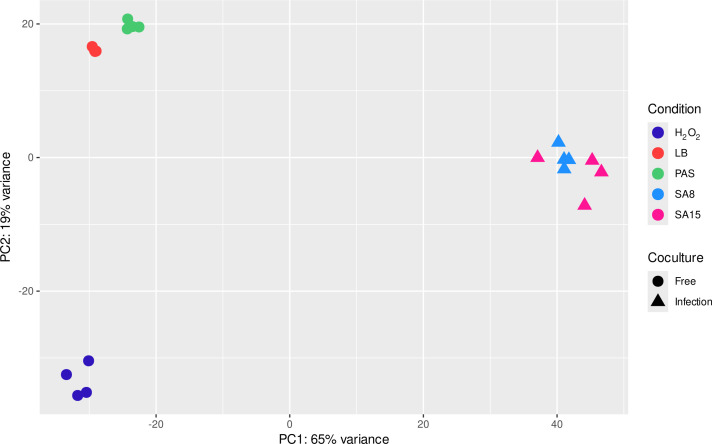 Figure 1
Peer Reviews
No public reviews on file for this paper yet. If you reviewed it on a platform where reviews are public (OpenReview, ICLR, NeurIPS, ICML), you can paste yours below so the community can read it here.
Videos
No videos yet. Explain this paper in a talk, walkthrough, or lecture? Add one.
Taxonomy
TopicsVibrio bacteria research studies · Legionella and Acanthamoeba research · Salmonella and Campylobacter epidemiology