The network approach to psychopathology: investigating inter-individual variability and the association with clinical relapse in psychosis
George Gillett, Dan W. Joyce, Cedric E. Ginestet, James H. MacCabe, Nicholas Meyer

TL;DR
This paper explores how interconnected symptoms in psychosis form networks and finds that these networks vary a lot between individuals and don't strongly predict relapse.
Contribution
The study reveals significant inter-individual variability in symptom networks and challenges assumptions about their association with clinical outcomes.
Findings
Substantial inter-individual variability in psychological symptom network structures was identified.
No strong evidence was found linking network structure to clinical relapse in psychosis.
Abstract
Recent years have seen a proliferation of interest in psychological networks, which conceptualise psychopathology as networks of inter-connected, mutually reinforcing symptoms. It has been hypothesised that the topological structure of such networks is associated with clinical presentation. Analysing data from a longitudinal study of participants diagnosed with psychosis, we identify substantial inter-individual variability in network structure, problematising causal inference from cross-sectional networks. Additionally, we do not find strong evidence for an association between network structure and clinical relapse.
Genes, proteins, chemicals, diseases, species, mutations and cell lines named across the full text — each resolved to its canonical identifier and authoritative record.
Click any figure to enlarge with its caption.
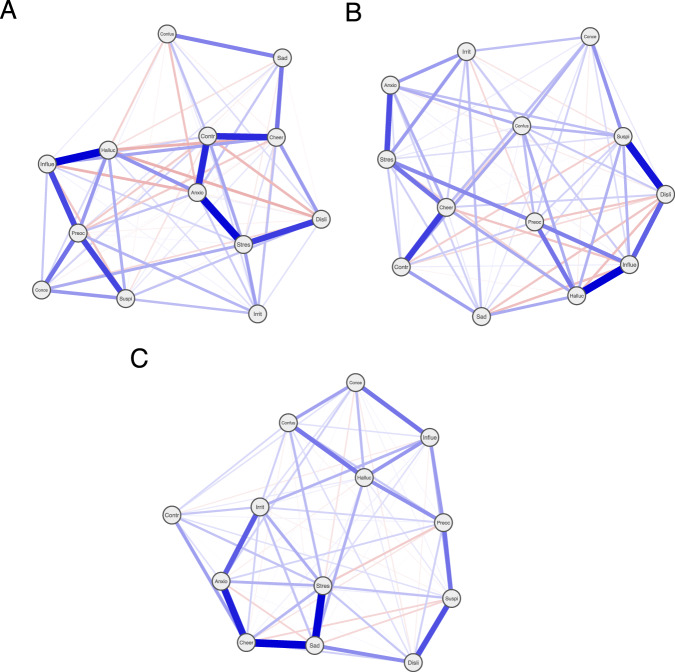 Figure 1
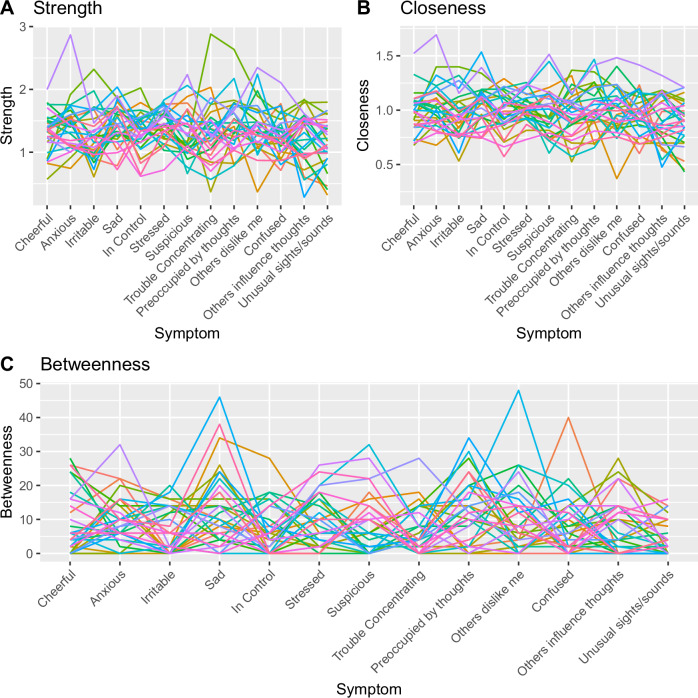 Figure 2
Peer Reviews
No public reviews on file for this paper yet. If you reviewed it on a platform where reviews are public (OpenReview, ICLR, NeurIPS, ICML), you can paste yours below so the community can read it here.
Videos
No videos yet. Explain this paper in a talk, walkthrough, or lecture? Add one.
Taxonomy
TopicsMental Health Research Topics · Functional Brain Connectivity Studies · Tryptophan and brain disorders