Prevalence of Differences of Sex Development Among Pediatric Endocrine Care Centers in Switzerland From 2000 to 2019
Sara Metzger, Christine Aebi-Ochsner, Kanetee Busiah, Mirjam Dirlewanger, Sylvia Gschwend, Melanie Hess, Beatrice Kuhlmann, Dagmar l'Allemand, Mariarosaria Lang-Muritano, Kees Noordam, Franziska Phan-Hug, Ursina Probst, Maristella Santi, Silvia Schmid, Valérie Schwitzgebel

TL;DR
This study estimates the prevalence of differences of sex development (DSD) in Swiss pediatric endocrine centers from 2000 to 2019, providing insights into the types and causes of DSD cases.
Contribution
The study offers population-based prevalence data for DSD in Switzerland, highlighting diagnostic group distributions and trends.
Findings
47% of DSD cases were sex chromosome DSD, 32% were 46,XY DSD, and 21% were 46,XX DSD.
46,XX congenital adrenal hyperplasia prevalence matches newborn screening data, indicating good case completeness.
On average, 28 new DSD cases were identified annually in Switzerland.
Abstract
Reliable data on prevalence of differences of sex development (DSD) are lacking. We aimed to estimate population-based prevalence of DSD among pediatric endocrine care centers in Switzerland. Retrospective population-based study including children and adolescents with DSD according to Chicago Consensus, born in Switzerland from 2000 through 2019. Endocrine departments in 10 Swiss Children's Hospitals and 8 private endocrine practices collected DSD data through the I-DSD registry or case report forms. We calculated prevalence for DSD diagnostic groups and analyzed trends in prevalence. Over the 20-year study period, we identified 561 individuals with DSD. Almost half (n = 266, 47%) had sex chromosome DSD, 177 (32%) had 46,XY DSD, and 118 (21%) had 46,XX DSD. Causes for 46,XY DSD were disturbed androgen synthesis or action (37/177, 21%), atypical gonadal development (28/177, 16%), or…
Genes, proteins, chemicals, diseases, species, mutations and cell lines named across the full text — each resolved to its canonical identifier and authoritative record.
Click any figure to enlarge with its caption.
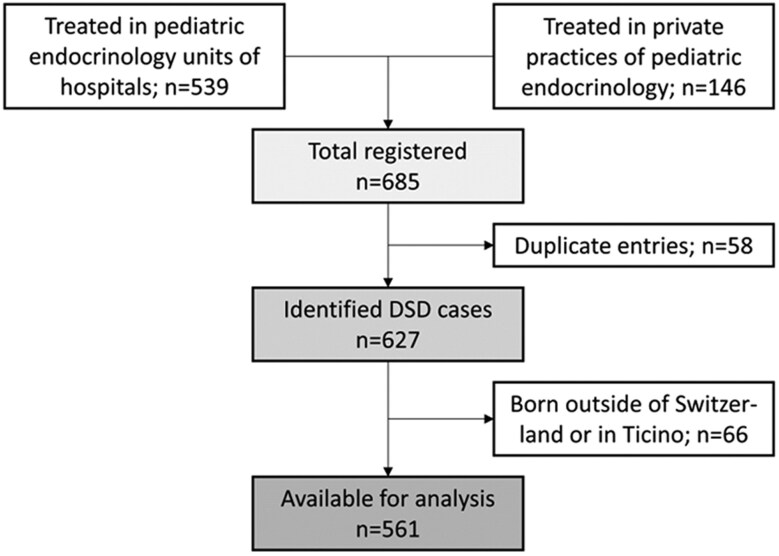 Figure 1
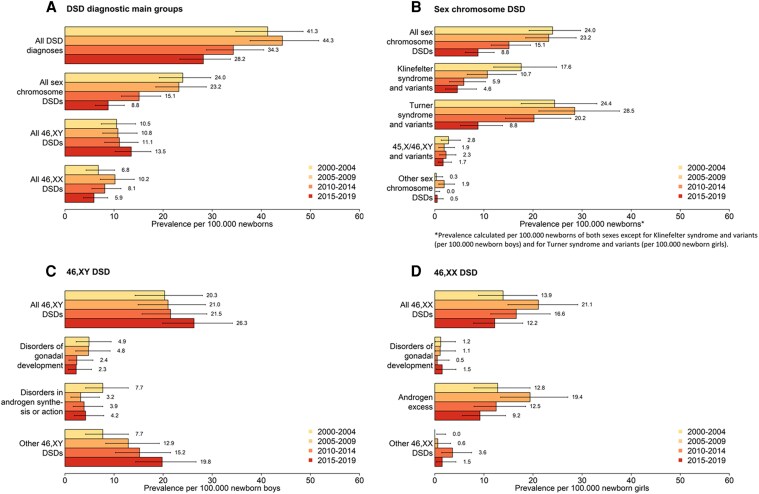 Figure 2
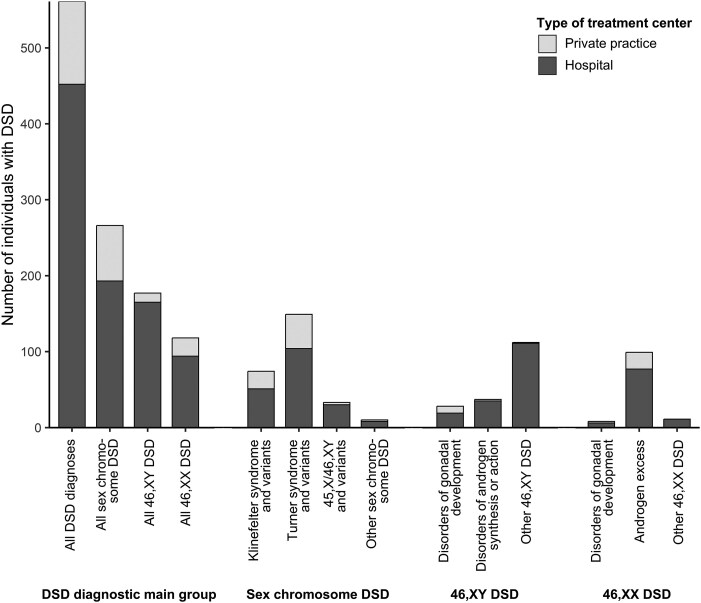 Figure 3
| Total | Sex at birth | |||||||
|---|---|---|---|---|---|---|---|---|
| Female | Male | Other/not assigned | ||||||
| N = 561 | N = 301 | N = 242 | N = 18 | |||||
| n | % | n | % | n | % | n | % | |
|
| ||||||||
| 2000-2004 | 146 | 26 | 83 | 28 | 61 | 25 | 2 | 11 |
| 2005-2009 | 160 | 28 | 92 | 31 | 60 | 25 | 8 | 44 |
| 2010-2014 | 136 | 24 | 78 | 26 | 54 | 22 | 4 | 22 |
| 2015-2019 | 119 | 21 | 48 | 16 | 67 | 28 | 4 | 22 |
|
| 266 | 100 | 171 | 100 | 95 | 100 | 0 | n/a |
| Klinefelter syndrome and variants | 74 | 28 | 0 | 0 | 74 | 78 | 0 | n/a |
| Turner syndrome and variants | 149 | 56 | 148 | 87 | 1 | 1 | 0 | n/a |
| 45,X/46,XY and variants | 33 | 12 | 22 | 13 | 11 | 12 | 0 | n/a |
| Other | 10 | 4 | 1 | 1 | 9 | 9 | 0 | n/a |
|
| 177 | 100 | 28 | 100 | 135 | 100 | 14 | 100 |
| Disorders of gonadal development | 28 | 16 | 9 | 32 | 17 | 13 | 2 | 14 |
| Complete or partial gonadal dysgenesis | 16 | 8 | 7 | 1 | ||||
| Gonadal regression | 9 | 0 | 9 | 0 | ||||
| Ovotesticular DSD | 3 | 1 | 1 | 1 | ||||
| Disorders in androgen synthesis or action | 37 | 21 | 18 | 64 | 18 | 13 | 1 | 7 |
| Disorders of androgen synthesis | 12 | 2 | 9 | 1 | ||||
| Disorders of androgen action | 19 | 16 | 3 | 0 | ||||
| Disorders of AMH or AMH receptor | 6 | 0 | 6 | 0 | ||||
| Other | 112 | 63 | 1 | 4 | 100 | 74 | 11 | 79 |
| Complex genital anomalies | 106 | 1 | 95 | 10 | ||||
| Cloacal anomalies | 2 | 0 | 1 | 1 | ||||
| Other | 4 | 0 | 4 | 0 | ||||
|
| 118 | 100 | 102 | 100 | 12 | 100 | 4 | 100 |
| Disorders of gonadal development | 8 | 7 | 2 | 2 | 6 | 50 | 0 | 0 |
| Gonadal dysgenesis | 2 | 2 | 0 | 0 | ||||
| Ovotesticular DSD | 2 | 0 | 2 | 0 | ||||
| Testicular DSD | 4 | 0 | 4 | 0 | ||||
| Androgen excess | 99 | 84 | 89 | 87 | 6 | 50 | 4 | 100 |
| Fetal | 97 | 87 | 6 | 4 | ||||
| Fetoplacental | 2 | 2 | 0 | 0 | ||||
| Maternal | 0 | 0 | 0 | 0 | ||||
| Other | 11 | 9 | 11 | 11 | 0 | 0 | 0 | 0 |
| Cloacal anomalies | 7 | 7 | 0 | 0 | ||||
| Other | 4 | 4 | 0 | 0 | ||||
|
| ||||||||
| Female | 304 | 54 | 294 | 52 | 5 | 1 | 5 | 1 |
| Male | 256 | 46 | 6 | 1 | 237 | 42 | 13 | 2 |
| Both | 1 | 0.2 | 1 | 0.2 | 0 | 0 | 0 | 0 |
| Average number of cases/year | Prevalence per 100 000 newborns per year (95% CI) | 1:N newborns | |
|---|---|---|---|
| All DSD diagnoses | 28.1 | 36.6 (33.6-39.7) | 2735 |
| DSD diagnostic group | |||
| Sex chromosome DSD | 13.3 | 17.3 (15.3-19.5) | 5768 |
| 46,XY DSD | 8.9 | 11.5 (9.9-13.4) | 8669 |
| 46,XX DSD | 5.9 | 7.7 (6.4-9.2) | 13 003 |
| Sex chromosome DSD | |||
| Klinefelter syndrome and variants | 3.7 | 9.4 (7.4-11.8) | 10 660 |
| Turner syndrome and variants | 7.5 | 20.0 (16.9-23.5) | 5004 |
| 45,X/46,XY and variants | 1.7 | 2.2 (1.5-3.0) | 46 496 |
| Other | 0.5 | 0.7 (0.3-1.2) | 153 437 |
| 46,XY DSD | |||
| Disorders of gonadal development | 1.4 | 3.5 (2.4-5.1) | 28 172 |
| Disorders in androgen synthesis or action | 1.9 | 4.7 (3.3-6.5) | 21 319 |
| Other | 5.6 | 14.2 (11.7-17.1) | 7043 |
| 46,XX DSD | |||
| Disorders of gonadal development | 0.4 | 1.1 (.5-2.1) | 93 195 |
| Androgen excess | 5.0 | 13.3 (10.8-16.2) | 7531 |
| Other | 0.6 | 1.5 (.7-2.6) | 67 778 |
- —Swiss Society of Endocrinology and Diabetes10.13039/501100023287
- —Boveri Foundation Zürich
- —Stiftung Kinderinsel
Peer Reviews
No public reviews on file for this paper yet. If you reviewed it on a platform where reviews are public (OpenReview, ICLR, NeurIPS, ICML), you can paste yours below so the community can read it here.
Videos
No videos yet. Explain this paper in a talk, walkthrough, or lecture? Add one.
Taxonomy
TopicsSexual Differentiation and Disorders · LGBTQ Health, Identity, and Policy · Urological Disorders and Treatments
Differences of sex development (DSD) is an umbrella term that stands for a heterogeneous group of rare conditions that affect human sex development and maturation [1]. The term DSD was introduced with the Chicago Consensus Statement in 2006 that defined DSD as “congenital conditions in which the development of chromosomal, gonadal, anatomic sex is atypical” [2]. Most DSDs are congenital due to their genetic origins. However, many individuals never receive a genetic diagnosis but are diagnosed as DSD based on phenotype [3]. Although this consensus around terminology has been widely accepted by medical professionals, it remains controversial [4], and other terms have been suggested including intersex, variations of sex development, or more recently variations of sex characteristics. New knowledge on human sex development and the introduction of a classification based on genetics clarified the perspective on this broad and complex subject. A clear definition allowed researchers and physicians to identify and work together with persons with DSD and improve efforts toward well-integrated, progressive, patient-centered care and research across the DSD spectrum. The International Registries For Rare Conditions Affecting Sex Development & Maturation (SDMregistries) include international databases for DSD (eg, the I-DSD Registry) that allow for standardized and pseudonymized data collection [5]. They provide valuable tools for researchers and physicians to record and obtain data of individuals with DSD to solve clinical and translational research questions [5, 6]. As of June 2024, the I-DSD Registry included data of 9165 individuals with DSD originating from 152 centers of 46 countries worldwide [7]. It has formed the basis of >65 research projects addressing various topics of DSD such as mechanisms of disease of specific subtypes of DSD, genetic and diagnostic approaches, treatment options, long-term outcomes, quality of care, and psychosocial topics.
Recent developments have shifted perceptions and approaches toward DSD, yet many open research questions remain to improve care for individuals with DSD [1, 8-10]. Provision of optimal health care for individuals with DSD and perception by policymakers, ethical and legal bodies, as well as society require a clear understanding of the occurrence of these conditions. However, the accurate incidence and prevalence of DSD are still unknown [11]. One exception is studies reporting incidences of congenital adrenal hyperplasia (CAH), because CAH is included in national neonatal screening programs [12]. Only a few studies estimated incidence or prevalence for other types of DSD, but these studies were either old, dating from 1955 to 2000 [13], or covering only single centers or regions and thus yielding variable results [14-23]. To date, no country has a nationwide registration system for DSD.
We aimed to calculate prevalence and trends of DSD diagnostic groups according to the Chicago Consensus Classification in children and adolescents from 2000 through 2019 among endocrine care centers in Switzerland.
Material and Methods
Ethics, Study Design, and Participants
For this population-based retrospective observational study cohort, we retrospectively identified patients with DSD in 18 different Swiss centers of pediatric endocrinology.
We included all individuals with DSD, as defined by the Chicago Consensus Classification [2], who were born in Switzerland between January 1, 2000, and December 31, 2019. In Switzerland, care for children and adolescents with DSD is mainly provided by a specialized interdisciplinary DSD team [4] at pediatric hospitals’ outpatient clinics under the lead of a pediatric endocrinologist. Additionally, there are pediatric endocrinologists in private practices that may provide care for a few individuals, predominantly with Turner syndrome, Klinefelter syndrome, or CAH. We approached all 11 departments of pediatric endocrinology in pediatric hospitals to collaborate for data collection, and 10 of 11 participated, covering the whole of Switzerland except the canton of Ticino. We also contacted the pediatric endocrinologists in private practices to participate in our study via email through the Swiss Society of Pediatric Endocrinology and reminded them if we did not hear back. Of a total of 16 private practices, we heard back from 13, of which 5 did not treat eligible children and adolescents. The remaining 3 who did not answer are small practices. The Ethics Committee of the Canton of Bern granted ethical approval to the Swiss DSD Cohort Study under BASEC ID 2016-01210. With ethical approval, we were able to collect a core data set without informed consent of participants.
Data Collection
Participating centers identified eligible patients through patient lists of treating physicians and searches in their administrative clinical databases or hospital coding systems. Physicians extracted data from medical records and filled them into the basic registration module of the I-DSD Registry (https://sdmregistries.org/). Centers without access to the registry used a case report form identical to the variables in the I-DSD Registry. Extracted data included treatment center, year of birth, assigned sex at birth, country of birth, karyotype, details of DSD condition including genetic analyses, and current gender. We coded each individual according to the diagnostic categories suggested from the Chicago Consensus Classification [2] into 3 DSD main groups (sex chromosome DSD, 46,XY DSD, 46,XX DSD) and diagnostic subgroups (sex chromosome DSD: Klinefelter syndrome and variants, Turner syndrome and variants, 45,X/46,XY and variants, other; 46,XY DSD: disorders of gonadal development, disorders in androgen synthesis or action, other [including severe, complex hypospadias]; 46,XX DSD: disorders of gonadal development, androgen excess [including 46,XX CAH]), other. We clarified missing or inconclusive data with the collaborating physicians.
Population-based data on live births came from the Swiss Federal Office of Statistics (SFSO). Numbers of cases of CAH identified by newborn screening came from the Swiss Neonatal Screening laboratory (https://www.neoscreening.ch/de/).
To ensure that our cohort did not include duplicate entries of the same individuals with DSD, an independent institution performed record linkage based on first and last name and date of birth.
Data Analysis and Statistics
We calculated prevalence based on the day the individuals were born, assuming that any DSD regardless of the timing of clinical presentation, is already present at birth, similar to a Danish study on CAH [24]. We calculated prevalence based on population data on live births from the SFSO. The SFSO publishes live birth statistics by year and canton, which allowed us to exclude population data of Ticino [25]. We calculated the average number of cases born with DSD per year for main DSD categories and specific DSD subgroups during the entire observation period from 2000 through 2019 and for four 5-year intervals (2000-2004, 2005-2009, 2010-2014, 2015-2019). We calculated prevalence of DSD expressed per 100 000 liveborn individuals per year. Depending on the diagnosis, we calculated prevalence based on all newborns, or only newborn boys or newborn girls. For all DSDs combined, for the main DSD categories (sex chromosome DSD, 46,XY DSD, 46,XX DSD), and for 2 sex chromosome DSD subgroups (45,X/46,XY and variants, other sex chromosome DSD) we used the number of all newborns. For Klinefelter syndrome and variants and the 46,XY DSD subgroups (disorders of gonadal development, disorders in androgen synthesis or action, other 46,XY DSD), we used newborn boys. For Turner syndrome and variants and the 46,XX DSD subgroups (disorders of gonadal development, androgen excess, other 46,XX DSD), we used newborn girls. We calculated CIs for prevalence using the Poisson distribution [26]. We used Stata, Version 16.1, for data preparation and descriptive statistics, and R statistic management, R Version 4.2.2, for prevalence calculations.
To examine trends in prevalence expressed as annual percentage changes (APC), we used JoinPoint, Version 4.0.2.2. JoinPoint is a statistical package originally developed by the US National Cancer Institute to describe trends in cancer incidence and mortality [27]. JoinPoint fitted regression lines through the selected data, with the natural logarithm of proportion (prevalence) as dependent variable and calendar year (2000-2019) as independent variable. We allowed for a maximum number of 0 joinpoints to capture overarching trends within the data.
Results
A total of 685 individuals with DSD born between 2000 and 2019 were treated in the 10 pediatric hospitals including all University Children's Hospitals in Switzerland and the 8 private pediatric practices. We excluded duplicate individuals (n = 56) and individuals born outside of Switzerland or in the canton Ticino (n = 66), leading to a final cohort of 561 individuals with DSD (Fig. 1).
Patient recruitment and exclusion flow chart, from eligible individuals identified through clinical centers, to individuals included in the analysis.
We classified our cohort of 561 individuals into the 3 main DSD categories according to the Chicago Consensus Classification [2]. A total of 266 (47%) individuals had sex chromosome DSD, 177 (32%) 46,XY DSD, and 118 (21%) 46,XX DSD. Table 1 gives an overview of the specific diagnoses comprised within these 3 main DSD categories.
Prevalence of DSD in Switzerland
Throughout the entire 20-year study period spanning from 2000 to 2019, an annual average of 76 719 children were born in all Swiss cantons excluding Ticino. During the same period, we identified an average number of 28 individuals with DSD born per year (Table 2), resulting in an overall prevalence of 36.6 (95% CI, 33.6-39.7) per 100 000 newborns per year for all DSD diagnoses (Table 2).
When we stratified our study period into 5-year intervals, annual DSD prevalence per 100 000 newborns was highest with 44.3 (95% CI, 31.7-51.7) between 2005 and 2009, and lowest with 28.2 (95% CI, 23.4-33.7) in the most recent interval between 2015 and 2019 (Fig. 2A and Supplemental Table 1 [28]). Sex chromosome DSD accounted for the largest proportion of cases among all DSD main groups between 2000 and 2014. Between 2015 and 2019 only, the 46,XY DSD proportion was larger. Throughout all time intervals, the 46,XX DSD group accounted for the smallest proportion of cases.
Comparison of prevalence of identified DSDs in Switzerland between 2000 and 2004, 2005 and 2009, 2010 and 2014, and 2015 and 2019, by DSD diagnostic group (A-D), according to the Chicago Consensus Classification of DSD. Error bars indicate 95% CIs. Abbreviation: DSD, differences of sex development.
Sex chromosome DSD prevalence was highest with 24.0 (95% CI, 19.2-29.7) per 100 000 newborns per year between 2000 and 2004 (Fig. 2B and Supplemental Table 1 [28]). Turner syndrome and variants accounted for the largest proportion of sex chromosome DSD (prevalence 20.0 per 100 000 newborn girls; 95% CI, 16.9-23.5), followed by Klinefelter syndrome and variants (prevalence 9.4 per 100 000 newborn boys; 95% CI, 7.4-11.8). Other types of sex chromosome DSD were rare (prevalence 0.5-1.7 per 100 000 newborns). Prevalence of sex chromosome DSD decreased from 2000 through 2019 with an APC of −6.3 (95% CI, −8.4 to −4.1), which was mainly driven by the Klinefelter syndrome (APC −8.2; 95% CI, 11.4 to −4.8) and Turner syndrome group (APC −5.2; 95% CI, −7.8 to −2.5) (Fig. 2B, Supplemental Figure 1B [28]).
Prevalence of 46,XY DSD was 11.5 (95% CI, 9.9-13.4) per 100 000 newborns for the entire study period and remained stable over time (APC 1.8; 95% CI, −.5 to 4.1) (Table 2, Supplemental Figure 1C [28]), with a slight trend toward an increasing prevalence after 2014 (Fig. 2C). Other 46,XY DSD (prevalence 14.2 per 100 000 newborn boys; 95% CI, 11.7-17.1) was highest among the group of 46,XY DSD, followed by disorders in androgen synthesis or action (prevalence 4.7 per 100 000 newborn boys; 95% CI, 3.3-6.5) and disorders of gonadal development (prevalence 3.5 per 100 000 newborn boys; 95% CI, 2.4-5.1) (Table 2). While prevalence of other 46,XY DSD increased over time (APC 4.5; 95% CI, 1.0-8.1), prevalence of disorders of gonadal development or disorders in androgen synthesis or action remained stable (Supplemental Figure 1C [28]).
Prevalence of 46,XX DSD was 7.7 (95% CI, 6.4-9.2) per 100 000 newborns (Table 2, Fig. 2D), and remained stable over time (APC −2.3; 95% CI, −5.9 to 1.4) (Table 2, Supplemental Figure 1D [28]). Among 46,XX DSD, the androgen excess group had the highest prevalence with 13.3 (95% CI, 10.8-16.2) per 100 000 newborn girls with stable prevalence over the study period. Other types of 46,XX DSD were rare (prevalence 1.1-1.5 per 100 000 newborn girls).
Sex Registration at Birth
In Switzerland, sex registration at birth is mandatory and only the traditional categories of either male or female are officially available. We did not observe a difference in ratio of sex registration over the study period (Table 1). In our cohort of 561 individuals, 301 (54%) were registered with female sex at birth and 242 (43%) with male sex at birth. For 18 individuals among the subgroups of nonchromosomal DSD (3%; n = 14 46,XY DSD and n = 4 46,XX DSD), physicians reported that sex directly at birth was not assigned/registered directly after birth, and data on official sex registration thereafter were not available for the study. All individuals with sex chromosome DSD were registered with a female or male sex at birth. Discordance between karyotype and sex registration at birth was found in 28/177 individuals with 46,XY DSD (16%) and in 12/118 individuals with 46,XX DSD (10%). A difference between registered sex at birth and gender at last follow-up was reported in 5 individuals originally registered female at birth (1%) and in 7 individuals originally registered male at birth (1%), with 1 individual identifying as both male and female.
Provision of Care for Individuals with DSD
We found that most children and adolescents with DSD in Switzerland (452/561, 80%) were seen by pediatric endocrinologists working in hospitals with an interdisciplinary DSD team (Fig. 3). Pediatric endocrinologists in private practice cared predominantly for children and adolescents with Turner syndrome, Klinefelter syndrome, or 46,XX androgen excess.
Number of DSD diagnoses according to the Chicago Consensus Classification by type of treatment center, identified in Switzerland between 2000 and 2019. Abbreviation: DSD, differences of sex development.
Discussion
We report prevalence for different DSD diagnoses according to the Chicago Consensus Classification in a population-based cohort between 2000 and 2019 among pediatric endocrine care centers in Switzerland. Prevalence of DSD treated by pediatric endocrinologist was 37 per 100 000 (1 of 2735) newborns including sex chromosome, 46,XY, and 46,XX DSD. Overall, DSD prevalence decreased from 2000 through 2019, which was driven by a strong decrease in prevalence of sex chromosome DSD. Prevalence of 46,XY DSD tended to increase and prevalence of 46,XX DSD to decrease over time.
Most studies on epidemiology of DSD come from single centers in different countries. These studies mostly describe prevalence of DSD [15, 18, 20, 21, 29] or atypical genitalia [16, 19, 22], and only some used the Chicago Consensus Classification. The reported prevalence at birth ranges from 280 per 100 000 (1 of 357) when including any kind of atypical genitalia [29] to 16 per 100 000 (1 of 6347) when using DSD diagnoses according to the Chicago Consensus Classification [21]. The 2 existing multicenter studies from the United States [17] and Scotland [23] reported numbers of children with either atypical genitalia or DSD at birth. The Scottish study registered atypical genitalia in Scotland prospectively between 2013 and 2019. They found that 53 per 100 000 (1 of 1881) newborns, the treating physicians suspected a DSD and 30 per 100 000 (1 of 3318) newborns required DSD specialist consultation [23]. The US study by Finlayson et al [17] compared relative prevalence of DSD diagnoses within a cohort of 99 infants with atypical genitalia to other cohorts and found large differences in relative prevalence of sex chromosome, 46,XY, and 46,XX DSD between cohorts. Several factors may contribute to this broad variability, including definition of diagnosis (eg, inclusion/exclusion of cases without atypical genitalia), differences in study population (eg, ethnicity, consanguinity), sampling (single center vs multicenter), study design (eg, prospective, cross-sectional), and age of study participants (eg, newborns, children, all ages). Thus population-based data to obtain representative estimates of prevalence for different DSD diagnoses is crucial.
Sex Chromosome DSD
We calculated prevalence of DSD based on live birth rates in Switzerland. Our overall prevalences are lower than published data for sex chromosome DSD [30, 31]. Turner syndrome occurs in 25 to 50 individuals per 100 000 females [30, 32]. We found a prevalence of 24 to 29 per 100 000 newborn girls for Turner syndrome and variants during 2000 through 2009, which decreased to 9 per 100 000 during 2015 through 2019. The reason for this decrease is that less than one third of individuals with Turner syndrome are diagnosed in childhood or adolescence [30, 32]. The reported prevalence for Klinefelter syndrome varies from 40 to 250 per 100 000 males, with the main proportion only diagnosed in adulthood [33, 34]. For Klinefelter and variants, we found a prevalence of 18 per 100 000 newborn boys during 2000 through 2004 that decreased to 5 per 100 000 during 2015 through 2009. Our cohort included individuals with DSD who were born from 2000 through 2019; thus, a large proportion of individuals were too young to have received a Turner syndrome or Klinefelter syndrome diagnosis, for example because they were still prepubertal at time of study or because fertility concerns may arise only later in adulthood. Cohort studies with systematic screening or longer observation periods are needed to capture real prevalence estimates for individuals with Turner and Klinefelter syndromes. Some individuals with Turner or Klinefelter syndrome may not have required pediatric endocrine care and thus were missed by our cohort study. Pregnancy termination after a prenatal diagnosis of sex chromosome DSD leads to additional underestimation of sex chromosome prevalence [35]. We only included data of live births; thus, we cannot determine to what extent this would affect our prevalence estimates.
Nonchromosomal DSD
We assume almost complete coverage of rare and complex subgroups of nonchromosomal DSD with atypical genitalia. These individuals are mostly diagnosed at birth and require extensive diagnostic assessments, which leads to referral to interdisciplinary DSD teams at pediatric hospitals. Specialized DSD physicians of these interdisciplinary teams reported all their DSD cases to our study cohort, reducing the likelihood of missing eligible individuals. Comparable prevalence data are scarce for individuals with complex forms of DSD.
46,XY DSD comprise disorders of gonadal development, disorders in androgen synthesis or action, and other forms. A Swedish study [36] found a prevalence of 6.4 per 100 000 live born females for individuals with a 46,XY karyotype and a female phenotype. These figures are hard to compare to our results because we calculated prevalence based on newborn boys and did not include data on phenotype. We observed a prevalence of 3.5 per 100 000 newborn boys for individuals with disorders of gonadal development and of 4.7 for individuals with androgen synthesis or action. Our estimates for prevalence of 46,XY individuals with disorders of androgen sensitivity or action likely underestimated the true prevalence because those with a female phenotype may perhaps only be evaluated after pubertal age due to primary amenorrhea. The largest group among the 46,XY DSD was the heterogeneous group of other 46,XY DSD including complex genital and cloacal anomalies. Often individuals of this group are not classified as DSD in hospital administration coding systems, as they have their first presentation in departments other than endocrinology (eg, urology). Only a fraction is referred to specialized DSD teams for interdisciplinary care and genetic workup. Genetic workup does not yield a genetic diagnosis relating to a DSD in >50% of individuals [37]. In a US single-center study among 131 boys with proximal hypospadias, only 60 (46%) received endocrine and genetic testing and 9 (7%) received a DSD diagnosis [38]. In a Chinese single-center study in 165 individuals with proximal hypospadias, only 14 (8%) obtained a DSD diagnosis [39]. Depending on which forms of hypospadias might qualify as DSD, we assume that we have largely underestimated the prevalence of the subgroup of other 46,XY DSD in our study. Interestingly, we observed the highest prevalence in the most recent study period from 2015 through 2019. Increased awareness of DSD among different specialties may have led to more referrals to pediatric endocrinologists in more recent years, particularly after the Chicago Consensus Statement [2]. This group may also include individuals who have not yet received a genetic DSD diagnosis that would allow categorization into the more specific DSD subcategories.
46,XX DSD comprise disorders of gonadal development, androgen excess, and other forms. Most studies describe prevalence for individuals with androgen excess, mostly for CAH. Only 1 nationwide cohort study from Sweden reported data on other forms of 46,XX DSD [36]. That study reported a prevalence of 3.5 to 4.7 per 100 000 newborn males for individuals with a 46,XX karyotype and a male phenotype who mainly presented for fertility concerns and were diagnosed with DSD. Among their study cohort of 44 individuals, 33 had disorders of gonadal development and 3 had CAH. Comparison to our data is difficult because categorization of 46,XX DSD diagnoses differed. In our study, we calculated prevalence for 46,XX DSD based on newborn girls, whereas they used newborn boys, and we did not collect data on phenotype. Because our cohort was relatively young, we may have missed individuals with 46,XX DSD who only come to medical attention later in life due to fertility concerns, leading to an underestimation of the prevalence in this DSD group. We also assume underreporting of 46,XX disorders of gonadal development and other 46,XX DSD for the earliest interval from 2000 through 2004 due to the retrospective study design and lack of consensus on diagnostic nomenclature. Several countries, including Switzerland, published CAH prevalence data from their national neonatal screening programs. Our prevalence estimates are hard to compare to data from the Swiss Newborn Screening (https://www.neoscreening.ch/de) because they do not distinguish between girls and boys and they only capture individuals with classic CAH. Our cohort included individuals with nonclassic CAH. Prevalence of all subtypes of CAH in Danish females was 15.1 per 100 000 newborn girls [24], which was comparable to our study with a prevalence of 13.3 per 100 000 newborn girls for 46,XX androgen excess.
Information of population-based cohorts is important to yield reliable estimates on DSD prevalence and to provide evidence-based data for topics such as sex reassignment, genital surgery, hormonal treatments, and other needs of DSD care. In Switzerland, most individuals with any type of DSD born between 2000 and 2019 are cared for by interdisciplinary DSD teams as recommended by international recommendations [1, 4, 8, 10, 40-43]. Our study showed that individuals with complex forms of DSD are extremely rare in Switzerland. For these, interdisciplinary care and shared decision-making are crucial because they require comprehensive diagnostic procedures, and detailed treatment guidelines are lacking. In the past decades, different perspectives from patient representatives, human rights activists, medical professionals, and policy makers raised public awareness and led to extensive discussions among stakeholders [44]. Controversially discussed is, for example, whether medical treatments offered to children with atypical genitalia who cannot consent should be legally banned and how sex registration should be managed [4, 9]. In the multicenter study from Scotland, sex registration was delayed in 9 per 100 000 (1 of 11 097) newborns who had atypical genitalia at birth, suggesting a complex form of DSD [23]. In our 20-year study period, only 13/543 individuals (2.4%) had a gender at last follow-up that differed from the registered sex at birth. This indicates that sex registration at birth is mostly fitting. However, we may have underestimated the frequency of gender reassignment in DSD because data on sex registration were not available in 18 individuals (3.2%) and gender incongruence might manifest only later in life in our young study cohort.
Our study has some limitations. Data collection covered the whole of Switzerland except for the canton of Ticino. Ticino's population represented ∼4% of the total Swiss population and 3.5% of the newborn population during our study period [25, 45]. Ticino has a unique position within Switzerland. It is the only canton where Italian is the official language and is culturally influenced by Italy due to its geographical location in the South of Switzerland and its proximity to Italy. It is unlikely that individuals with DSD born and living in Ticino are treated in other cantons, which allowed us to calculate population-based prevalence of DSD in Switzerland. For all prevalence estimations, we excluded live birth population data of Ticino. Our study is also limited by underestimation of prevalence for individuals with DSD. Our time interval of data collection was relatively short and very recent (2000-2019), leading to a young study population at time of data collection. Thus, our study did not capture individuals with DSD who have not yet received a diagnosis. Identification of individuals with DSD was retrospective; thus, we may have missed patients who were not correctly coded as DSD in the administrative clinical databases or hospital coding systems. As the Chicago Consensus Classification was published and implemented in 2006, and the structure of the I-DSD Registry changed during our study period, classification of DSD might have differed over time. To avoid misclassification, a designated study team coded all DSD cases into categories according to the Chicago Consensus Classification based on extracted data. We could not calculate incidence of DSD because information on year of diagnosis was missing. We also could not calculate the external genitalia score [46] or the external masculinization score [47] because the core data set used in this study did not include phenotype information. However, the scope of our study focused on prevalence of DSD according to Chicago Consensus Classification, and we did not require phenotype information for coding. Data on procedures and/or specific investigations were incomplete, with information available only for a subset of individuals. A prospective collection of such data would provide further insight into current practice of individuals with DSD.
In summary, we found that individuals with complex forms of DSD were rare and received treatment from interdisciplinary specialized DSD teams. Our data, similar to other studies, underestimated prevalence. National and international registries with complete prospective and standardized follow-up, such as the International Registries For Rare Conditions Affecting Sex Development & Maturation (SDMregistries) [5], are important tools to provide urgently needed evidence-based data. Particularly in the field of rare diseases, international networking is very important. Standard guidelines for analyzing prevalence of DSD are lacking to enable comparison of countries and studies. Such guidelines should include standards on classification of diagnostic groups and a definition of the population at risk for each DSD diagnostic subgroup.
The reference list from the paper itself. Each links out to its DOI / PubMed record.
- 1Cools M, Nordenstrom A, Robeva R, et al Caring for individuals with a difference of sex development (DSD): a consensus statement. Nat Rev Endocrinol. 2018;14(7):415‐429.29769693 10.1038/s 41574-018-0010-8PMC 7136158 · doi ↗ · pubmed ↗
- 2Hughes IA, Houk C, Ahmed SF, Lee PA. Lawson wilkins pediatric endocrine society/European society for paediatric endocrinology consensus G. Consensus statement on management of intersex disorders. J Pediatr Urol. 2006;2(3):148‐162.18947601 10.1016/j.jpurol.2006.03.004 · doi ↗ · pubmed ↗
- 3Fluck CE, Guran T. Ambiguous genitalia in the newborn. In: Feingold KR, Anawalt B, Blackman MR, et al, eds. Endotext. 2000. Update 2023.
- 4Lee PA, Nordenstrom A, Houk CP, et al Global disorders of sex development update since 2006: perceptions, approach and care. Horm Res Paediatr. 2016;85(3):158‐180.26820577 10.1159/000442975 · doi ↗ · pubmed ↗
- 5Lucas-Herald AK, Ali SR, Mc Millan C, et al I-DSD: the first 10 years. Horm Res Paediatr. 2023;96(2):238‐246.35390801 10.1159/000524516 · doi ↗ · pubmed ↗
- 6Ali SR, Lucas-Herald A, Bryce J, Ahmed SF. The role of international databases in understanding the aetiology and consequences of differences/disorders of sex development. Int J Mol Sci. 2019;20(18):4405.31500256 10.3390/ijms 20184405 PMC 6770749 · doi ↗ · pubmed ↗
- 7International Registries for Rare Conditions Affecting Sex Development & Maturation . The SD Mregistries Network Activity Report 2024. Accessed June 18, 2025. https://sdmregistries.org/wp-content/uploads/2024/07/SD Mregistries-Activity-Report-June-2024-1.pdf
- 8Hiort O, Cools M, Springer A, et al Addressing gaps in care of people with conditions affecting sex development and maturation. Nat Rev Endocrinol. 2019;15(10):615‐622.31406344 10.1038/s 41574-019-0238-y · doi ↗ · pubmed ↗