Children's Trait Inference and Partner Choice in a Cooperative Game
Laura Schlingloff‐Nemecz, Maayan Stavans, Barbu Revencu, Kazuhide Hashiya, Hiromi Kobayashi, Gergely Csibra

TL;DR
This study shows that children aged 7 start using observed traits to choose cooperative partners, but this ability depends on learning and task context.
Contribution
The study reveals that trait inference for partner choice is learned and task-dependent, emerging around age 7.
Findings
Trait inference does not naturally follow from action understanding but requires learning and task framing.
Children aged 7 and older begin using trait inferences to guide partner selection in cooperative games.
Abstract
A series of experiments conducted in Central Europe (Hungary, Austria) and East Asia (Japan) probed whether 5‐ to 10‐year‐old children (n = 436, 213 female) and adults (n = 71, 43 female; all data collected between July 2020 and May 2023) would infer traits and choose partners accordingly, in a novel touchscreen game. The participants observed third‐party actions and interactions of animated agents whose behavior varied in prosociality and skill, and subsequently selected whom to play with in potentially cooperative endeavors. Overall, the results indicate (1) that trait inference may not naturally follow from action understanding but relies on learning and experimental task framing, and (2) that by 7 years of age, children begin to capitalize on such inferences in partner choice.
Genes, proteins, chemicals, diseases, species, mutations and cell lines named across the full text — each resolved to its canonical identifier and authoritative record.
Click any figure to enlarge with its caption.
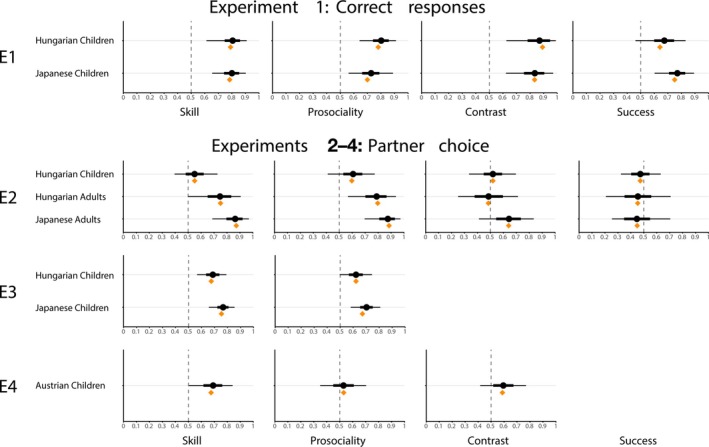 Figure 1
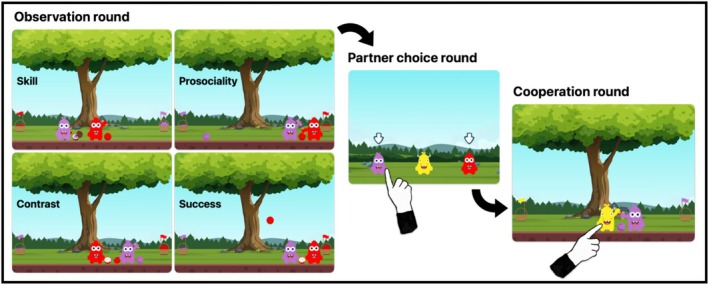 Figure 2
Peer Reviews
No public reviews on file for this paper yet. If you reviewed it on a platform where reviews are public (OpenReview, ICLR, NeurIPS, ICML), you can paste yours below so the community can read it here.
Videos
No videos yet. Explain this paper in a talk, walkthrough, or lecture? Add one.
Taxonomy
TopicsChild and Animal Learning Development · Evolutionary Psychology and Human Behavior · Evolutionary Game Theory and Cooperation