Association of exposure to PM2.5-bound metals with premature rupture of membranes: a prospective cohort study
Mengdan Liang, Liping Qiu, Biyun Lin, Zhehui Chen, Xiannuan Jiang, Mengying Xie, Xiaowei Xie, Hanbing Chen, Xiongkun He, Xiaoxiao Huang, Liang Lu, Lanlan Zhang, Hongjie Qiu, Yihong Chen, Junqi Wu, Xiaoxu Xie

TL;DR
This study finds that exposure to certain metals in fine particulate matter is linked to an increased risk of premature rupture of membranes during pregnancy.
Contribution
The study identifies specific PM2.5-bound metals associated with premature rupture of membranes using multiple statistical models.
Findings
Exposures to Al, Cd, Pb, Cr, Ni, Se, and Tl increased the risk of PROM with hazard ratios from 1.40 to 1.87.
Metal mixtures increased PROM risk by 3% (GWQS) and 5% (Q-gcomp), mainly driven by Pb.
Ni had the highest influence in the BKMR model, and Pb, Se, and Tl were positively correlated with preterm PROM.
Abstract
Exposure to PM2.5 has been linked to premature rupture of membranes (PROM). However, research on the effects of PM2.5-bound metals on the PROM is limited. Here, we investigated this relationship using data from 6090 pregnant women, estimating exposure to 11 PM2.5-bound metals throughout pregnancy. Cox models assessed associations between individual metals and PROM, while grouped weighted quantile sum regression (GWQS), quantile g-computation (Q-gcomp), and Bayesian kernel machine regression (BKMR) were used for metal mixtures. Exposure to Al, Cd, Pb, Cr, Ni, Se, and Tl increased PROM risk, with hazard ratios ranging from 1.40 to 1.87. As and Mn were also correlated with PROM during specific trimesters. The GWQS model showed a 3% increased risk of PROM with metal mixture exposure (95% CI: 2%, 4%), mainly driven by Pb in the positive direction. The Q-gcomp model revealed a 5% increased…
Genes, proteins, chemicals, diseases, species, mutations and cell lines named across the full text — each resolved to its canonical identifier and authoritative record.
Click any figure to enlarge with its caption.
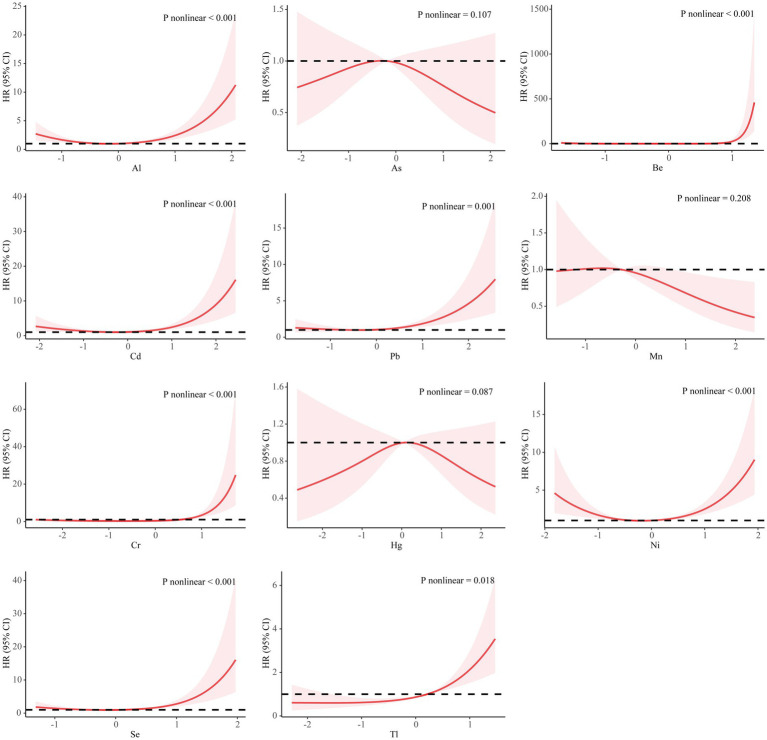 Figure 1
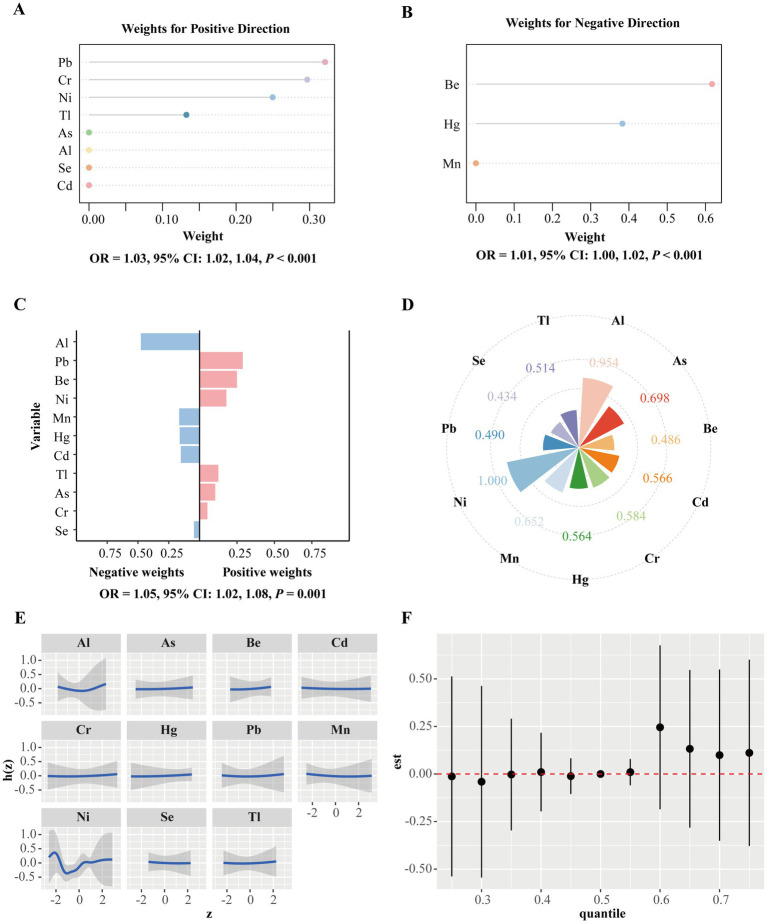 Figure 2
Peer Reviews
No public reviews on file for this paper yet. If you reviewed it on a platform where reviews are public (OpenReview, ICLR, NeurIPS, ICML), you can paste yours below so the community can read it here.
Videos
No videos yet. Explain this paper in a talk, walkthrough, or lecture? Add one.
Taxonomy
TopicsAir Quality and Health Impacts · Heavy Metal Exposure and Toxicity