Genome Sequence of the Cluster EF Bacteriophage TinyMiny, Isolated using Microbacterium foliorum
Iain Duffy, Juan Jimenez, Luis Gomez, Alexa Keeler, Aisha Ambrose, Moises Guadarrama, Hailey Kerns, Rachael Martin, Jade Moorehead, Arrianne Orgill, Brianna Reiber, Aisha Severe, Leslie Sivley, Genesis Valentin, John Duncan

TL;DR
This paper describes the genome of a new bacteriophage called TinyMiny, isolated from soil using a specific bacterium.
Contribution
The paper presents the genome sequence and classification of the newly isolated bacteriophage TinyMiny into the EF cluster.
Findings
TinyMiny has a 57,042 base pair double-stranded DNA genome.
The phage encodes 86 genes and is classified into the EF cluster based on gene content similarity.
It was isolated using Microbacterium foliorum NRRL B-24224 from a soil sample in Maryland.
Abstract
The bacteriophage TinyMiny was isolated from a soil sample collected on the campus of the University of Maryland Baltimore County, in Baltimore, Maryland, using the bacterium Microbacterium foliorum NRRL B-24224. TinyMiny is presumed to be a lytic bacteriophage, consisting of a double-stranded DNA genome 57,042 base pairs in length and encoding 86 genes. Based on gene content similarity to actinobacteriophages, TinyMiny is assigned to the EF cluster.
Genes, proteins, chemicals, diseases, species, mutations and cell lines named across the full text — each resolved to its canonical identifier and authoritative record.
Click any figure to enlarge with its caption.
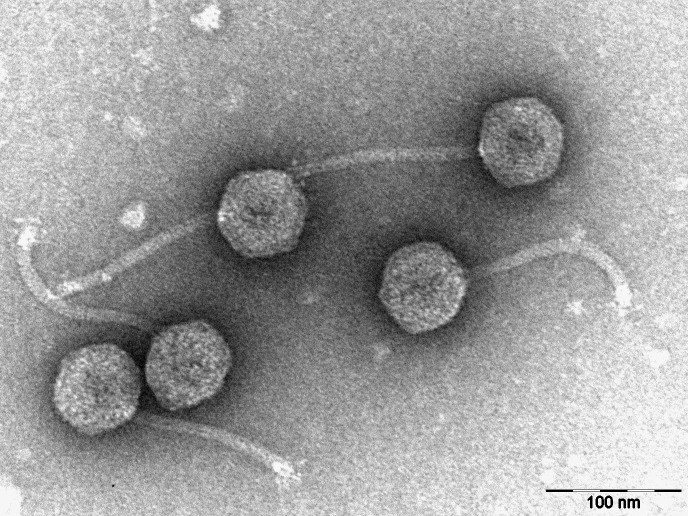 Figure 1
Peer Reviews
No public reviews on file for this paper yet. If you reviewed it on a platform where reviews are public (OpenReview, ICLR, NeurIPS, ICML), you can paste yours below so the community can read it here.
Videos
No videos yet. Explain this paper in a talk, walkthrough, or lecture? Add one.
Taxonomy
TopicsBacteriophages and microbial interactions
Description
Bacteriophage TinyMiny was isolated as part of the effort by the Science Education Alliance-Phage Hunters Advancing Genomic and Evolutionary Science (SEA-PHAGES) program, supported by the Howard Hughes Medical Institute, to uncover the genetic diversity of actinobacteriophages, including those that infect *Microbacterium foliorum * ( M. foliorum ) (Jordan et al., 2014; Hatfull GF. 2020; Jacobs-Sera et al., 2020) . Using standardized protocols, a soil sample was collected from under a layer of mulch beneath a bush (GPS coordinates: 39.255319 N, 76.708294 W) when the ambient temperature was 25°C (Zorawik et al., 2024). The sample was suspended in peptone yeast calcium (PYCa) liquid medium and shaken at 220 rpm for 2hrs at 30 ^o^ C, following which, the sample was spun in a centrifuge at 2,000 rpm for 10 minutes and the supernatant filtered through a 0.22-µm pore filter. To this filtrate was added M. foliorum NRRL B-24224 and the suspension further incubated with shaking at 30°C for 24 hours to enrich for phages capable of infection of M. foliorum . Following incubation, the resulting culture was filtered, and the filtrate plated in M. foliorum PYCa top agar overlays and incubated at 30 ^o^ C. Bacteriophage TinyMiny was purified via two rounds of plating, after which a lysate was prepared. TinyMiny formed plaques that were <1mm at 24 hours, which enlarged to approximately 1mm at 48 hours. Negative staining (1% uranyl acetate) transmission electron microscopy revealed TinyMiny to have a siphoviral morphology with an icosahedral capsid 62-65 nm in diameter and a tail 127-132 nm in length (n=5) (Figure 1).
TinyMiny DNA was extracted from a lysate using the Wizard DNA Clean-Up Kit (Promega, Madison, WI). This DNA was then prepared for sequencing at Pittsburgh University using the Ultra II Library Kit (NEB, Ipswich, MA) and sequenced using an Illumina MiSeq (v3 reagents), yielding 316,038 150-base single-end reads that provided 815-fold coverage of the genome when assembled using Newbler v2.9 (Miller et al., 2010; Russell 2018). The assembled genome was checked for completeness and genome termini using Consed v29 (Gordon et al., 2013). TinyMiny has a circularly permuted genome of 57,042 base pairs, with a GC content of 62.7%.
Annotation of the TinyMiny genome was accomplished using DNA Master v5.23.6 (http://cobamide2.bio.pitt.edu/) (Pope et al., 2018), Glimmer v3.02 (Delcher et al., 1999), GeneMark v2.5p (Besemer and Borodovsky 2005), PECAAN v20211202 (http://blog.kbrinsgd.org/), Starterator v485 (https://seaphages.org/software/#Starterator), Blast searches (Altschul et al., 1990) against the NCBI non-redundant protein and Actinobacteriophage (https://phagesdb.org/) databases (Russell and Hatfull, 2017), HHPred v3.2 (searching against the PDB_mmCIF70, SCOPe70, Pfam-A v36, NCBI Conserved Domain database v3.19) (Zimmermann et al., 2018), Phamerator v.37 (Cresawn et al., 2011), DeepTMHMM v1.0.24 (Hallgren et al., 2022), Aragorn v1.2.41 (Laslett and Canback, 2004) and tRNAscan-SE 2.0 (Chan and Lowe 2019). All software used in this annotation utilized the default settings.
The annotation process resulted in 86 genes being predicted for TinyMiny, 27 of which could be assigned a putative function. No tRNAs were predicted. Based on gene content similarity of >35% to bacteriophages in the Actinobacteriophage database, TinyMiny was assigned to cluster EF (Gauthier et al., 2023). TinyMiny encodes 42 homologues that are shared across the EF cluster including a terminase, portal, major tail, major and minor capsid proteins, minor tail proteins, tail assembly chaperones, tape measure protein, DNA helicase, DNA primase, a RuvC-like resolvase, and two related alpha subunits of RNA polymerase III. The endolysin function identifiable in cluster EF phages belong to two different protein phamilies, with TinyMiny encoding the endolysin that is encoded by a minority (6 other) of EF phages (Cresawn et al., 2011). No immunity repressor, integrase, or DNA partitioning proteins could be identified in TinyMiny or any other cluster EF phage, suggesting they are unlikely to establish lysogeny.
Nucleotide sequence accession numbers
The GenBank Accession No. for TinyMiny is MZ681513 and Sequence Read Archive (SRA) No. SRX14485096 .
The reference list from the paper itself. Each links out to its DOI / PubMed record.
- 1Altschul Stephen F. Gish Warren Miller Webb Myers Eugene W. Lipman David J. 1990101 Basic local alignment search tool Journal of Molecular Biology 21530022-283640341010.1016/s 0022-2836(05)80360-22231712 · doi ↗ · pubmed ↗
- 2Besemer J. Borodovsky M. 200571 Gene Mark: web software for gene finding in prokaryotes, eukaryotes and viruses Nucleic Acids Research 33Web Server 0305-1048 W 451W 45410.1093/nar/gki 48715980510 PMC 1160247 · doi ↗ · pubmed ↗
- 3Chan Patricia P. Lowe Todd M. 2019 t RN Ascan-SE: Searching for t RNA Genes in Genomic Sequences Methods in Molecular Biology 1064-374511410.1007/978-1-4939-9173-0_1PMC 676840931020551 · doi ↗ · pubmed ↗
- 4Cresawn Steven G Bogel Matt Day Nathan Jacobs-Sera Deborah Hendrix Roger W Hatfull Graham F 20111012 Phamerator: a bioinformatic tool for comparative bacteriophage genomics BMC Bioinformatics 1211471-210510.1186/1471-2105-12-395PMC 323361221991981 · doi ↗ · pubmed ↗
- 5Delcher A. 1999121 Improved microbial gene identification with GLIMMER Nucleic Acids Research 27231362-49624636464110.1093/nar/27.23.463610556321 PMC 148753 · doi ↗ · pubmed ↗
- 6Gauthier Christian H. Hatfull Graham F. 20231026 Pham Clust: a phage genome clustering tool using proteomic equivalencem Systems 852379-507710.1128/msystems.00443-23PMC 1065410337791778 · doi ↗ · pubmed ↗
- 7Gordon David Green Phil 2013831 Consed: a graphical editor for next-generation sequencing Bioinformatics 29221367-48112936293710.1093/bioinformatics/btt 51523995391 PMC 3810858 · doi ↗ · pubmed ↗
- 8Hallgren Jeppe Tsirigos Konstantinos D. Pedersen Mads Damgaard Almagro Armenteros José Juan Marcatili Paolo Nielsen Henrik Krogh Anders Winther Ole 2022410 Deep TMHMM predicts alpha and beta transmembrane proteins using deep neural networks 10.1101/2022.04.08.487609 · doi ↗