Draft genome sequence of multidrug-resistant Bacillus subtilis strain Hakim RU_LJ isolated from lacchi juice in Bangladesh
Muhib Ullah Khan, Md. Arif-Uz-Zaman Polash, Nusrat Zahan, Md. Mottaleb Ali, Nilima Rubaba Azad, Subir Sarker, Md. Hakimul Haque

TL;DR
The paper presents the draft genome of a drug-resistant Bacillus subtilis strain from Bangladesh, revealing resistance and virulence genes.
Contribution
The study provides a new multidrug-resistant genome from lacchi juice with detailed resistance and virulence gene profiles.
Findings
The genome has 17 antibiotic resistance genes and 10 virulence factor genes.
Six CRISPR arrays and 19 prophages were identified in the genome.
The assembled genome has a GC content of 43.5% and 50.33× coverage.
Abstract
This report details the draft genome sequence of the multidrug-resistant Bacillus subtilis strain Hakim RU_LJ derived from lacchi juice. The assembled genome spans 4.03 Mb, with 50.33× coverage and a GC content of 43.5%. Analysis revealed six CRISPR arrays, 19 prophages, 17 antibiotic resistance genes, and 10 virulence factor genes.
Genes, proteins, chemicals, diseases, species, mutations and cell lines named across the full text — each resolved to its canonical identifier and authoritative record.
Click any figure to enlarge with its caption.
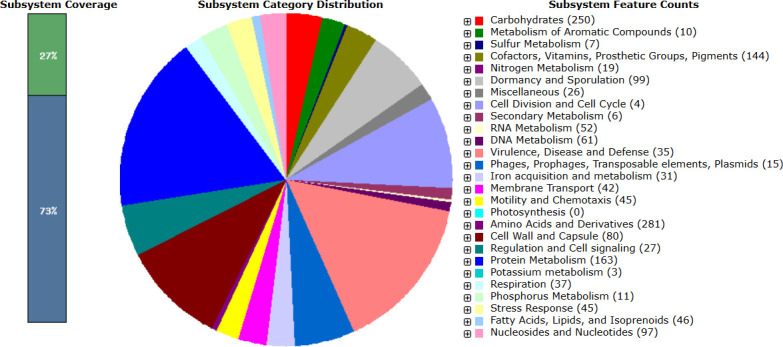 Fig 1
Fig 1| Elements | Values |
|---|---|
| Genome size | 4,033,419 bp |
| Genome coverage | 50.33× |
| G + C content | 43.5% |
| Number of contigs | 104 |
| Contig L50 | 12 |
| Contig N50 | 110,116 bp |
| Total genes | 4,321 |
| Coding sequences | 4,293 |
| Coding genes | 4,117 |
| RNA genes | 28 |
| tRNAs genes | 18 |
| rRNAs genes | 4 |
| tmRNAs gene | 1 |
| ncRNAs genes | 5 |
| Pseudo genes | 176 |
| Genes assigned to SEED subsystems | 4,428 |
| Number of subsystems | 326 |
Peer Reviews
No public reviews on file for this paper yet. If you reviewed it on a platform where reviews are public (OpenReview, ICLR, NeurIPS, ICML), you can paste yours below so the community can read it here.
Videos
No videos yet. Explain this paper in a talk, walkthrough, or lecture? Add one.
Taxonomy
TopicsGenomics and Phylogenetic Studies · Bacteriophages and microbial interactions · Bacterial biofilms and quorum sensing
ANNOUNCEMENT
Bacillus subtilis, an aerobic, endospore-forming, Gram-positive bacterium with Generally Recognized as Safe (GRAS) status, can contaminate fermented beverages, such as lacchi juice, through soil, water, or raw ingredients (1–3). Its ability to thrive during fermentation is attributed to its spore-forming nature and adaptability. The bacterium’s multidrug resistance is likely driven by environmental exposure to antibiotics, which facilitates resistance development through mutations or horizontal gene transfer (4). Continuous antimicrobial resistance (AMR) surveillance is crucial for assessing potential risks, enhancing food safety measures, and unlocking biotechnological applications (5, 6).
In May 2024, with authorization from the Institute of Biological Sciences (IBScs) at the University of Rajshahi, Bangladesh (Memo No. 56/321/IAMEBBC/IBScs), we collected samples of lacchi juice from street vendors near the university (24.3733°N, 88.6049°E) using standard protocols. The samples were thoroughly mixed, transferred into sterile containers, and promptly delivered to the laboratory (7). Bacillus subtilis was isolated by culturing the samples on nutrient agar (HiMedia, India) and blood agar (HiMedia, India), with aerobic incubation at 37°C for 18–24 hours, followed by microscopic staining and biochemical analyses (8). The antimicrobial resistance patterns of the isolates were evaluated against 10 widely used antibiotics through the disk diffusion technique (9), adhering to CLSI standards (10). A multidrug-resistant strain, showing resistance to tetracycline, doxycycline, cefixime, ceftazidime, and nalidixic acid, was selected for genomic analysis.
The bacterial strain was grown overnight in nutrient broth (HiMedia, India) at 37°C, and its genomic DNA was isolated using the Qiagen DNA Mini Kit (QIAGEN, Hilden, Germany). The extracted DNA was fragmented enzymatically with the NEBNext dsDNA Fragmentase Kit (NEB, MA, USA), and fragments were size-selected using SPRI beads (11)). A sequencing library was constructed with the Nextera DNA Flex Library Preparation Kit (Illumina, San Diego, CA, USA) and sequenced on the Illumina NextSeq2000 platform, generating 2 × 150 paired-end reads. Sequence quality was assessed with FastQC v0.11.7 (12), and the raw reads (n = 1,382,869) were processed using Trimmomatic v0.39 (13) to remove low-quality bases and adapters. Genome assembly was carried out with Unicycler v0.4.9 (14), followed by gene annotation using PGAP v3.0 (15). Additional analyses involved screening for antibiotic resistance genes with CARD v3.2.4 (16) and RGI v6.0.2 (17), identifying virulence factors using VFDB and VFanalyzer v4.0 (18), estimating pathogenicity with PathogenFinder v1.1 (19), determining sequence type via MLST v2.0 (20), detecting CRISPR arrays with CRISPRimmunity (21), and evaluating metabolic capabilities with RAST v2.0 (22). Default settings were applied for all software unless specified otherwise.
The elements of the draft genomes are documented in Table 1. Notably, 17 ARGs, including putative aadK, mph(K), tet(L), acquired resistance genes and aminoglycosides, macrolide, tetracycline antibiotic classes, and 10 virulence genes comprising ClpP, cap8D, cpsJ, LPG_RS03745, hasC, cap8P, cps4I, wbpM, fepC, and galF were predicted. MLST classified the genome as an unknown sequence type, and the PathogenFinder tool specified a pathogenicity index of 0.236. The genome exhibited five CRISPR arrays with six signature genes (cas3, DEDDh, DinG, TnsC, csa3, and WYL) and 19 prophages. RAST analysis revealed 326 subsystems comprising 4,428 genes with 27% coverage (Fig. 1).
Metabolic functional features in the Bacillus subtilis Hakim RU_LJ assembled genome in SEED viewer. The 27% coverage indicates the completeness of functional roles within a specific subsystem across different genomes.
The reference list from the paper itself. Each links out to its DOI / PubMed record.
- 1Haque MA, Wang F, Chen Y, Hossen F, Islam MA, Hossain MA, Siddique N, He C, Ahmed F. 2021. Bacillus spp. contamination: a novel risk originated from animal feed to human food chains in South-Eastern Bangladesh. Front Microbiol 12:783103. doi:10.3389/fmicb.2021.78310335058902 PMC 8764408 · doi ↗ · pubmed ↗
- 2Alcaraz LD, Moreno-Hagelsieb G, Eguiarte LE, Souza V, Herrera-Estrella L, Olmedo G. 2010. Understanding the evolutionary relationships and major traits of Bacillus through comparative genomics. BMC Genomics 11:332. doi:10.1186/1471-2164-11-33220504335 PMC 2890564 · doi ↗ · pubmed ↗
- 3Earl AM, Losick R, Kolter R. 2008. Ecology and genomics of Bacillus subtilis. Trends Microbiol 16:269–275. doi:10.1016/j.tim.2008.03.00418467096 PMC 2819312 · doi ↗ · pubmed ↗
- 4Ahmed I, Rabbi MB, Sultana S. 2019. Antibiotic resistance in Bangladesh: a systematic review. Int J Infect Dis 80:54–61. doi:10.1016/j.ijid.2018.12.01730634043 · doi ↗ · pubmed ↗
- 5Schallmey M, Singh A, Ward OP. 2004. Developments in the use of Bacillus species for industrial production. Can J Microbiol 50:1–17. doi:10.1139/w 03-07615052317 · doi ↗ · pubmed ↗
- 6Saikat TA, Sayem Khan MA, Islam MS, Tasnim Z, Ahmed S. 2024. Characterization and genome mining of Bacillus subtilis BDSA 1 isolated from river water in Bangladesh: a promising bacterium with diverse biotechnological applications. Heliyon 10:e 34369. doi:10.1016/j.heliyon.2024.e 3436939114027 PMC 11305188 · doi ↗ · pubmed ↗
- 7Haque MH, Islam MZ, Miah ML, Das SK, Sarker S. 2023. Molecular characterization of multidrug-resistant Escherichia coli isolated from human urine infections with their antibiogram profile. J Adv Biotechnol Exp Ther 6:172. doi:10.5455/jabet.2023.d 116 · doi ↗
- 8Bergey DH, Buchanan RE, Gibbons NE. 1974. Bergey’s manual of determinative bacteriology. 8th ed, p 966–1097. American Society for Microbiology, Washington, DC, USA.