methylMapR—an R package to generate the functional prokaryotic methylome
Christopher Morrissey, Arun Sethuraman

TL;DR
methylMapR is an R package that helps analyze prokaryotic methylomes using PacBio sequencing data for three bacterial species.
Contribution
The novel contribution is the development of methylMapR for functional methylome analysis in prokaryotes.
Findings
methylMapR enables functional methylome analysis from PacBio sequencing data.
The package was applied to Escherichia coli, Klebsiella pneumoniae, and Pseudomonas aeruginosa.
Comparative analyses revealed insights into prokaryotic methylation patterns.
Abstract
Here, we present an R package called methylMapR to capture the functional methylome from long read sequencing of prokaryotic genomes using the PacBio sequencing platform. We then describe its utility by comparative analyses of the functional methylomes in three bacterial species—Escherichia coli, Klebsiella pneumoniae, and Pseudomonas aeruginosa.
Genes, proteins, chemicals, diseases, species, mutations and cell lines named across the full text — each resolved to its canonical identifier and authoritative record.
Click any figure to enlarge with its caption.
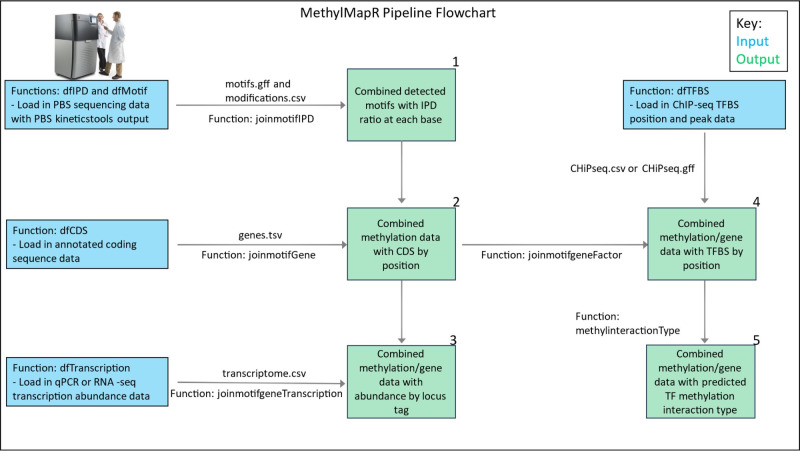 Fig 1
Fig 1| Prokaryote | IPD ratio at methylation target bases and all other bases | Number and proportion of methylation types | Methylation motif/TFBS crowdedness (10 bp window, both strands) Avg and Max | Number and proportion of promoter region-associated motifs | TFBS/methyl interaction types – ratio of promoting to repressive |
|---|---|---|---|---|---|
|
| m4C: 1.0657 | m4C: 3215, 0.0236 | m4C: 1.4325, 4 | m4C: 27, 0.0260 | m4C: 62:445, 0.1393 |
|
| m4C: 1.0137 | m4C: 3464, 0.0297 | m4C: 2.0370, 6 | m4C: 50, 0.0302 | m4C: 21:93, 0.2258 |
|
| m4C: 1.0523 | m4C: 3126, 0.0398 | m4C: 1.0000, 1 | m4C: 19, 0.0294 | m4C: 0:0, 0 |
- —National Science Foundationhttp://dx.doi.org/10.13039/501100008982
Peer Reviews
No public reviews on file for this paper yet. If you reviewed it on a platform where reviews are public (OpenReview, ICLR, NeurIPS, ICML), you can paste yours below so the community can read it here.
Videos
No videos yet. Explain this paper in a talk, walkthrough, or lecture? Add one.
Taxonomy
TopicsEpigenetics and DNA Methylation · RNA modifications and cancer · Genomics and Phylogenetic Studies
ANNOUNCEMENT
DNA methylation has been studied extensively in transcription regulation and gene expression across prokaryotes (1–4). A shared aspect of prokaryotic DNA methylation is that DNA methyltransferase (DNMT) requires the methyl donor molecule, S-adenosyl methionine, and covalently transfers the heritable epigenetic methyl tag to a base within its target motif (5). During binary fission, each daughter chromosome is hemi-methylated with the daughter strand retaining methylation patterns from its parent chromosome. The nascent strand remains unmethylated, needing to be remethylated by DNMT (6). Active gene processes like transcription can block or modulate the methylation reaction during re-methylation events (7). Conversely, methylation has been shown to both promote and repress transcription. Some technologies like PacBio Sequencing, henceforth PBS, and its associated software, kineticsTools, can monitor polymerase kinetics by tracking the time of incorporation of each new base on the nascent strand and estimate the interpulse duration ratio (IPD), the likelihood that a methyl functional group is present at that base (8, 9). A high IPD ratio is indicative of a slower incorporation rate by DNA polymerase, which can be caused by the presence of a methyl group (10, 11). Here, we present methylMapR, a tool that leverages the IPD ratio data from PBS and combines it with other functional genomic data to describe the functional prokaryotic methylome.
methylMapR implements several mapping functions that calculate new metrics and/or add columns to the output data frames, including assigning transcription factor methylation interaction type, finding promoter-associated motif sites, and calculating the number of TFBSs near each motif (Fig. 1). We utilized and compared functional methylomes from publicly available NCBI repositories for three well-studied prokaryotes, Escherichia coli, specifically the laboratory-born K12 strain, Klebsiella pneumoniae, and Pseudomonas aeruginosa. We acknowledge that none of these data comes from a single source or experiment(s). Our analyses here were therefore designed to help compare the power of methylMapR across multiple genera.
A flowchart showing inputs and outputs generated by functions in the methylMapR R package.
A comparison of the output from methylMapR and summary metrics of the three functional methylomes regarding transcription is presented in Table 1. The global IPD ratio observed across methylomes suggested that E. coli had the highest average IPD, for all known methylation types (m4C: 1.0657, m5C: 1.1643, and m6A: 1.1945). Global IPD ratios in both K. pneumoniae and P. aeruginosa were lower, exhibiting 1.1001 and 1.0018 IPD ratio at target adenines with a m6A motif, respectively. Comparing the types and proportions of motifs that were methylated, we observe one main difference between the isolates*—E. coli* has an extra methyl transferase/motif type (m5C) that the other two prokaryotes do not. Additionally, we uncovered differences in proportions of detected methylation motifs across all species. K pneumoniae shows over 60% of its methylation motifs are from the m6A tag. The m4C tag, though present in all species, accounts for less than 5% of all motifs in all three methylomes. All methylomes also show interactions with transcription factor binding sites, and the repressive methylation type was the most common interaction predicted. None of the methylomes had a methylation promotion rate above 20% at all methylated motif sites.
The methylMapR R package is available at https://github.com/therealtotodile/methylMapR/ and was tested on R 4.4.2 GUI 1.81 Big Sur ARM build (8462). To install methylMapR, source code, example data sets and code outputs, users can download the .gz to run on MacOSX, Windows, or Linux. From RStudio, users can go to Tools->Install packages, and under Install From , select the methylMapR Package Archive File (.tar.gz), then click install. R code to replicate analyses described in this manuscript is available via FigShare DOI: 10.6084/m9.figshare.2858581710.6084/m9.figshare.28585817.
The reference list from the paper itself. Each links out to its DOI / PubMed record.
- 1Moore LD, Le T, Fan G. 2013. DNA methylation and its basic function. Neuropsychopharmacology 38:23–38. doi:10.1038/npp.2012.11222781841 PMC 3521964 · doi ↗ · pubmed ↗
- 2Jin B, Li Y, Robertson KD. 2011. DNA Methylation: superior or subordinate in the epigenetic hierarchy? Genes & Cancer 2:607–617. doi:10.1177/194760191039395721941617 PMC 3174260 · doi ↗ · pubmed ↗
- 3Beaulaurier J, Schadt EE, Fang G. 2019. Deciphering bacterial epigenomes using modern sequencing technologies. Nat Rev Genet 20:157–172. doi:10.1038/s 41576-018-0081-330546107 PMC 6555402 · doi ↗ · pubmed ↗
- 4Jones PA, Miranda TB. 2007. DNA methylation: the nuts and bolts of repression - Wiley... DNA methylation: the nuts and bolts of repression. Available from: https://onlinelibrary.wiley.com/doi/10.1002/jcp.2122410.1002/jcp.2122417708532 · doi ↗ · pubmed ↗
- 5Struck A-W, Thompson ML, Wong LS, Micklefield J. 2012. S-adenosyl-methionine-dependent methyltransferases: highly versatile enzymes in biocatalysis, biosynthesis and other biotechnological applications. Chembiochem 13:2642–2655. doi:10.1002/cbic.20120055623180741 · doi ↗ · pubmed ↗
- 6Waldminghaus T, Weigel C, Skarstad K. 2012. Replication fork movement and methylation govern Seq A binding to the Escherichia coli chromosome. OUP Academic. Available from: https://academic.oup.com/nar/article/40/12/5465/2414657. https://doi.org/10.1093/nar/gks 18710.1093/nar/gks 187PMC 338431122373925 · doi ↗ · pubmed ↗
- 7Héberlé É, Flore Bardet A. 2019. Sensitivity of transcription factors to DNA methylation. Portland Press. Available from: https://portlandpress.com/essaysbiochem/article/63/6/727/221209/Sensitivity-of-transcription-factors-to-DNA. https://doi.org/10.1042/EBC 2019003310.1042/EBC 20190033 PMC 692332431755929 · doi ↗ · pubmed ↗
- 8Clark TA, et al.. 2011. Characterization of DNA methyltransferase specificities using single- molecule, real-time DNA sequencing. OUP Academic. Available from: https://academic.oup.com/nar/article/40/4/e 29/2411089. https://doi.org/10.1093/nar/gkr 114610.1093/nar/gkr 1146 PMC 328716922156058 · doi ↗ · pubmed ↗