Draft genome sequences of a novel Escherichia coli K-12 MG1655 L-form strain and its evolved variant
Marjolein E. Crooijmans, Johannes H. de Winde, Dennis Claessen

TL;DR
This study presents draft genomes of an Escherichia coli strain that can grow without a cell wall and a variant that grows better.
Contribution
The paper introduces novel draft genome sequences of an E. coli L-form strain and its evolved variant with improved growth.
Findings
The L-form E. coli strain can proliferate without a cell wall.
An evolved variant of the L-form strain shows enhanced growth capabilities.
Draft genome sequences reveal genetic adaptations for cell wall-independent growth.
Abstract
L-forms are bacterial variants capable of proliferating without a cell wall. In this evolution study, we present draft genome sequences of a novel Escherichia coli K-12 L-form strain and an evolved variant that exhibits enhanced growth. These draft sequences provide insights into the genetic adaptations associated with cell wall-independent growth.
Genes, proteins, chemicals, diseases, species, mutations and cell lines named across the full text — each resolved to its canonical identifier and authoritative record.
Click any figure to enlarge with its caption.
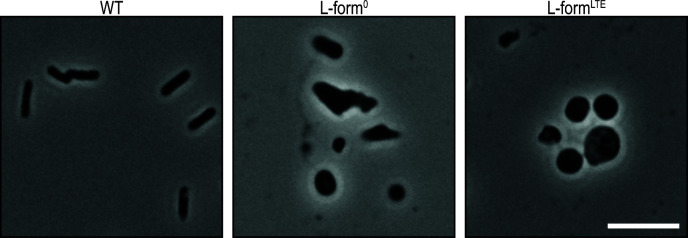 Fig 1
Fig 1| WT | L-form0 | L-formLTE | |
|---|---|---|---|
| BioSample |
|
|
|
| GenBank chromosome no. |
|
|
|
| GenBank plasmid no. |
|
|
|
| SRA no. |
|
|
|
| Total no. of raw Illumina reads | 7,655,618 (3,827,809 paired) | 7,157,602 (3,578,801 paired) | 4,849,560 (2,424,780 paired) |
| FASTQC quality control score | 35.52 | 35.59 | 35.25 |
| Total no. of trimmed Illumina reads | 6,303,758 (3,151,879 paired) | 5,872,224 (2,936,112 paired) | 3,776,720 (1,888,360 paired) |
| Read length (bp) | 50–151 | 50–151 | 50–151 |
| No. of contigs | 2 | 2 | 2 |
| Largest contig size (bp) | 4,628,058 | 4,628,071 | 4,623,550 |
| Total length (bp) | 4,632,732 | 4,632,792 | 4,628,271 |
| Coverage of total genome (×) | 139 | 130 | 81 |
| Genome GC content (%) | 50.8 | 50.8 | 50.8 |
| No. of chromosomal genes (coding) | 4,217 | 4,214 | 4,207 |
| No. of mutated chromosomal genes | 5 | 16 | |
| Location of mutated genes | |||
- —Nederlandse Organisatie voor Wetenschappelijk Onderzoekhttp://dx.doi.org/10.13039/501100003246
Peer Reviews
No public reviews on file for this paper yet. If you reviewed it on a platform where reviews are public (OpenReview, ICLR, NeurIPS, ICML), you can paste yours below so the community can read it here.
Videos
No videos yet. Explain this paper in a talk, walkthrough, or lecture? Add one.
Taxonomy
TopicsGenomics and Phylogenetic Studies · Bacterial Genetics and Biotechnology · Bacteriophages and microbial interactions
ANNOUNCEMENT
L-forms are bacteria that proliferate without a cell wall often due to unique, species-specific mutations (1–3). These cells are crucial for studying bacterial survival under cell wall-targeting antibiotics and provide insights into bacterial persistence and antibiotic resistance. To investigate mutations that enable L-form growth, we generated an Escherichia coli K-12 MG1655 L-form strain from a Weizmann Institute parental strain (WT) carrying a kanamycin-resistant green fluorescent protein (GFP) reporter plasmid under control of the serW promoter (4). The L-form strain (L-form^0^) was created by diluting the WT overnight culture in L-phase broth with 50 µg mL^−1^ kanamycin and 0.4 mg mL^−1^ penicillin (5), then incubating it at 37°C. A 1 mL sample (8 × 10 ^ 8 spheroplasts) was plated on L-phase media agar with horse serum and Iberian agar, then exposed to UV light for 1 min. After 72 h at 30°C, a mucoid colony appeared.
The L-form^0^ colony was used to inoculate L-phase broth with kanamycin and penicillin (Fig. 1). To enhance growth, we performed a long-term evolution experiment, transferring cells of L-form^0^ weekly into L-phase broth with antibiotics. After 121 weeks, reaching the 800th generation, it was marked L-form^LTE^ (Fig. 1). For genomic analysis, L-form^0^ and L-form^LTE^ were cultured in L-phase broth to exponential phase (OD600 = 0.35) and WT in LB medium (OD600 = 2.0) both at 37°C overnight. DNA was extracted with the GenElute Bacterial Genomic DNA Kit. A minimum of 500 ng DNA at >25 ng µL^−1^ was submitted for Illumina sequencing by BaseClear (Leiden, Netherlands).
Morphology of the E. coli L-form strains. Wild-type (WT) cells were grown overnight in LB medium, while the L-form0 and L-formLTE strains were grown in L-phase broth. Brightfield microscope images were captured after placing 5 µL of each culture onto microscope slides. Scale bar: 10 µm.
The library was prepared with the Genomic Nextera XT Kit, including quality control (QC) and quantification steps. Whole-genome sequencing was performed on Illumina NovaSeq 6000. FASTQ-format reads were quality-filtered to remove PhiX and adaptors, ensuring a minimum read length of 50 bp. Secondary QC was done with FASTQC version 0.11.8 (6).
Reads were imported into Geneious Prime 2025.0.3 (7) and trimmed with BBDuk version 38.84 (trim low-quality min 30, discard short reads 30 bp) (8). WT reads were mapped to the K-12 MG1655 genome (National Center for Biotechnology Information U00096.3, 17 Nov. 2022) to create a WT sequence. Trimmed reads from L-form^0^ and L-form^LTE^ were then mapped to this WT sequence to generate consensus sequences. Annotation used the U00096.3 reference genome (Live Annotate & Predict, 95% similarity). Default parameters were used for all software per Geneious guidelines, unless otherwise specified (July 2024). Notably, we observed that after the formation of L-form^LTE^, a part of the original plasmid was replaced by an intF-containing region, which continued to drive the GFP signal. Variation analysis in Geneious (find variations/SNPs with default minimum variation of 0.25, WT as reference) identified SNPs, insertions, and deletions in L-form^0^ and L-form^LTE^ (Table 1) (9). L-form^LTE^ lost over 4,500 bp mainly due to loss of some RAC prophage genes, including trkG, ynaK, ydaY, and ynaA, impacting motility and biofilm formation (10). These genomic changes support cell wall-independent growth (9).
The reference list from the paper itself. Each links out to its DOI / PubMed record.
- 1Kawai Y, Mercier R, Wu LJ, Domínguez-Cuevas P, Oshima T, Errington J. 2015. Cell growth of wall-free L-form bacteria is limited by oxidative damage. Curr Biol 25:1613–1618. doi:10.1016/j.cub.2015.04.03126051891 PMC 4510147 · doi ↗ · pubmed ↗
- 2Leaver M, Domínguez-Cuevas P, Coxhead JM, Daniel RA, Errington J. 2009. Life without a wall or division machine in Bacillus subtilis. Nature 457:849–853. doi:10.1038/nature 0774219212404 · doi ↗ · pubmed ↗
- 3Liu Y, Zhang Y, Kang C, Tian D, Lu H, Xu B, Xia Y, Kashiwagi A, Westermann M, Hoischen C, Xu J, Yomo T. 2023. Comparative genomics hints at dispensability of multiple essential genes in two Escherichia coli L-form strains. Biosci Rep 43:BSR 20231227. doi:10.1042/BSR 2023122737819245 PMC 10600066 · doi ↗ · pubmed ↗
- 4Zaslaver A, Bren A, Ronen M, Itzkovitz S, Kikoin I, Shavit S, Liebermeister W, Surette MG, Alon U. 2006. A comprehensive library of fluorescent transcriptional reporters for Escherichia coli. Nat Methods 3:623–628. doi:10.1038/nmeth 89516862137 · doi ↗ · pubmed ↗
- 5Ramijan K, Ultee E, Willemse J, Zhang Z, Wondergem JAJ, van der Meij A, Heinrich D, Briegel A, van Wezel GP, Claessen D. 2018. Stress-induced formation of cell wall-deficient cells in filamentous actinomycetes. Nat Commun 9:5164. doi:10.1038/s 41467-018-07560-930514921 PMC 6279842 · doi ↗ · pubmed ↗
- 6Andrews S. 2010. Fast QC: a quality control tool for high throughput sequence data. Available from: https://www.bioinformatics.babraham.ac.uk/projects/fastqc/
- 7Kearse M, Moir R, Wilson A, Stones-Havas S, Cheung M, Sturrock S, Buxton S, Cooper A, Markowitz S, Duran C, Thierer T, Ashton B, Meintjes P, Drummond A. 2012. Geneious Basic: an integrated and extendable desktop software platform for the organization and analysis of sequence data. Bioinformatics 28:1647–1649. doi:10.1093/bioinformatics/bts 19922543367 PMC 3371832 · doi ↗ · pubmed ↗
- 8Bushnell B. 2014. B Btools software package. Available from: https://github.com/Bio Info Tools/BB Map/blob/master/README.md