Longitudinal associations between depressive symptoms and cell deformability: do glucocorticoids play a role?
Julian Eder, Martin Kräter, Clemens Kirschbaum, Wei Gao, Magdalena Wekenborg, Marlene Penz, Nicole Rothe, Jochen Guck, Lucas Daniel Wittwer, Andreas Walther

TL;DR
Depressive symptoms are linked to increased immune cell deformability over time, but not through long-term glucocorticoid levels.
Contribution
This study is the first to longitudinally examine the relationship between depressive symptoms, glucocorticoids, and cell deformability.
Findings
Depressive symptoms at T1 predicted higher cell deformability in monocytes and lymphocytes at T2.
Accumulated hair cortisol and cortisone levels did not mediate the relationship between depressive symptoms and cell deformability.
Long-term glucocorticoid levels were not associated with increased cell deformability.
Abstract
Cell deformability of all major blood cell types is increased in depressive disorders (DD). Furthermore, impaired glucocorticoid secretion is associated with DD, as well as depressive symptoms in general and known to alter cell mechanical properties. Nevertheless, there are no longitudinal studies examining accumulated glucocorticoid output and depressive symptoms regarding cell deformability. The aim of the present study was to investigate, whether depressive symptoms predict cell deformability one year later and whether accumulated hair glucocorticoids mediate this relationship. In 136 individuals (nfemale = 100; Mage = 46.72, SD = 11.28; age range = 20–65), depressive symptoms (PHQ-9) and hair glucocorticoids (cortisol and cortisone) were measured at time point one (T1), while one year later (T2) both depressive symptoms and hair glucocorticoids were reassessed. Additionally, cell…
Genes, proteins, chemicals, diseases, species, mutations and cell lines named across the full text — each resolved to its canonical identifier and authoritative record.
Click any figure to enlarge with its caption.
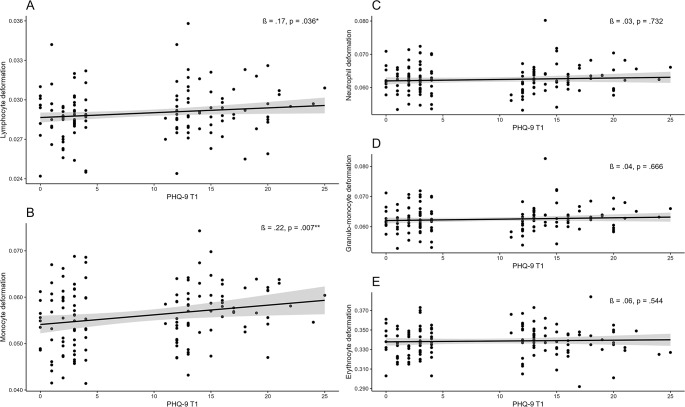 Figure 1
Peer Reviews
No public reviews on file for this paper yet. If you reviewed it on a platform where reviews are public (OpenReview, ICLR, NeurIPS, ICML), you can paste yours below so the community can read it here.
Videos
No videos yet. Explain this paper in a talk, walkthrough, or lecture? Add one.
Taxonomy
TopicsStress Responses and Cortisol · Dermatology and Skin Diseases · Tryptophan and brain disorders