A One Health Approach to Investigating Cache Valley Virus, Arkansas, USA, July 2023
Ann Carpenter, Noah Kojima, Theresa M. Dulski, Amanda E. Calvert, Kristen L. Burkhalter, Jennifer R. Ballard, Keith Blount, Anna Fagre, Elisa Thrasher, Katelyn Lazenby, Stephen Hedges, Audrey Long, Kerri Miazgowicz, Erin Wood, Phillip Owens, C. Roxanne Connelly, Carolyn V. Gould

TL;DR
This paper investigates the effects of Cache Valley Virus in Arkansas using a One Health approach after detecting the virus in an aborted lamb.
Contribution
The study applies a One Health approach to investigate CVV's impact in Arkansas, where the virus had not been previously documented.
Findings
CVV RNA was detected in an aborted lamb from a flock in Arkansas in July 2023.
The investigation aimed to explore the potential effects of CVV on both human and animal health in the region.
Abstract
Cache Valley virus (CVV), a mosquitoborne virus, can cause neuroinvasive disease in humans and adverse reproductive outcomes in sheep and goats. In 2023, CVV RNA was detected in an aborted lamb from a flock in Arkansas, USA. We conducted a One Health investigation to explore the potential effects of CVV in Arkansas.
Genes, proteins, chemicals, diseases, species, mutations and cell lines named across the full text — each resolved to its canonical identifier and authoritative record.
Click any figure to enlarge with its caption.
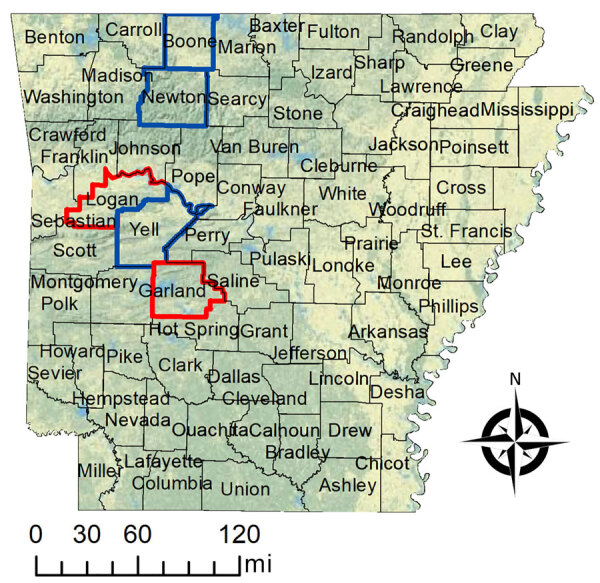 Figure 1
| County | CVV only | POTV only | CVV and JCV | CVV, JCV, and POTV |
|---|---|---|---|---|
| Yell, n = 5† | 1 (20) | 1 (20) | 0 | 2 (40) |
| Boone, n = 1 | 0 | 0 | 0 | 1 (100) |
| Newton, n = 7 | 0 | 0 | 1 (14) | 6 (85) |
| All, n = 13 | 1 (8) | 1 (15) | 1 (15) | 9 (30) |
| Species | No. collected |
|---|---|
|
| 32 |
|
| 5 |
|
| 1 |
|
| 10 |
|
| 2 |
|
| 22 |
|
| 264 |
| 10 | |
| 3 | |
|
| 2 |
|
| 77 |
|
| 5 |
| 3 | |
|
| 113 |
|
| 5 |
|
| 13 |
|
| 13 |
|
| 14 |
|
| 1 |
| 9 | |
|
| 3 |
|
| 9 |
|
| 17 |
| Unknown | 8 |
| Total | 641 |
Peer Reviews
No public reviews on file for this paper yet. If you reviewed it on a platform where reviews are public (OpenReview, ICLR, NeurIPS, ICML), you can paste yours below so the community can read it here.
Videos
No videos yet. Explain this paper in a talk, walkthrough, or lecture? Add one.
Taxonomy
TopicsVector-Borne Animal Diseases · Viral Infections and Vectors · Mosquito-borne diseases and control
Cache Valley virus (CVV), a mosquitoborne virus in the family Peribunyaviridae, genus Orthobunyavirus, and serogroup Bunyamwera, circulates among several vertebrate species, including sheep, deer, horses, and cattle (1–3). CVV has been isolated from multiple mosquito genera, but the primary vector species likely varies by geographic location (1–6).
Humans are susceptible to CVV and can develop asymptomatic infection or clinical disease ranging from febrile illness to meningitis and encephalitis. Although most CVV infections in animals are subclinical, infection in sheep and goats during pregnancy can cause abortions, malformed fetuses, and congenital abnormalities (1). Fetal deformities involve musculoskeletal and central nervous system malformations such as scoliosis, hydrocephalus, and arthrogryposis (7). Adverse fetal impact depends on the timing of infection during gestation (8).
The geographic distribution and burden of CVV disease among humans and animals is not well characterized (2,4,9). Since the initial identification of CVV in mosquitoes in Utah, USA, in 1956, the virus has been detected across North America, including the United States, Canada, and Mexico (1,3). Eight human disease cases have been reported in the United States, with likely exposures in North Carolina, Missouri, Wisconsin, Michigan, and New York (10–12); an additional case was associated with blood transfusion from an asymptomatic infected blood donor in Illinois (13). Seroprevalence studies have demonstrated widespread exposure to CVV in humans and animals (2,3).
In February 2023, CVV RNA was detected in tissues from an aborted lamb at a farm in central Arkansas, USA (farm A). The farmer reported an abortion storm with an attack rate of ≈30%. Previously, there had been 1 other report of CVV in Arkansas in 2020, a seropositive sheep from a flock in northwest Arkansas (farm B), located ≈60 miles northwest of farm A (Figure). The identification of an abortion storm in a flock potentially related to CVV raised concern about the potential risk for CVV to human and animal health. We investigated the occurrence and health risk for CVV among humans and animals in Arkansas.
The Study
To investigate the effect of CVV on livestock, we acquired archived serum samples collected at breeding in August 2022 and 2 months’ gestation from sheep bred at farm B. Most of the flock were lambing for the first time, and the others did not have a history of fertility issues. Husbandry records included reproductive outcomes. To confirm the presence of CVV-specific antibodies in wild ungulates, we obtained archived serum samples from white-tailed deer culled in 2017 and 2020 during herd health assessments conducted in 3 counties in Arkansas (Figure).
We performed plaque reduction neutralization tests on sheep and deer serum diluted 2-fold from 1:10 to 1:1,280. We calculated maximal effective concentrations in which the serum dilution resulted in a 50% reduction in viral plaques (EC_50_) using virus neutralization curves with a 4-parameter logistic model. We defined seropositivity as EC_50_
20. We also screened deer serum for neutralizing antibodies against Potosi and Jamestown Canyon viruses, 2 related orthobunyaviruses known to infect white-tailed deer in North America, including Arkansas (1).
To identify potential CVV vectors in Arkansas, we conducted dusk-to-dawn mosquito trapping using CO_2_-baited CDC miniature light traps, with and without light over 9 trap nights around farms A and B during the 2023 arboviral season (epidemiologic weeks 25–46). We homogenized captured female mosquitoes in cell culture medium/bovine albumin and extracted RNA for real-time reverse transcription PCR (14).
Meningitis and encephalitis are reportable conditions in Arkansas. To identify patients with meningitis and encephalitis of unknown etiology among cases reported to the Arkansas Department of Health (ADH) during January 1, 2022–July 9, 2023, we reviewed case data and applied standardized case definitions. Inclusion criteria were acute onset of fever and cerebrospinal fluid pleocytosis, defined as leukocytes (leukocyte) >5 cells/mm^3^. Patients classified as having encephalitis had >1 of the following: altered mental status, neurologic deficits, abnormal neuroimaging, abnormal electroencephalogram, or seizure. Patients classified as having meningitis had none of the characteristics of encephalitis and reported headache, stiff neck, or photophobia. To avoid capturing infections acquired at birth or in the hospital, we excluded patients <2 months of age and those whose initial CSF specimen was obtained on or after the third day of admission.
The Centers for Disease Control and Prevention deemed our investigation to be public health surveillance. We obtained archived serum samples from ewes under material transfer agreements with US Department of Agriculture and samples from deer from the Arkansas Game and Fish Commission. All specimens were collected under Institutional Animal Care and Use Committee–approved protocols held by the respective agencies.
We identified 39 ewes bred in August 2022 and lambed in mid-January to early February of 2023 with paired specimens at farm B. Of the 39 ewes, 8 (21%) were seropositive for CVV at breeding and 31 (79%) were seronegative. Of the seronegative ewes, 3 (10%) seroconverted during pregnancy; of those, 2 (66%) had adverse reproductive outcomes. The first ewe gave birth to a stillborn lamb with angular limb deformities and CVV detected in kidney tissue by PCR performed at Texas A&M Veterinary Medical Diagnostic Laboratory (College Station, Texas, USA) and a seropositive liveborn lamb reported to have weak legs. The second ewe had a stillborn lamb and a healthy-appearing liveborn lamb; no additional testing was performed. Of the 36 ewes that did not seroconvert during pregnancy, including the 8 seropositive at breeding, 6 (17%) had no pregnancy detected. Of the 30 with confirmed pregnancies, 10 (33%) had adverse reproductive outcomes: 3 embryo losses, 3 abortions, 3 stillbirths, and 1 congenital deformity.
Of 13 specimens obtained from deer culled in Yell, Boone, and Newton Counties (Figure), 11 (85%) were seropositive for CVV, including 1 that was seropositive only for CVV and 10 that were also seropositive for Jamestown Canyon or Potosi viruses (Table 1). One deer was seropositive for only Potosi virus. None of the 204 mosquito pools, representing 641 mosquitoes, tested positive for CVV (Table 2).
We excluded 83 (40%) of 206 human patients reported with suspected meningitis and encephalitis from our study. Of the 123 remaining, 82 (67%) had complete records available and met case definition. Of those 82 cases, 4 (5%) had an unknown etiology, and none had a record of arboviral testing.
Conclusions
This One Health investigation identified the presence of CVV and its likely effect on livestock health in Arkansas (15). Testing data for arboviral infections, including CVV infections, among human patients with meningitis and encephalitis were limited, suggesting human cases may be underdiagnosed.
We documented seroconversion during gestation in sheep, including those with adverse reproductive outcomes. Seropositivity among culled white-tailed deer provided further evidence of CVV transmission. We also detected antibodies to 2 related viruses in deer. More work is needed to understand the circulation and implications of CVV and other related orthobunyaviruses in domesticated and wild ungulates.
Vector surveillance activities did not identify CVV in collected mosquitoes. However, more extensive and sustained surveillance efforts over time are likely needed to detect virus in mosquitoes. Identifying reservoirs and local vectors of CVV will clarify opportunities for control measures to help prevent human and animal cases.
The reference list from the paper itself. Each links out to its DOI / PubMed record.
- 1Hughes HR, Kenney JL, Calvert AE. Cache Valley virus: an emerging arbovirus of public and veterinary health importance. J Med Entomol. 2023;60:1230–41. 10.1093/jme/tjad 05837862064 · doi ↗ · pubmed ↗
- 2Waddell L, Pachal N, Mascarenhas M, Greig J, Harding S, Young I, et al. Cache Valley virus: A scoping review of the global evidence. Zoonoses Public Health. 2019;66:739–58. 10.1111/zph.1262131254324 PMC 6851749 · doi ↗ · pubmed ↗
- 3Bergevin MD, Ng V, Sadeghieh T, Menzies P, Ludwig A, Mubareka S, et al. A scoping review on the epidemiology of orthobunyaviruses in Canada, in the context of human, wildlife, and domestic animal host species. Vector Borne Zoonotic Dis. 2024;24:249–64. 10.1089/vbz.2023.010938206763 · doi ↗ · pubmed ↗
- 4Andreadis TG, Armstrong PM, Anderson JF, Main AJ. Spatial-temporal analysis of Cache Valley virus (Bunyaviridae: Orthobunyavirus) infection in anopheline and culicine mosquitoes (Diptera: Culicidae) in the northeastern United States, 1997-2012. Vector Borne Zoonotic Dis. 2014;14:763–73. 10.1089/vbz.2014.166925325321 PMC 4208611 · doi ↗ · pubmed ↗
- 5Hayles LB, Lversen JO, Hayles LB, Lversen JO. Cache Valley virus: experimental infection in Culiseta inornata. Can J Microbiol. 1980;26:287–90. 10.1139/m 80-0486105910 · doi ↗ · pubmed ↗
- 6Ayers VB, Huang YS, Lyons AC, Park SL, Higgs S, Dunlop JI, et al. Culex tarsalis is a competent vector species for Cache Valley virus. Parasit Vectors. 2018;11:519. 10.1186/s 13071-018-3103-230236148 PMC 6149065 · doi ↗ · pubmed ↗
- 7Chung SI, Livingston CW Jr, Edwards JF, Crandell RW, Shope RE, Shelton MJ, et al. Evidence that Cache Valley virus induces congenital malformations in sheep. Vet Microbiol. 1990;21:297–307. 10.1016/0378-1135(90)90001-C 2107620 · doi ↗ · pubmed ↗
- 8Chung SI, Livingston CW Jr, Edwards JF, Gauer BB, Collisson EW. Congenital malformations in sheep resulting from in utero inoculation of Cache Valley virus. Am J Vet Res. 1990;51:1645–8. 10.2460/ajvr.1990.51.10.16452122779 · doi ↗ · pubmed ↗