Limbal stem cell deficiency: a dreaded complication of chickenpox in children
Oumayma Elmansouri, Assia Lemkhoudem, Houda Bezza, Houssaine Ait Lhaj, Mohamed Kriet, Fouad Elasri

TL;DR
A child developed a rare eye condition called Limbal Stem Cell Deficiency after having chickenpox, highlighting the need for early detection and coordinated care.
Contribution
This is the first reported case of Limbal Stem Cell Deficiency following chickenpox in a child.
Findings
The child showed ocular symptoms like pain, redness, and photophobia two months after chickenpox.
Ophthalmic examination revealed corneal neovascularization and conjunctivalization, indicating LSCD.
Early recognition and collaboration between pediatricians and ophthalmologists are crucial for managing this condition.
Abstract
We report a rare case of Limbal Stem Cell Deficiency (LSCD) in a 10-year-old child following chickenpox. The child presented with persistent ocular symptoms, including pain, redness, and photophobia, two months after the resolution of systemic chickenpox. Ophthalmic examination revealed conjunctival hyperemia, 360° conjunctivalization, corneal neovascularization, and an epithelial defect. LSCD, characterized by corneal neovascularization and conjunctivalization, can occur after viral infections, including herpes zoster. To our knowledge, this is the first reported case of LSCD following chickenpox in a child. Early recognition and collaborative care between pediatricians and ophthalmologists are essential for effective management.
Genes, proteins, chemicals, diseases, species, mutations and cell lines named across the full text — each resolved to its canonical identifier and authoritative record.
Click any figure to enlarge with its caption.
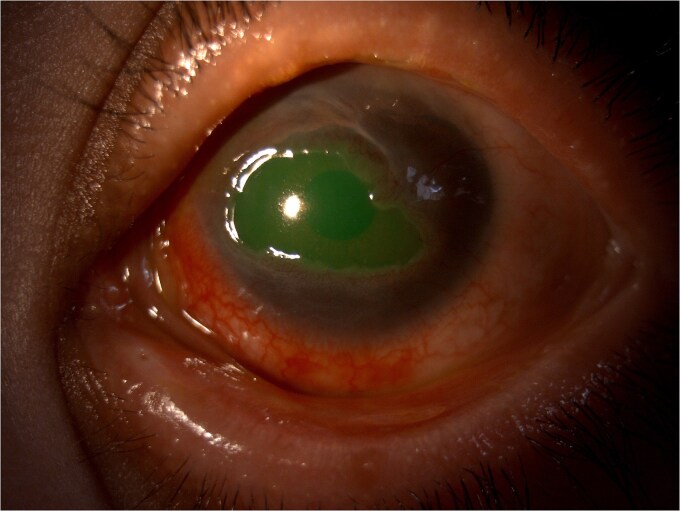 Figure 1
Peer Reviews
No public reviews on file for this paper yet. If you reviewed it on a platform where reviews are public (OpenReview, ICLR, NeurIPS, ICML), you can paste yours below so the community can read it here.
Videos
No videos yet. Explain this paper in a talk, walkthrough, or lecture? Add one.
Taxonomy
TopicsCorneal Surgery and Treatments · Ocular Surface and Contact Lens · Corneal surgery and disorders
We report the case of a 10-year-old child presenting with a painful red left eye with lacrimation and photophobia evolving for two months. These ocular symptoms coincided with the onset of a generalized rash and fever, leading to a clinically confirmed diagnosis of chickenpox by the pediatrician. The patient was started on oral aciclovir and ocular lubricants and vitamin A ointment. However, the ocular symptoms persisted even after the resolution of systemic chickenpox symptoms.
Ophthalmological examination of the left eye revealed an AV of 9/10, conjunctival hyperemia, 360° conjunctivalization and neovascularization of the cornea, sparing the visual axis. The fluorescein test was positive, revealing an epithelial defect (Fig. 1). The rest of the anterior segment and fundus examination was unremarkable.
The treatment approach includes lubricants to maintain corneal hydration and promote epithelial healing. Topical corticosteroids may be used cautiously to control immune-mediated damage. Given the viral etiology, antiviral eye drops can be prescribed to prevent further viral reactivation. After managing the inflammation, autologous limbal stem cell transplantation may be considered in our patient. Long-term follow-up is essential to monitor disease progression and prevent complications such as corneal scarring and infection.
Limbal stem cells act as a proliferative barrier between the cornea and conjunctiva. Limbal stem cell deficiency (LSCD) is characterized by neovascularization and conjunctivalization of the corneal surface [1].
LSCD can be congenital or develop following physical trauma, chemical burns, thermal injury, surgery, autoimmune disease or infection, particularly viral [2]. Several cases of LSCD have been reported following herpetic keratitis (HSV) [3]. Liu X et al. have reported 4 cases of limbic insufficiency complicating ophthalmic herpes zoster (VZV) [4].
To our knowledge, this is the first case of LSCD complicating chickenpox in a child reported in the literature. This case highlights the importance of recognizing LSCD in pediatric patients with concomitant viral infections, such as chickenpox. Early diagnosis and a collaborative approach between pediatricians and ophthalmologists are essential for effective management.
Consent for publication
Informed written consent was obtained from the patient’s guardian for publication of this report.
The reference list from the paper itself. Each links out to its DOI / PubMed record.
- 1Daniels JT, Harris AR, Mason C. Corneal epithelial stem cells in health and disease. Stem Cell Rev 2006;2:247–54. 10.1007/s 12015-006-0053-417625261 · doi ↗ · pubmed ↗
- 2Dua HS, Saini JS, Azuara-Blanco A. et al. Limbal stem cell deficiency: concept, etiology, clinical presentation, diagnosis and management. Indian J Ophthalmol 2000;48:83–92.11116520 · pubmed ↗
- 3Carreno-Galeano JT, Dohlman TH, Yin J. et al. Limbal stem cell deficiency associated with herpes keratitis. Cornea 2021;40:967–71. 10.1097/ICO.000000000000255733009093 · doi ↗ · pubmed ↗
- 4Liu X, Xu S, Wang Y. et al. Bilateral limbal stem cell alterations in patients with unilateral herpes simplex keratitis and herpes zoster ophthalmicus as shown by in vivo confocal microscopy. Invest Ophthalmol Vis Sci 2021;62:12. 10.1167/iovs.62.6.12PMC 811400633974047 · doi ↗ · pubmed ↗