Genomics Sheds New Light on the Ancestral Bilaterian Opsin Repertoire and Suggests Rhabdomeric Phototransduction in Xenacoelomorpha
Samuel Abalde, Ulf Jondelius

TL;DR
This study uses genomics to explore the evolution of light-sensing proteins in Xenacoelomorpha, revealing new insights into their opsin diversity and phototransduction mechanisms.
Contribution
The paper presents a novel analysis of opsin evolution in Xenacoelomorpha and proposes a revised ancestral bilaterian opsin repertoire.
Findings
Xenacoelomorpha have only six opsin types, with no more than three per species.
The study identifies a cnidarian-specific opsin (Anthozoa I) and a xenacoelomorph-specific opsin.
Xenacoelomorpha likely use rhabdomeric phototransduction despite lacking typical photoreceptors.
Abstract
Animals use opsins, light-sensing, transmembrane proteins, to detect light, which is then converted into an electrical stimulus in the photoreceptors through a process known as phototransduction. The steady generation of genomic data has facilitated the description of the opsin diversity and photoreceptor activity in different animals. However, Xenacoelomorpha still represents an important gap in our understanding of opsin evolution from early animals. Characterized by extreme morphological simplicity, some Xenacoelomorpha present ocelli, eyespots, and even eyes with lenses, but no ciliary or rhabdomeric photoreceptors have been described. Here, we have leveraged all available genomic data from this group to characterize their opsin repertoire and to annotate the genes involved in the two main phototransduction cascades, ciliary and rhabdomeric, in these worms. Only six opsin types were…
Genes, proteins, chemicals, diseases, species, mutations and cell lines named across the full text — each resolved to its canonical identifier and authoritative record.
Click any figure to enlarge with its caption.
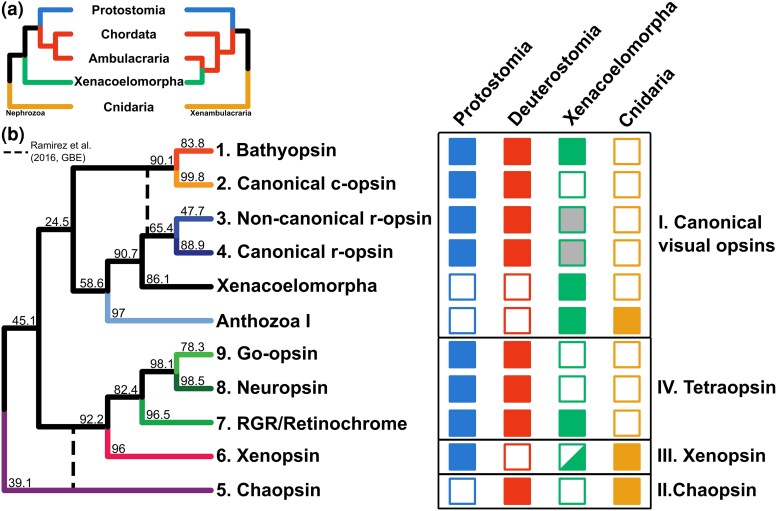 Figure 1
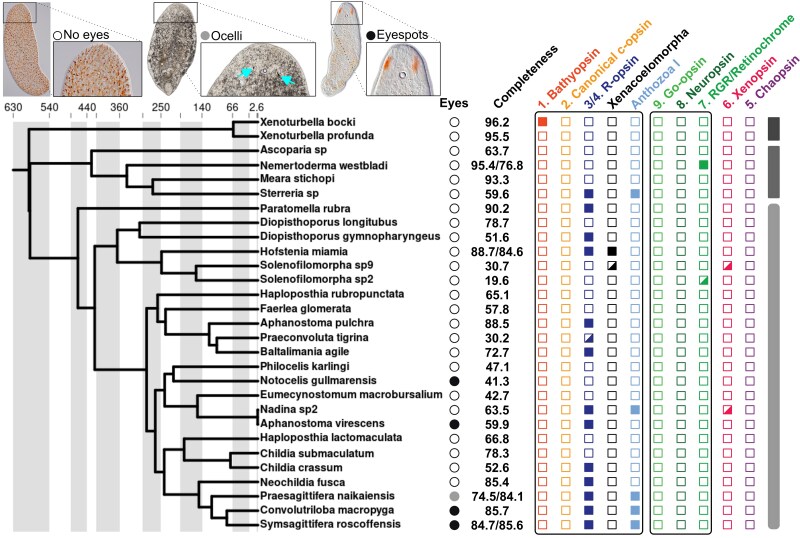 Figure 2
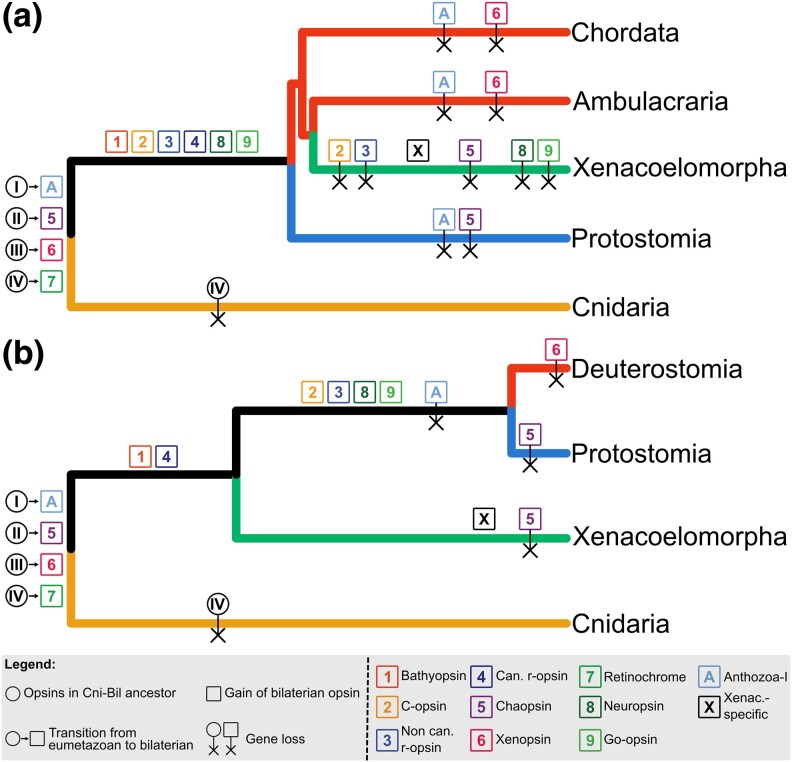 Figure 3
Peer Reviews
No public reviews on file for this paper yet. If you reviewed it on a platform where reviews are public (OpenReview, ICLR, NeurIPS, ICML), you can paste yours below so the community can read it here.
Videos
No videos yet. Explain this paper in a talk, walkthrough, or lecture? Add one.
Taxonomy
TopicsPhotoreceptor and optogenetics research · Planarian Biology and Electrostimulation · Retinal Development and Disorders